
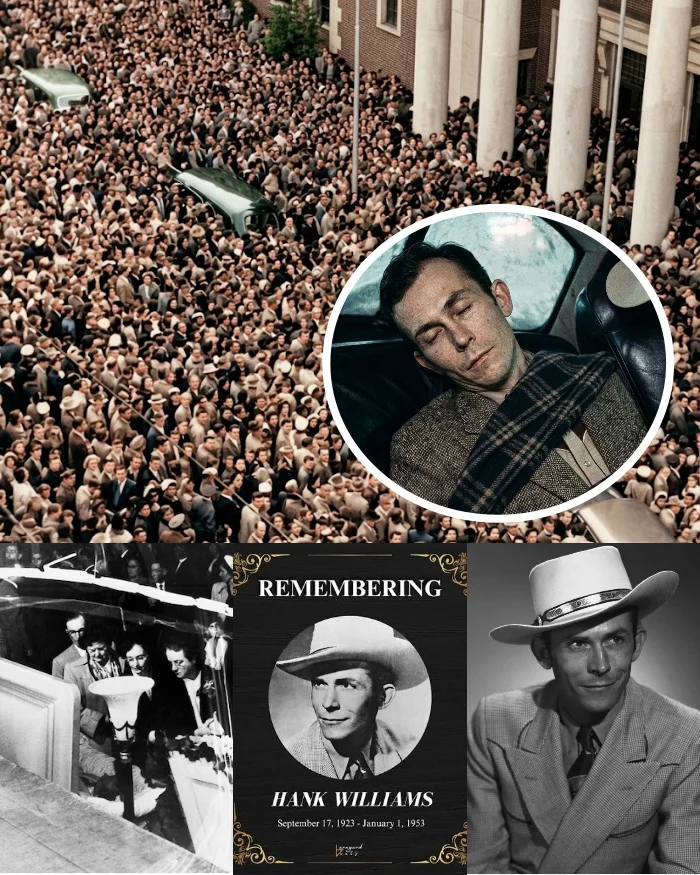
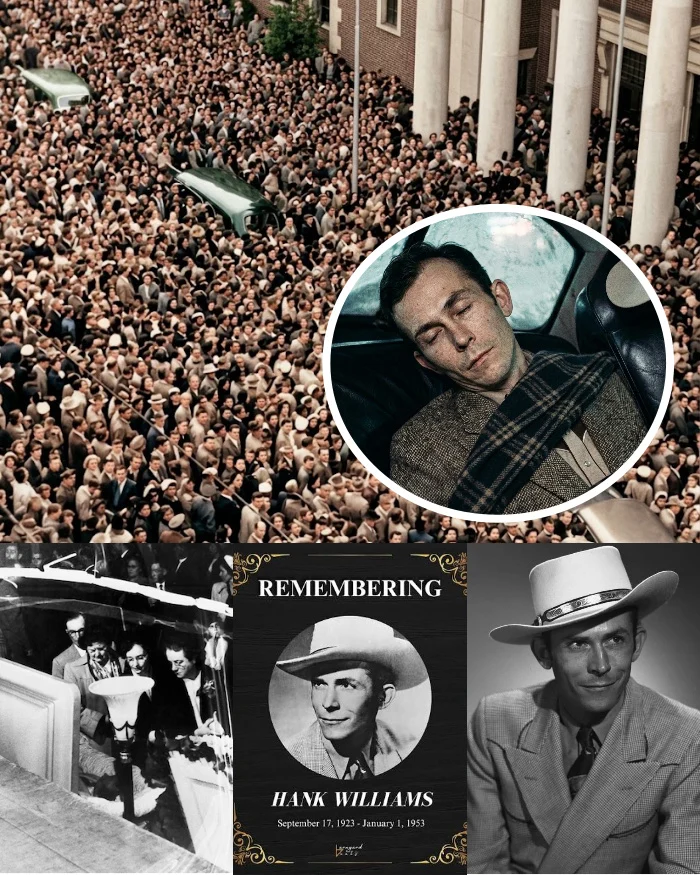
January 4, 1953 was not merely a funeral date in Montgomery, Alabama. It was the afternoon a silver casket arrived and drew a sea of strangers so vast that the city had to bend its streets around grief.
Hank Williams was only 29 years old, yet the crowd outside the Montgomery Auditorium proved that his short life had already carried the weight of a full lifetime of sorrow, prayer, and working class longing.
His death on New Year’s Day left behind a staggering catalog of country standards, a fiercely loyal fanbase, and a memorial service that quickly outgrew every assumption. The gathering officially became the largest funeral event the South had ever recorded, drawing numbers that eclipsed previous historical gatherings in the state.
The auditorium could seat fewer than 3,000 people, but an estimated 20,000 to 25,000 mourners flooded downtown blocks. Many traveled from across state lines, arriving on early morning trains or driving overnight down rural highways.
Massive floral arrangements sent by fans and fellow musicians spilled from the building and lined the entrance. Some were shaped like guitars, others like Bibles, turning the doorway into a physical barrier of grief.
The surge overwhelmed local infrastructure. Montgomery police officers, highway patrolmen, and local fire departments erected extensive barricades and shut down traffic for blocks in every direction.
Emergency personnel spent hours managing crushing lines. They pulled fainting women and exhausted fans from the packed masses while trying to maintain order among a public determined to get near the doors.
Those who stood shivering on the January pavement were not ordinary celebrity onlookers.
They were farmers, factory hands, mechanics, and working class listeners wearing heavy winter coats and everyday work clothes. They had waited for hours in freezing air without any guarantee of getting inside.
These were the exact people whose heartaches, financial struggles, and private loneliness Williams had spent his short life documenting on country radio.
Inside the auditorium, the mood offered a stark emotional contrast to the chaotic streets. The Nashville establishment, many of whom had struggled to navigate the singer’s volatile nature and unreliability during his final years, gathered around the silver casket to honor his undeniable genius.
Grand Ole Opry star Red Foley stepped to the microphone and delivered a tearful, breaking rendition of “Peace in the Valley,” struggling openly to push his vocals through his own grief.
Moments later, Roy Acuff stepped forward to lead a chorus of peers through Williams’ own defining spiritual composition, “I Saw the Light,” bringing the songwriter’s personal plea for redemption directly into his memorial.
The true weight of the day belonged to the sheer volume of strangers outside.
Williams had lived a profoundly difficult, turbulent existence, battling physical pain that ended his life decades too soon. Yet the thousands refusing to abandon the blocked off streets proved that his audience did not just view him as an entertainer.
They saw him as one of their own.
They endured freezing weather and physical exhaustion simply to offer a silent goodbye to a man who had translated their quietest pains into anthems.
The doors of the auditorium eventually shut, closing a painfully short and complicated era in American music. Hank Williams was laid to rest that afternoon, but the staggering size of the crowd guaranteed that his voice would never be buried with him.