
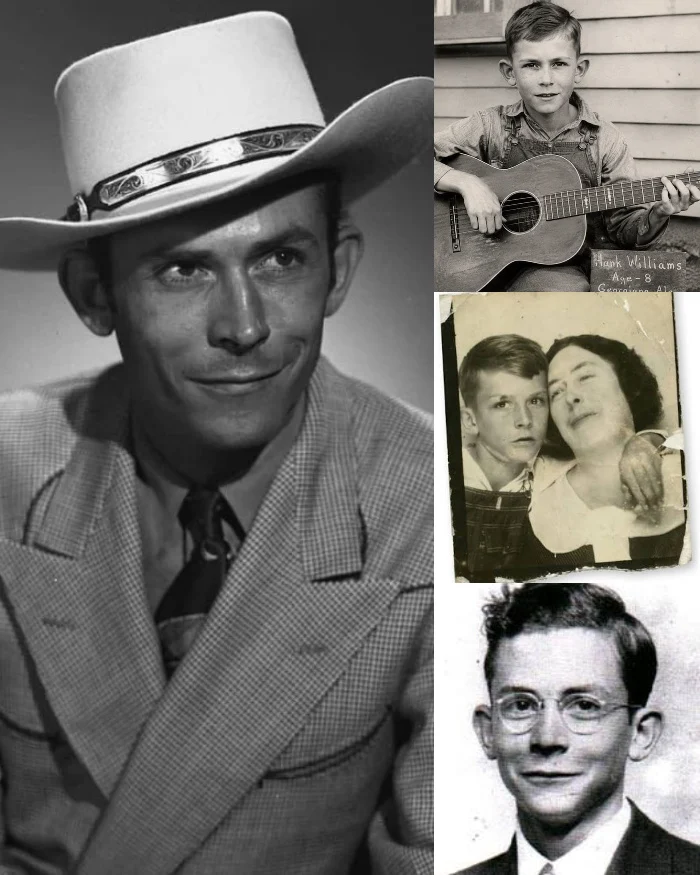
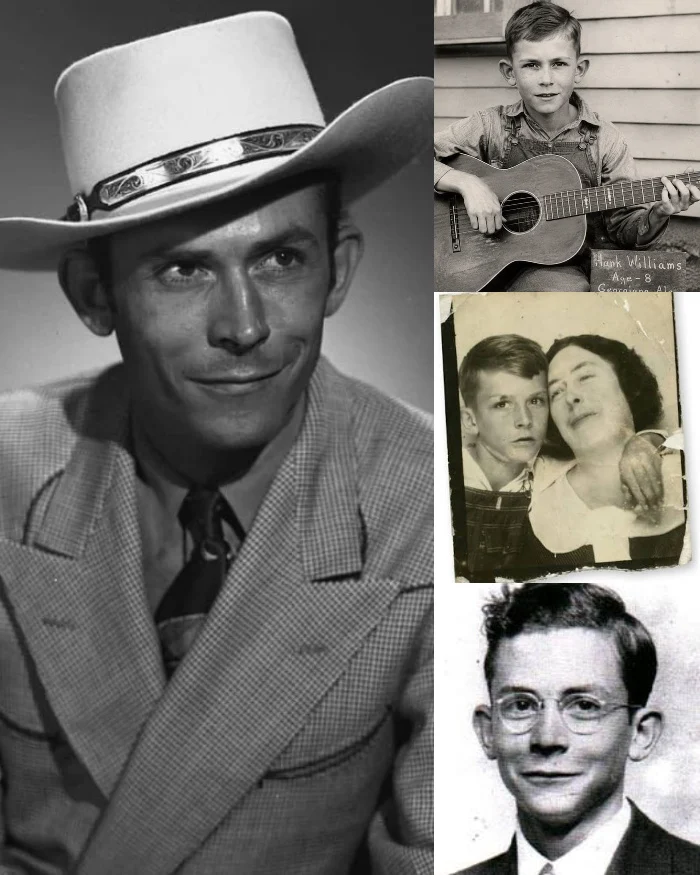
The night air outside the Jefferson Davis Hotel in Montgomery held a strange magic when a thirteen year old boy set down his shoe shine box and began to sing. Hiram Williams, known as Hank, had no money for medicine and no doctor had ever named the spinal defect that made every step feel like a blade. Yet the street crowd listened. Radio people listened. Pain followed him for the rest of his life, but music gave him a way to stand taller than his body allowed.
He arrived on September 17, 1923, in the timber settlement of Mount Olive in Butler County, Alabama. An undiagnosed case of spina bifida occulta left his lower vertebrae partially open and exposed delicate nerves along his spinal column. His family lived in deep rural poverty, far from specialists, hospital care, and X rays. His parents, Elonzo Lon Williams and Lillie Skipper, could not afford the kind of examination that might have explained why the infant cried whenever pressure touched his lower back. Lon worked as a locomotive engineer for local logging railroads, but his body was already wounded by World War One.
Lon suffered facial paralysis and severe neurological trauma. When Hank was six, Lon entered a Veterans Administration hospital in Alexandria, Louisiana, and remained there for nearly a decade. Lillie became the anchor of a fragile household, raising Hank and his older sister Irene through the early years of the Great Depression. The family moved through south Alabama sawmill towns, including McWilliams, Chapman, and Greenville, before renting rooms in Georgiana. Lillie ran boarding houses, sewed garments, and worked as a night shift nurse. She could offer no medicine for Hank’s back, only rubbed hands and church hymns in the evening.
His body carried a wound that no one could see and no one could treat.
Unable to run, chop wood, or play rough games with other boys, Hank spent long afternoons on porches and front steps. In Georgiana, near railroad tracks, eight year old Hank met Rufus Tee Tot Payne, an African American street musician who carried a worn acoustic guitar through Butler County roads. Payne became his first musical mentor. He traded guitar chords and blues timing for meals Lillie provided or a few pennies Hank earned running errands. Sitting on curbstones and courthouse lawns, Payne taught him to slide chords, keep rhythm with his thumb, and project his voice over street noise. When a secondhand guitar finally came into Hank’s hands, the light wooden instrument gave him a rare kind of relief. Unlike hauling firewood or lifting water buckets, holding it allowed him to sit upright and work without triggering back spasms.
In 1937, the family moved to Montgomery, where Lillie operated another boarding house on North McDonough Street. Hank took to the sidewalks to help pay rent, shining shoes and selling newspapers outside the Montgomery Advertiser offices. The heavy canvas sacks slung across his shoulders aggravated his spinal defect and drove a dull ache into his legs each night. To escape the physical toll of manual street work, thirteen year old Hank began leaving his shoe shine box aside and singing on the steps of the WSFA radio studios inside the Jefferson Davis Hotel. Program directors noticed the gathering crowd and invited him inside. By late 1937, WSFA gave him a fifteen minute live radio segment and paid him fifteen dollars a week.
He turned isolation into sound, and sound into a stage.
Hank used the broadcast income to organize his first backing band, the Drifting Cowboys, and performed at south Alabama honky tonks, schoolhouses, and square dances. Because his lower spine continued to deteriorate without medical intervention, long hours behind the wheel of old sedans on unpaved county roads caused unrelenting agony. By his late teens, he began turning to local corn whiskey and over the counter painkillers to numb the nerve spasms so he could stand through multi set night performances.
When Hank traveled to Nashville in the late 1940s to audition for Fred Rose and eventually join the Grand Ole Opry, the physical condition had progressed into chronic spinal degeneration. The untreated spinal damage followed him into every recording booth and tour car. The stooped posture, hollowed frame, and cutting ache in his vocal phrasing were not theatrical choices. They were the direct consequence of an Alabama boy carrying an untreated childhood injury into every room he ever sang in. The songs that made him famous remain anchored in that quiet ache from birth.