
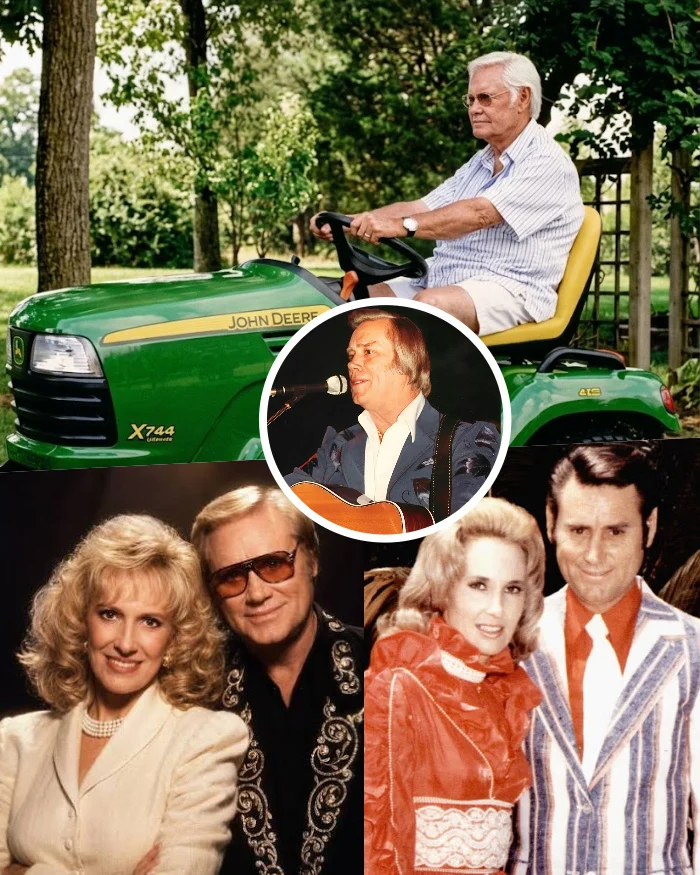
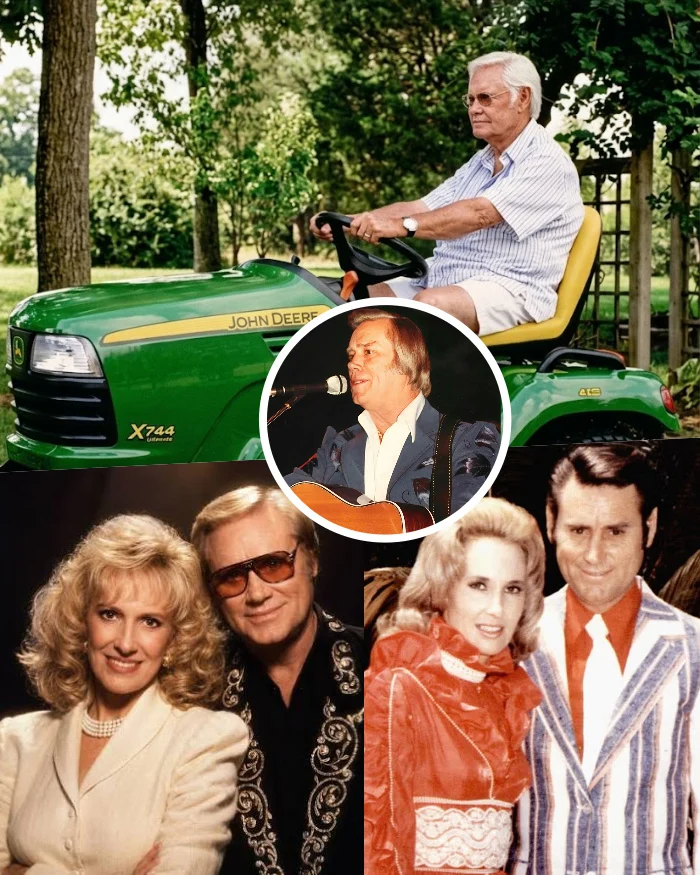
Midnight in Lakeland, Florida. Tammy Wynette woke to silence, then heard a distant engine crawling down the highway. Her luxury cars sat parked in the driveway. Her husband was gone. George Jones had chosen the only road left to him, a green John Deere lawn tractor, and was riding it toward the nearest bar.
That lonely mower ride became one of the most human moments in country music history. It was not cleverness. It was pain. It was a man fighting a bottle so hard that his family had to hide every key, every tank of gas, and every dollar he could use to drive away.
Long before the laughter, the story began outside Beaumont, Texas, in the late 1960s. Jones had already built a voice that could make heartbreak feel holy. Yet his marriage to Shirley Ann Corley was being strained by his alcoholism. Desperate to keep him home, she locked away their cars and removed his cash.
She thought the plan had worked. Jones thought otherwise. He found the family riding lawnmower, a 10-horsepower machine that barely belonged on a road, and started it anyway. He shifted it into gear and moved along the shoulder of Highway 96 at about five miles per hour. The liquor store was nearly eight miles away. He went anyway.
Years later, the same pattern followed him into another marriage. In Lakeland, Wynette tried to end the midnight escapes. One evening near one in the morning, she gathered every car key, locked them in a bedroom closet, and went to bed hoping the house would stay quiet.
It did not. Wynette woke, found the house empty, and saw the cars untouched. Then she heard it. A small engine chugging through the warm night. Jones was heading toward a tavern, ten miles away, on a lawn tractor. He had no car. He had no plan. He had only the need.
“He had no car. He had no plan. He had only the need.”
For many years, those rides were not legends. They were wounds. They showed how addiction can turn love into surveillance and shame into a private chase. Jones was not riding a mower for fun. He was riding it because the disease had narrowed his world to one destination.
The change came when Jones began rebuilding his life. With the support of his fourth wife, Nancy, he stopped treating his darkest seasons as secrets to be buried. He faced them. He spoke about them. He let the audience see the wreckage without pretending he was untouchable.
Then he did something unexpected. He made the lawnmower part of his public story. In 1989, he climbed onto a vintage mower in the music video for “One Woman Man.” He cruised past country scenery with a deadpan grin, turning a humiliating memory into a visual joke.
In 1992, he used the tractor again in the video for “I Don’t Need Your Rockin’ Chair.” The image carried more weight than nostalgia. It said he was still alive, still working, still willing to point at his own failures without flinching.
The joke reached its biggest stage in 1993. Vince Gill’s video for “One More Last Chance” ended with a surprise. Jones rolled into a golf course parking lot on a green John Deere, tipped his cowboy hat, and waved at the camera. Country music fans saw the mower, and they understood.
“The mower was not a symbol of failure. It was proof that survival could be funny, humble, and loud.”
That brief cameo became a staple on Country Music Television. Fellow artists admired the way Jones acknowledged his rough edges. He did not demand pity. He did not hide behind legend. He used humor as a bridge between the man who once rode a lawnmower to a bar and the singer who stayed alive long enough to keep singing.
George Jones finished his life with fourteen uninterrupted years of sobriety. He left behind ballads that still ache, but he also left a stranger gift. He showed that the lowest point in a life can become a shared story when courage replaces concealment.
The lawnmower remains one of the simplest and most powerful images in American country music. It was not a car. It was not a stage. It was a slow green tractor carrying a wounded man through the dark. Then, years later, it carried a survivor into legend.