
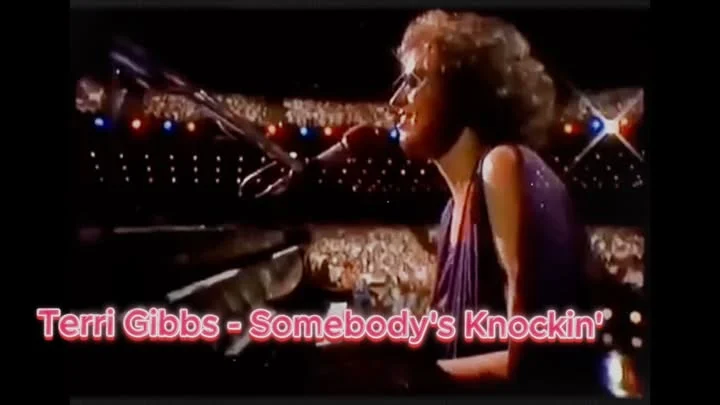
The quiet hangs in the air, thick with anticipation. A single knock echoes through the room, and then nothing but the sound of a heart wrestling with itself. Terri Gibbs did not just sing about that moment of temptation, she became its soundtrack. Her 1980 release Somebody’s Knockin’ is not a song that starts, it is a world that descends, a slow haze of doubt and desire that wraps around the listener from the very first note. It is music designed for the dark hours, when every decision feels like a lifetime.
Gibbs arrived at a crossroads in country music. The Urban Cowboy craze was rewriting the rules, blending twang with pop polish. Yet where many of those hits leaned into high energy and big hooks, Gibbs offered something different. She gave the audience a slow burn, a restrained and deeply intimate performance that somehow filled the room without ever raising its voice. That voice itself was the weapon, a tremulous, soulful instrument shaped by early exposure to gospel and the smoky blues of Ray Charles. Blind from birth, Gibbs learned to hear the world in textures, and she poured that sensitivity into every phrase.
Producer Ed Penney recognized the power in that vulnerability. He framed her not just for country radio but for a broader audience, a gamble that paid off handsomely. The song climbed into the Top Ten on the country charts and nearly cracked the Top Ten on both the Adult Contemporary and Billboard Hot 100 lists. It became the title track of her debut album on MCA Records, a statement of arrival that announced a major new talent.
The true power of the song lies not in the question, ‘Should I let him in?’ but in the palpable silence between the knocking and her answer.
The arrangement is a masterclass in restraint. A walking bass line and soft drum brushes create a groove that feels almost swampy, a Louisiana-flavored foundation that Billboard praised for its atmosphere. The piano skims through the middle register, providing harmonic stability without ever demanding attention. Clean electric guitar swells hang in the air like wisps of smoke, and when a solo finally arrives, it is played with a light touch of echo, never overwhelming the moment. A modest string section lifts the chorus, but it avoids the heavy melodrama of earlier countrypolitan production, leaning instead toward the clean, premium clarity that defined the coming decade. The mix is so spacious that the listener can almost feel the air in the studio.
Gibbs delivers the lyrics with a dramatic restraint that borders on whispered confession. Her vibrato is controlled, her phrasing lingering on each word as if weighing its consequence. The song is a simple internal argument about letting temptation in, but the performance turns it into a universal moment of human frailty. The backing vocals appear only when the emotional stakes are highest. There is no unnecessary solo, no bombast. It is a lesson in economy, a sonic representation of that terrible pause between thought and action, the fraction of a second when a life can pivot.
Even decades later, the song translates remarkably well to modern listening. Through decent studio headphones or a careful music streaming subscription, the track maintains its spaciousness. It does not sound loud, it sounds present. In an era of highly compressed, maximalist production, the simplicity of this song feels like a revelation. It pulls the listener out of the algorithm and into the moment.
Gibbs never quite matched the commercial peak of her debut, but the song itself secured her legacy. She won the Academy of Country Music’s Top Female Vocalist award in 1981 and the CMA Horizon Award, cementing her status as a trailblazer. A sightless woman in an industry obsessed with image, she won on the sheer undeniable quality of her sound. Somebody’s Knockin’ remains a powerful reminder that the most dramatic performance is often the one that chooses quiet over clamor. It is the sound of a secret being kept, a decision being weighed, a world waiting on the other side of a closed door. It invites us not just to listen, but to lean in.
For listeners looking to explore similar territory, Janie Fricke offered the same early 80s country pop sophistication on Don’t Worry ‘Bout Me Baby. The Marshall Tucker Band captured a similar restrained Southern rock groove with Heard It in a Love Song. Juice Newton blended intimate vocals with polished adult contemporary on Angel of the Morning from the same era. Ray Charles provided the foundational link to blues and gospel with Crying Time. And Rosanne Cash used dark atmospheric production to tell a modern narrative on Seven Year Ache, another 1981 chart topper that echoed the same atmospheric depth.