
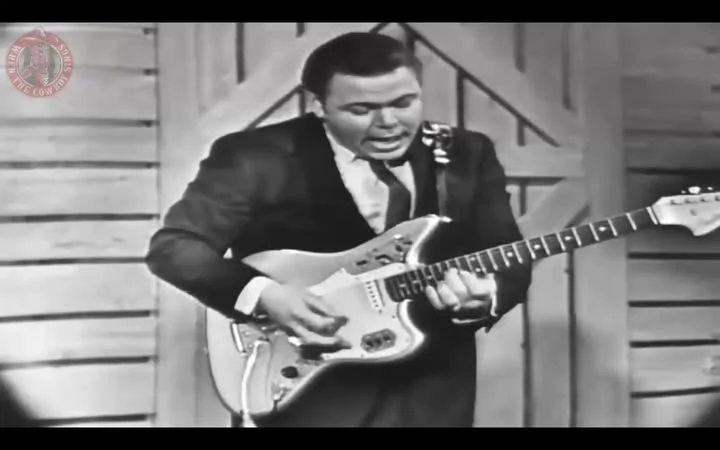
The needle drops. A crackle, a hiss, and then—an explosion. The opening notes of Roy Clark’s “12th Street Rag” tear through the silence like a bolt of lightning in a quiet room. It’s 1963, and inside the warm glow of a record player, something extraordinary is happening. This isn’t just music; it’s a gauntlet thrown down, a virtuoso’s declaration that the guitar could sing, scream, and dance all at once.
Roy Clark is a name that, for decades, conjured images of a smiling co-host on Hee Haw, trading jokes in overalls amid hay bales. But beneath that folksy charm was a musician of staggering depth. Before the cornfield corniness, there was the flashpoint—a blistering instrumental that would define his legacy before the world knew his face. “12th Street Rag” is that moment: a raw, unapologetic showcase of technical brilliance that still leaves listeners breathless.
“He didn’t just play the song; he wrestled it, tamed it, and then set it on fire with his sheer, undeniable talent.”
This track anchored Clark’s debut Capitol Records album, The Lightning Fingers of Roy Clark, released in 1962. At the time, he was a restless young musician in his late twenties, a journeyman who’d cut his teeth alongside legends like Jimmy Dean and Wanda Jackson. His roots ran deep through country, bluegrass, swing, and rockabilly—a melting pot of American sound that made him fluent in genres most artists only glimpsed. The album’s title wasn’t hyperbole; it was a promise. Produced by Capitol veteran Ken Nelson, known for capturing the grit of live performance with studio clarity, the session aimed to let Clark’s fingers do the talking. The choice of “12th Street Rag,” a 1914 ragtime standard by Euday L. Bowman, was deliberate. This wasn’t a country guitarist showing off; this was a virtuoso reclaiming a century of American music and making it his own.
The arrangement itself is a masterclass in restraint and ferocity. A tight rhythm section lays down a relentless groove—drums dry and compact, bass walking with jazz-inflected purpose. The star, however, is Clark’s acoustic-electric guitar, its tone clean and crystalline, every pick attack a sharp, percussive event. The tempo defies belief, a sprint that tests the physical limits of human dexterity. His technique is a hybrid of flatpicking and fingerstyle, a dizzying blend of scale runs and arpeggios that mirror the octave-jumping of complex piano rags. He adapts a keyboard piece to six strings without losing melody, injecting it with the string-bending swagger of country-rockabilly. There’s no room for subtlety here; the dynamics stay high, the energy unflagging.
The cultural impact of “12th Street Rag” ripples far beyond its era. A young metal guitarist once confessed to me that learning its sheet music was a gateway to understanding country technique—the descending chromatic runs and arpeggios rivaling any classical etude or jazz solo. In the track’s second half, Clark leans into showmanship, accelerating with almost comedic audacity. His vibrato, when he pauses for breath, is wide and commanding, a fleeting warmth before the next onslaught. This performance is a testament to the versatility that made Clark a crossover icon. He could later deliver heart-wrenching ballads like “Yesterday, When I Was Young,” but instrumentals like this gave him credibility to move between worlds. The ‘Rag’ is Clark’s quiet roar: beneath the TV fame and easy jokes lay a monster musician.
For the modern listener, perhaps stuck in traffic with the stereo cranked, “12th Street Rag” is a time capsule of pure velocity. It mirrors the chaos of contemporary life, yet Clark’s control offers a strange, exhilarating peace. He juggles chainsaws—effortlessly. The feeling of witnessing such skill is a reminder that music, at its core, can be a celebration of human athleticism. To experience it on quality home audio equipment is to hear every nuance, every string ring, every breath between runs.
This track remains a foundational text for studying the rapid evolution of country and rockabilly instrumentation in the early 1960s. It’s an infectious, high-octane blast that cuts through decades of studio polish and genre boundaries. Don’t listen for comfort; listen for a reminder of what the six-string can achieve in the hands of a master.
Listening Recommendations
Explore the world of virtuosic guitar with these essential tracks:
Chet Atkins – “Country Gentleman” for clean, masterful fingerstyle balancing speed and melody.
Jerry Reed – “The Claw” for ragtime-meets-country instrumentals with complex, syncopated picking.
Doc Watson – “Black Mountain Rag” for breakneck acoustic flatpicking in the bluegrass tradition.
Merle Travis – “Cannonball Rag” for the rolling rhythmic technique that inspired generations.
Les Paul and Mary Ford – “How High the Moon” for the joyous, technically dazzling spirit of early multi-track novelty.
Joe Pass – “Joy Spring” for a comparison to pure jazz guitar, showing how swing and harmonic complexity influenced virtuosos across genres.