
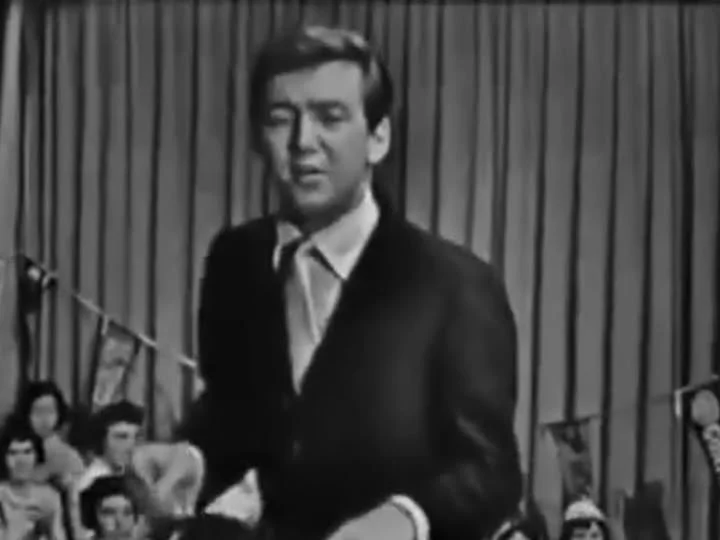
In the spring of 1958, a 22-year-old singer named Bobby Darin turned a bathtime joke into one of the most infectious pop singles of the decade. That track, Splish Splash, would become the cornerstone of his debut album and the catalyst for a career that defied easy categorization. The story begins not in a recording studio but in a New York radio booth, where disc jockey Murray the K (Murray Kaufman) bet Darin he couldn’t write a song starting with the words Splish splash, I was takin’ a bath—a phrase suggested by Kaufman’s mother, Jean. Darin took the challenge, and the result was credited to Bobby Darin and Jean Murray, a clever portmanteau that honored the idea’s source while sidestepping payola concerns. What emerged from that dare was more than a novelty; it was a masterclass in pop craft that still resonates today.
The single, recorded April 10, 1958, at Atlantic Studios and released by Atco (catalog number 6117), quickly climbed the charts. It reached No. 3 on the U.S. pop chart and No. 2 on the R&B Best Sellers tally, while also crossing over to country and making the U.K. Top 20. Those numbers matter because they signaled that Darin was no flash in the pan. Later that year, the song was folded into his self-titled debut LP, Bobby Darin, a brisk 26-minute set that packaged the single’s momentum into an album-length calling card. Produced by Ahmet Ertegun and Herb Abramson for Atco, the record consolidated his rock-and-roll appeal while hinting at the versatility that would soon lead to Mack the Knife and the adult-pop triumph of That’s All in 1959.
The origin is already music-biz folklore, but it’s worth retelling because it reveals Darin’s rare gift for turning a gimmick into something durable. The lyric doesn’t just milk the bath-time hook; it paints a quick comic strip, then zooms into a house party where contemporary hits are name-checked—Lollipop, Peggy Sue, Good Golly, Miss Molly—placing Darin in fast conversation with his peers. The song’s shouted-out titles aren’t just jokes; they’re invitations into a web of 1958 listening, a time when teenagers curated taste via radio request lines and diner jukeboxes. Music historians sometimes read the lyric as a gleeful pop collage, using references the way beboppers used quotes. The result is both of-the-moment and, decades later, a miniature time capsule.
Splish Splash flies on a simple but impeccably executed combo. The documented session personnel included Jesse Powell on tenor saxophone, Al Caiola and Billy Mure on guitar, Wendell Marshall on bass, and Panama Francis on drums—players steeped in New York’s crack studio scene. Their approach is textbook 1958: an insistent backbeat, walking bass that never grandstands, strummed rhythm guitars that brighten the midrange, and a honking tenor sax that punctuates phrases like an audible grin. The arrangement is economical: introduction with drum figures, verse with rhythm-section lock-in, sax interjections, and a middle eight that loosens room for Powell’s lines. Producers Ertegun and Abramson keep the sonics dry and forward, minimizing reverb so that transients—the snap of Francis’s snare, the bite of Caiola’s pick—sit on top of the mix. For listeners used to later stereo extravagance, the record’s economy is striking; there is just enough room around the sax to let the hook breathe.
What the track doesn’t do is equally instructive. There is no orchestral sweetening, no imitation of New Orleans R&B pianos, no background choir to telegraph jokes. The instruments function like a small theater troupe: every entrance counts, exits are crisp, and the star—Darin’s vocal—has room to mug and dance. From a musician’s standpoint, the time feel is everything. Francis leans the backbeat slightly forward, creating a sense of momentum that mirrors the lyric’s rush from bathroom to party. The tenor sax doubles as a character actor, punctuating Darin’s punchlines. The guitars, split between rhythm strum and light fills, keep the groove percolating without ever challenging the singer. If you enjoy geeking out on session craft, this is one of those records where you can isolate each chair in your mind and admire the restraint. (Personnel and session date cross-checked via the song’s discography entry.)
Darin’s vocal performance belongs to that small club of pop recordings where personality does as much work as pitch. He attacks consonants so the narrative moves like panel-to-panel frames, then softens vowels to make hooks linger. You hear how carefully he places Splish and Splash, converting onomatopoeia into rhythmic bricks. There is also the actor’s instinct: he builds a tiny world in seconds, switching from mock-surprise to delighted discovery without swallowing the beat. It would be easy for a young singer to overplay the humor. Instead, Darin lets the band carry the punchlines and focuses on groove, trusting that the words will do their own winking.
On the charts, Splish Splash was a cultural weather report. Its No. 3 pop peak, No. 2 R&B placement, and No. 14 country crossover (Darin’s only appearance there) confirm a truth you can hear: the arrangement borrows from jump-blues and early rock while leaving space for country listeners to connect with the story and backbeat. In an era before formats hardened into separate ecosystems, crossover wasn’t just a bonus; it was an index of cultural permeability. The single’s success gave Atco confidence to invest in Darin as a multi-format artist, paving the way for the stylistic leap of Mack the Knife and the adult-pop triumph of That’s All in 1959. The connective tissue is control—over time, tone, and narrative spotlight.
It’s tempting to call the song a throwaway that fate elevated. The reality is more interesting. Musically, the piece uses a blues-adjacent harmonic spine and teaches a masterclass in arrangement economy. The tenor sax doesn’t simply solo; it converses with the vocal, creating something like pop counterpoint. The guitars keep the pocket buoyant rather than filling every bar with riffs. The drummer plays for the record, not the stage—tight, dry, and punchy. When students ask how to make lightweight material feel heavyweight on tape, Splish Splash is a model. It is also a case study in how production choices communicate brand: keep it bright, keep it brisk, and leave listeners with a hook they can hum before the needle lifts.
From a country-music vantage, what jumps out is narrative compression—a hallmark of great honky-tonk writing where tales unfold in a verse and a half with a kicker in the chorus. Darin’s lyric, while comic, respects that discipline. And while there is nothing classical about the idiom, classical listeners might appreciate the rhetoric of repetition: the title figure operates like a recurring motif, reappearing between episodes, and the sax interjections function as brief ritornellos—structural markers that knit the verses together. Those parallels remind us that pop craft and so-called high art often speak a common language of timing, contrast, and return.
Spin Splish Splash on modern streaming services and you’ll be struck by how contemporary the punch still feels. In an age of over-compressed loudness, the record’s transient detail is refreshing—the crack of the snare and the reediness of the tenor sax leap from the speakers. This is a single that rewards a good listening chain; if you’re auditioning a pair of headphones and want to test midrange clarity plus timing, the track’s tight two-minute sprint is a fine benchmark. The tune also functions beautifully on family playlists, bridging generations with a humor that never curdles into kitsch and a groove that remains instant.
Understanding Splish Splash helps explain Darin’s seemingly radical pivots. The same precision he brings to rhythmic delivery here becomes his interpretive superpower on sophisticated material one year later. Within a short window, he moves from dancing through teenage scenes to declaiming Brecht-Weill with debonair menace. The 1958 debut album serves as a core sample of his early instincts, with Splish Splash the sparkling layer that caught daylight first. Bobby Darin—released September 1958 on Atco, produced by Ertegun and Abramson—is the historical anchor for that transition.
A closer look at the instruments reveals the craft behind the joy. Panama Francis on drums provides the heartbeat—tight snare and crisp cymbal work that pins the backbeat to the floor. Wendell Marshall on bass walks with jazz-bred suppleness, avoiding thudding quarter-notes and keeping the record buoyant. The guitars of Al Caiola and Billy Mure offer texture and lift, one leaning into rhythmic strum while the other drops fills in the spaces. Jesse Powell’s tenor sax is the grin you can hear, operating as call-and-response and ear candy that nudges the listener through transitions. And the production by Ertegun and Abramson is tasteful minimalism—dry and front-loaded, perfect for AM radio in 1958 and still compelling today. The emphasis on transients gives the record a live-in-the-room energy that flatters both vocal and sax.
The song’s lyrical references—Lollipop, Peggy Sue, Good Golly, Miss Molly—aren’t just jokes; they’re invitations into a shared record-store culture. In an era when teenagers curated taste via radio request lines and diner jukeboxes, references were currency. Darin knew that if he placed his narrative inside that collective listening experience, the tune would feel bigger than its running time. The result is both of-the-moment and a miniature time capsule.
Labels like novelty can be misleading because they describe an effect (it makes you laugh) rather than a technique (how the music is built). Darin and the Atlantic team didn’t treat the session as a throwaway. They hired top-flight players, cut the track with the same attention to pacing and pocket that they’d bring to a serious R&B side, and mixed it to command radio. The proof is its longevity. DJs still reach for it when they want to brighten a set, music supervisors deploy it in films and television to conjure uncomplicated joy, and young musicians can learn a semester’s worth of arrangement lessons from its two minutes. That durability starts with craftsmanship, not gimmickry.
It’s easy to forget that this was Darin’s first hit; the leap from Splish Splash to Mack the Knife within roughly a year tells you how fast his career evolved. Contemporary reviews of the Bobby Darin album noted his energetic rhythm feel and ability to freshen familiar material—skills that would soon serve larger, more ambitious arrangements. When you line up the debut LP, the hit single, and the next year’s That’s All, a pattern emerges: Darin was not merely a genre hopper; he was an interpreter who understood that groove and diction are transferable tools.
If you want to hear what engineers mean by punch, cue the opening bars and note how the drum and bass lock before the vocal enters. Then focus on the sax stabs in the first verse—each one pushes the narrative forward. On vintage vinyl pressings, the track has a bit of upper-mid bark that suits car radios and jukeboxes; modern digital masters smooth some edges, but the essential character remains. For ear-training, A/B the track with Little Richard sides from the same period and listen to how the Atlantic/Atco approach differs from Specialty’s—less room noise, more focus on the lead line. If you’re assembling a survey of 1958 rock-and-roll craft, this sits comfortably alongside the Coasters’ hits and Buddy Holly’s singles as a compact primer in arrangement clarity.
To extend the mood and hear the latticework of references that Splish Splash flashes, spin these tracks next: Buddy Holly – Peggy Sue (1957), Little Richard – Good Golly, Miss Molly (1958), The Chordettes – Lollipop (1958), The Coasters – Yakety Yak (1958), Bobby Darin – Dream Lover (1959), and Larry Williams – Bony Moronie (1957). Each one shares DNA with Darin’s breakthrough—energy, economy, and a wink.
Splish Splash is more than a bright cartoon; it is a concise demonstration of studio craft and pop dramaturgy. As a single, it launched a career. Folded into Bobby Darin, it anchored a debut album that distilled the sound of 1958 youth culture while hinting at the interpretive breadth to come. The band’s pocket is impeccable, the tenor sax is practically a co-star, and Darin’s vocal treats humor like rhythm—never forced, always in time. That’s why the record still lands. Play it loud, appreciate the micro-decisions that make it move, then trace the line it draws through the rest of Darin’s catalog. You’ll hear how a cheeky bath-time bet became the first chapter in one of American pop’s most improbable trajectories—and why, more than six decades on, the splash still ripples.