
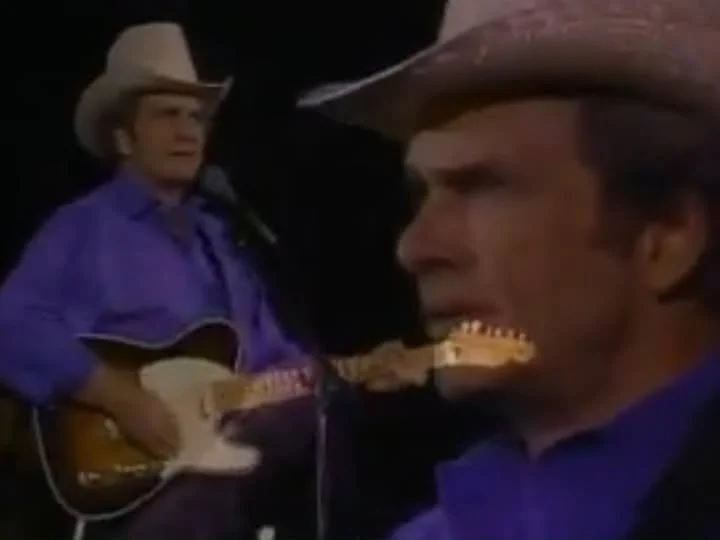
A haunting melody, a voice etched with hard-won wisdom, and a single image that has resonated across generations: a mother’s hungry eyes. Merle Haggard, the iconic outlaw of country music, poured his own childhood into this devastating ballad, creating a timeless tribute to sacrifice, resilience, and the quiet dreams that fuel a family.
The story behind “Mama’s Hungry Eyes” is as raw and real as the Bakersfield dust that shaped Haggard’s youth. Released in December 1968 as the lead single from the album A Portrait of Merle Haggard, the song quickly climbed to the top of the Billboard Hot Country Singles chart, cementing its place as one of the most defining works of his storied career. But beyond the charts, it was a deeply personal confession.
Haggard wrote the song as a love letter to his mother, Flossie Mae Haggard, a woman forced into extraordinary strength by tragedy. When Merle was just nine years old, his father, James F. Haggard, died, leaving Flossie to raise three children alone. She worked punishing shifts as a waitress, scraped together every penny, and somehow found the will to keep her family afloat. It was this quiet, grinding heroism that Haggard captured in his lyrics.
The song’s narrative follows a young boy watching his mother struggle, vowing silently that he will one day change her world. Each verse is painted with images of a canvas-covered cabin in a crowded labor camp, of a father’s worn hands, and of the unspoken longing in a mother’s gaze. Haggard masterfully transformed personal memory into universal poetry, making the listener feel the weight of every sacrifice.
A canvas covered cabin in a crowded labor camp
Stands out in this memory I revile
My daddy raised a family there with two hard working hands
And tried to feed my mamas hungry eyes
Born in Oildale, California, in 1937, Merle Haggard rose from a troubled youth to become one of the most influential voices in country music. Known for his distinctive vocal style and outlaw persona, he helped pioneer the Bakersfield sound—a gritty, working-class alternative to the polished Nashville productions of the era. Over his decades-long career, he released dozens of albums, earned the Country Music Association’s Entertainer of the Year award in 1970, and was inducted into the Country Music Hall of Fame in 1994. In 2010, he received the Kennedy Center Honors for his lifetime achievement in the arts. Haggard passed away in 2016 at the age of 79, but his legacy remains deeply etched in the American songbook.
“Mama’s Hungry Eyes” stands as a signature masterpiece, a testament to both Haggard’s songwriting craft and his profound empathy. It avoids sentimentality by anchoring its emotion in stark details: a mother praying for a better way, the slow erosion of courage as age began to show, the sadness that never quite leaves her eyes. The power lies in what Haggard leaves unsaid—the understanding that some hungers are never fully fed by food or fortune.
Here, in the words that have moved millions, is the full lyric:
“Mama’s Hungry Eyes” (with Alison Krauss)
A canvas covered cabin in a crowded labor camp
Stands out in this memory I revile
My daddy raised a family there with two hard working hands
And tried to feed my mamas hungry eyesHe dreamed of something better and my mama’s faith was strong
Us kids were just too young to realize
That another class of people put us somewhere just below
One more reason for my mama’s hungry eyesMama never had the luxury she wanted
But it wasn’t ’cause my daddy didn’t try
She only wanted things she really needed
One more reason for my mama’s hungry eyesI remember mama praying for a better way of life
But I don’t recall a change of any size
Just a little loss of courage as their age began to show
And more sadness in my mama’s hungry eyesMama never had the luxury she wanted
But it wasn’t ’cause our daddy didn’t try
She only wanted things she really needed
One more reason for my mama’s hungry eyes
Oh, I still recall my mama’s hungry eyes
The song remains a moving reminder that the greatest luxuries are not always made of gold, but of love, endurance, and the quiet promise to remember the ones who carried us through. In every note of “Mama’s Hungry Eyes,” Merle Haggard kept that promise alive.