
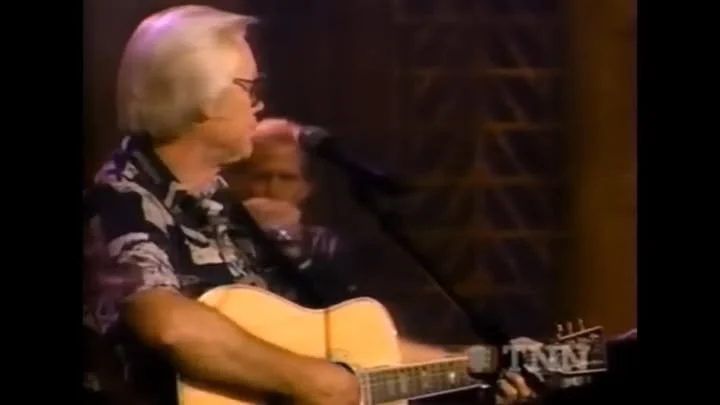
You hear it in the small hours, when the house is still and the only light comes from the amplifier dials. A guitar note rings out, then hangs in the air like a question no one is ready to answer. Before a single word is sung, the room feels heavy with years. This is the sound of George Jones and Merle Haggard meeting inside a song that would come to define quiet endurance. Their voices don’t compete; they complete each other, two shadows merging at dusk.
The year is 1982, and Billy Sherrill sits behind the console. He knows what he has: he brought Jones back from the dead with He Stopped Loving Her Today two years earlier, a resurrection so complete it felt like a miracle. Haggard, on the other hand, never needed saving. The Poet of the Common Man had spent twenty years building a fortress of authenticity, a songwriter whose every line felt carved from experience. These two titans in one studio could have been a clash. Instead, they became a handshake across time.
The album A Taste of Yesterday’s Wine was built around a Willie Nelson composition that arrived as a whisper. Sherrill stripped the arrangement to bare essentials: a single acoustic guitar, soft bass, a weeping steel guitar, and piano chords that hovered like smoke. No strings, no chorus, no drama. Just space. In that emptiness, the voices found their gravity.
This isn’t a duet. It’s a conversation between two men who have lived long enough to know that the party ends for everyone. And when it does, what remains is the quiet hum of memory.
Haggard opens with a baritone worn smooth by highways and honky-tonks. He sings Yesterday’s wine is just sour grapes like a man stating a fact he’s accepted. There’s no sorrow in his voice, only the calm of a philosopher reviewing the ledger. Then Jones takes the second verse, and the air changes. His tenor rises with a raw, aching beauty that seems to pull every broken promise from the past into the room. Where Haggard is steady, Jones is exposed. Where Haggard observes, Jones feels. The contrast is not a flaw; it is the song’s architecture.
These two do not harmonize until the very last line. For nearly three minutes they trade verses like old friends passing a bottle, each offering a different lens on the same fading light. Then, on And yesterday’s wine is all we have, their voices finally merge. It is a moment of chilling unity, as if the thinker and the feeler have arrived at the same door.
Young songwriters in Nashville that year might have missed it. The song lacked a hook, refused to shout, and moved at the pace of a slow walk. But those who listened closely knew they were hearing something rare: a performance that required decades of living to fully understand. To hear it now, with studio headphones, is to catch every breath, every quiver, every ounce of history poured into a single syllable. You can almost see the control room hush, the engineers leaning in, the two singers facing each other across the microphone.
Billy Sherrill called the recording a masterclass in restraint. He could have filled the track with strings and echoes, as he often did with his Countrypolitan sound. Instead, he stepped back and let the voices carry the weight. The result is a song that never offers easy comfort. It offers something rarer: companionship in the quiet hours. It sits with you, acknowledges the passing of time, and reminds you that even legends drink from the same sour glass.
Tomorrow, the radio will play something louder. But tonight, in the dim light of a nearly silent room, Yesterday’s Wine still spins. And two mountains of song, one weathered and one resurrected, share a single truth: the past, for all its flaws, is what we have left.