
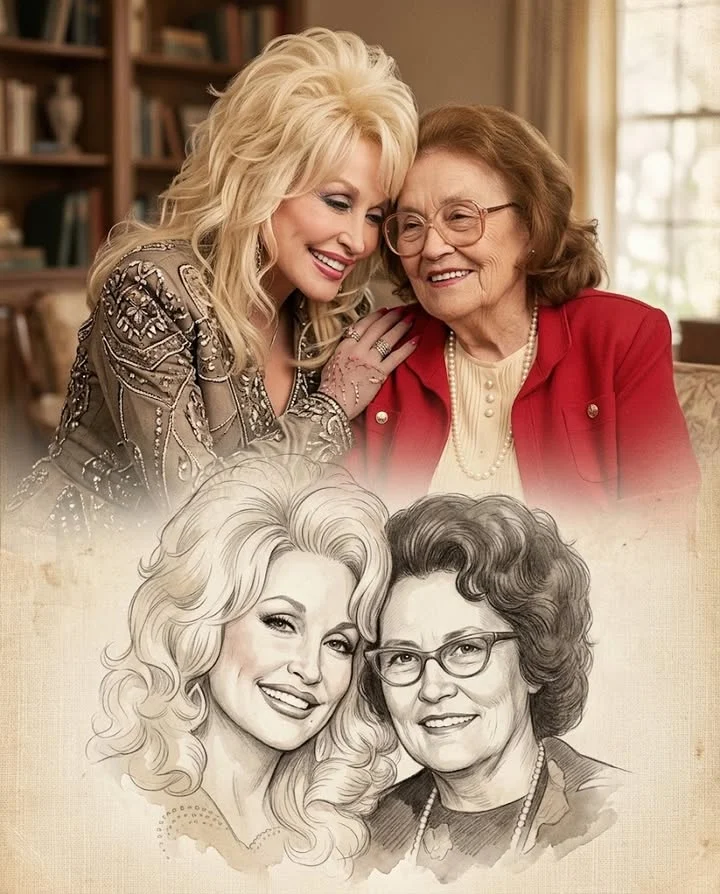
When Dolly Parton stepped onto the world’s biggest stages, millions heard her voice—but the true source of that legendary sound was a quiet woman sewing by lamplight in the Smoky Mountains.
On December 5, 2003, Avie Lee Owens Parton passed away in Sevierville, Tennessee, at 78. Her death, just three years after Dolly’s father Robert Lee Parton, closed the curtain on a twelve-child household where music was as vital as the river that ran past their two-bedroom cabin.
Long before Nashville, Avie Lee was Dolly’s first teacher—of song, of story, and of survival.
In that Locust Ridge home, with no television and little money, Avie Lee filled the air with Elizabethan ballads and gospel hymns while stirring pots over a woodstove. She showed her daughter how a melody could cradle sorrow)Skip, how a chorus could steady a hard day, and how a story could be carried without a single written word.
When winter’s chill crept in, Avie Lee gathered donated fabric scraps and stitched a coat for little Dolly, weaving the biblical tale of Joseph’s coat of many colors into every seam. When classmates mocked the patchwork, Avie Lee held her daughter close and taught her that true wealth had nothing to do with store-bought cloth. That lesson became the heart of Coat of Many Colors, a song that would carry the mountain spirit across the globe.
Even as Dolly built an empire from the Grand Ole Opry to Hollywood, her heart never left East Tennessee. She bought her mother a home in Sevierville, kept the family close, and credited every lyric she ever wrote to her mother’s storytelling.
In Avie Lee’s final hours at Fort Sanders Sevier Nursing Home, Dolly and her siblings gathered at the bedside. They spoke no words of fame or fortune—only hands held tight and voices rising in the old gospel harmonies their mother had hummed to them decades before.
Since that December goodbye, Dolly has quietly safeguarded the treasures of her mother’s world: intimate cassette recordings of Avie Lee singing at home, handwritten notes, and private memories she has kept away from the spotlight—precious echoes of the raw mountain soprano that first sparked her own.
For fans of country music, Dolly’s enduring strength has always mirrored the woman who raised her on that small farm. The grand stages gave the world a star, but the voice began with a mother’s love.
The stadiums listened to the daughter, but the voice began with the mother.