
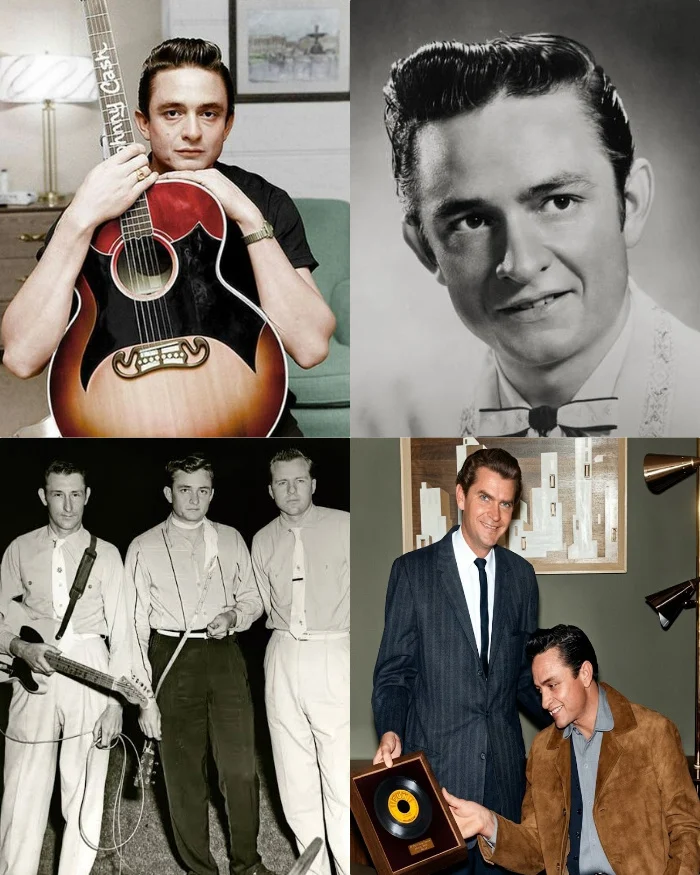
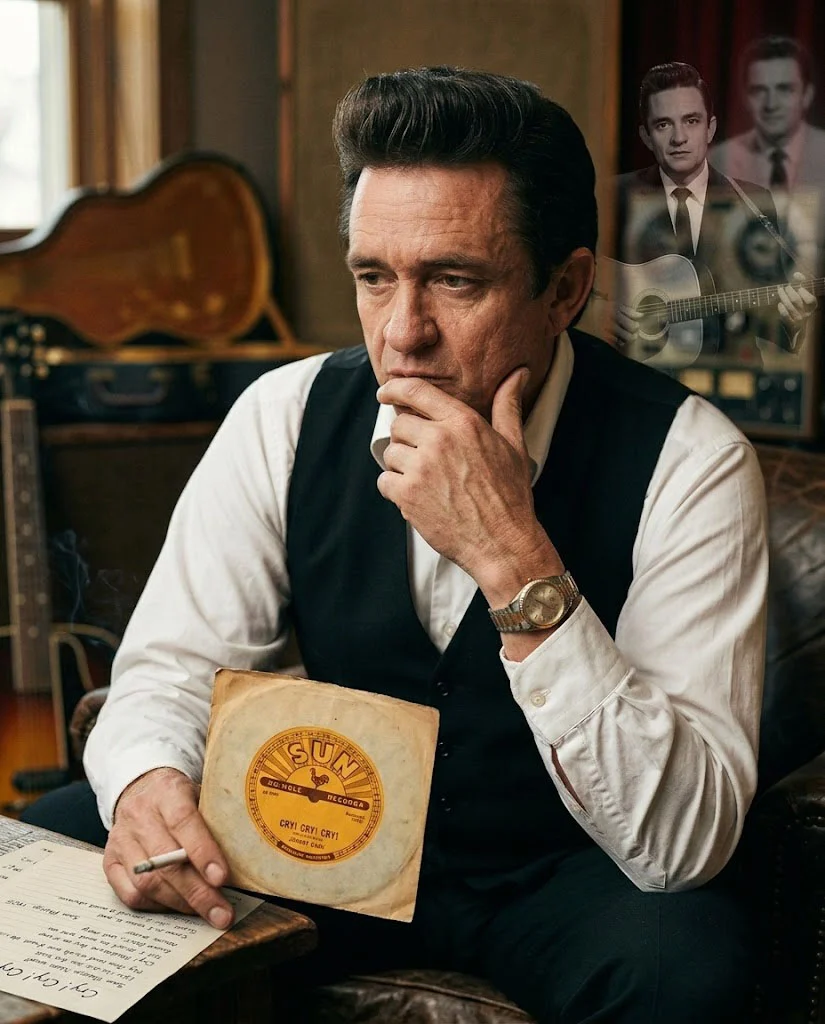
The room was small. The microphone was ordinary. And the young man standing before it had no way to know that history was listening.
In the spring of 1955 a twenty-three-year-old Johnny Cash walked into a plain recording studio and quietly took his place at the microphone. He was not yet the haunted outlaw the world would later call the Man in Black. He was not yet a symbol of prison walls and dark suits. He was simply a singer with a steady voice and a first chance.
That session gave the world ‘Cry! Cry! Cry!’ a song that did not arrive with headlines or grand expectations. It was easy to overlook. It did not carry the heavy shadows that would later settle into his most famous recordings. Yet the track holds a different kind of power. It captures a voice in the act of becoming.
The Myth That Came Later
When people remember Johnny Cash they often begin with the danger. They see the roaring prison concerts and the all-black silhouette. They hear the rebel spirit that sold millions of records worldwide. They imagine a man who had lived every broken line he sang.
By the height of his fame the myth had grown larger than the singer from Arkansas. He seemed to carry the burdens of every forgotten man in America. The dark suits and the gravel-deep voice made him look like a force that had always existed.
But that towering shadow can hide the quieter truth. Long before the legend took hold there was no massive audience waiting. There was only a small studio and a young performer trying to get the sound right.
Before a legend can set the world on fire he must first learn how to strike a match in the dark
A Voice Finding Its Footing
Listen closely to that 1955 recording and you do not hear a hardened man wrestling with inner demons. You hear restraint. You hear a clear and unpolished vocal performance from someone who is not yet trying to be an outlaw or a rugged voice for the working class. He is trying to be heard.
The true wonder of that first recording is not what it contains. It is what it lacks. It does not carry the exhausted shadows of his later masterpieces. It is grounded and emotionally direct and almost ordinary in its execution. That quiet quality is exactly why it matters.
Before Johnny Cash could become the voice of prisoners and lifelong outlaws he had to build a foundation. He had to find his artistic footing without a global audience demanding a daily miracle. He had to stand still.
The Spark That Held Everything Together
Decades later ‘Folsom Prison Blues’ would echo off cold concrete walls and Johnny Cash would command every room he entered. His tone had deepened into gravel and his personal stories had grown impossibly heavy with time.
None of that historic success would have been possible without the quiet confidence of an unknown singer in 1955. That first session was not the song that made his name unforgettable. It was the necessary foundation beneath everything else.
It was the small and certain spark right before the whole world caught fire.