
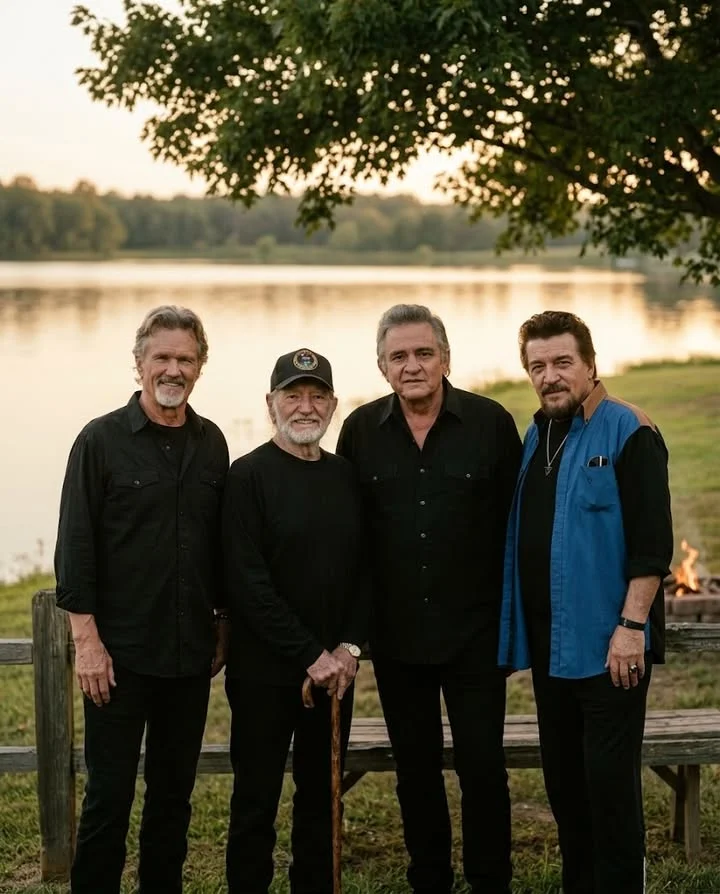
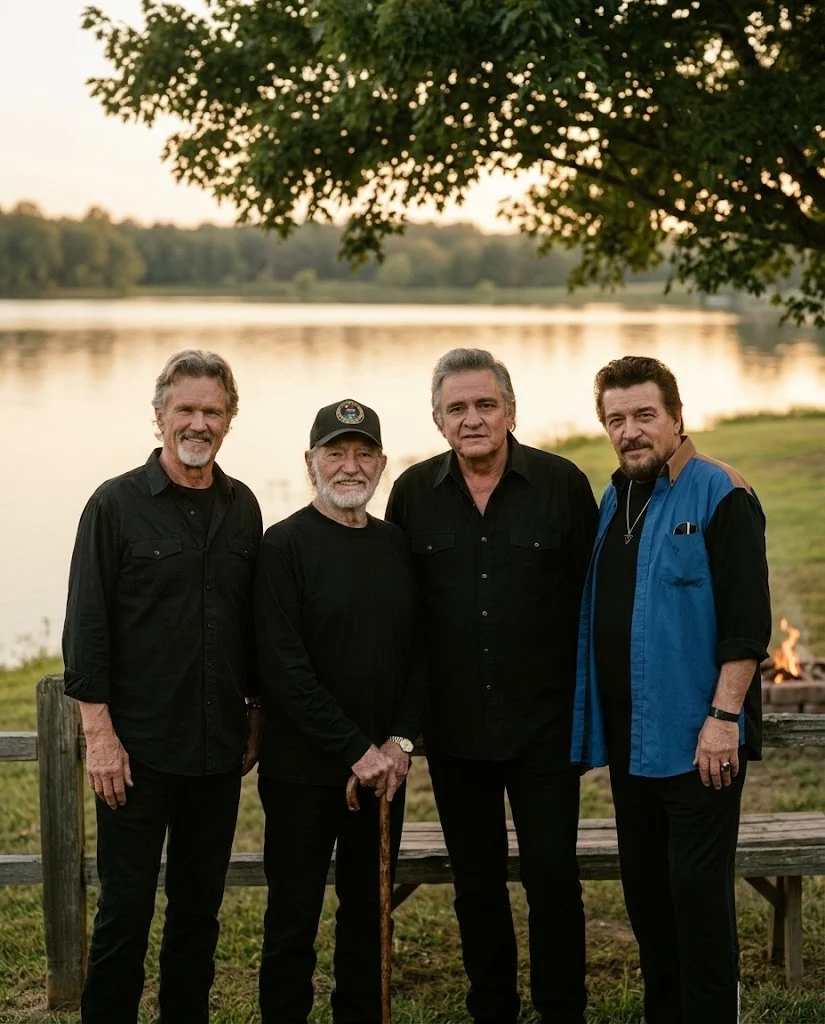
Four silver-haired legends stood shoulder to shoulder under arena lights, and the loudest statement they made was the quiet way they stepped back for one another.
In the spring of 1990, Johnny Cash, Waylon Jennings, Willie Nelson, and Kris Kristofferson took the Mount Rushmore of country music on the road. They had just released Highwayman 2 through Columbia Records, the follow-up to their monumental debut. Between them sat decades of history, hundreds of chart hits, and a cultural footprint no single star could match. Yet when they walked into the cinematic glow of arena lights, they did not behave like a package tour of aging superstars. They worked as a real band.
Most multi-headliner shows split into separate sets and end with a polite all-sing chorus. The Highwaymen refused that script. They stayed on stage together all night. If Kristofferson eased into the opening lines of a quiet ballad, the other three did not drift into the wings. They stood at their microphones, locked into the music.
Night after night, fans saw breathtaking humility. Waylon Jennings, a man who had spent decades demanding creative control, smiled quietly in the background and strummed rhythm guitar. Willie Nelson played gentle fills on his battered acoustic guitar Trigger to support Cash’s authoritative baritone on solo hits like Ring of Fire. The men who had fought Nashville, battled industry expectations, and survived their own public demons now stood side by side. Silver hair caught the spotlights. Weathered faces told four distinct survival stories. Willie’s jazz-like phrasing, Waylon’s driving backbeat, Cash’s boom-chicka-boom foundation, and Kristofferson’s literary gravity merged into one front.
That protective bond on stage grew from the way they worked behind closed doors. When the quartet returned to the studio for its second chapter, veteran producer Chips Moman built an ego-free room. Moman had guided their 1985 debut, and he understood that the group’s power lived in authentic camaraderie rather than vocal perfection. Instead of isolating the men in separate booths to out-sing each other, he put them in a circle. They passed guitars, traded verses on impulse, and found whose voice naturally belonged to each lyric. Moman was less a dictator and more a trusted guide. He kept the tape rolling and captured the unpolished, fierce brotherhood of four men building a wall around one another.
The anthem of that 1990 era was Silver Stallion, a soaring Lee Clayton cover that opened the new record. On stage, acoustic guitars and easy interactions turned echoing arenas into rooms as intimate as an old Tennessee cabin. When their four voices met on the chorus, the song became a gorgeous declaration of untamed and deeply unified spirits.
Each man was a fiercely independent frontman, used to carrying an audience alone. For a few hours every night, the biggest rebels in country music surrendered individual pride for the collective.
The stage was no longer a battlefield to prove who was the biggest star in the room. It was simply a place where four old friends could finally share the load.