
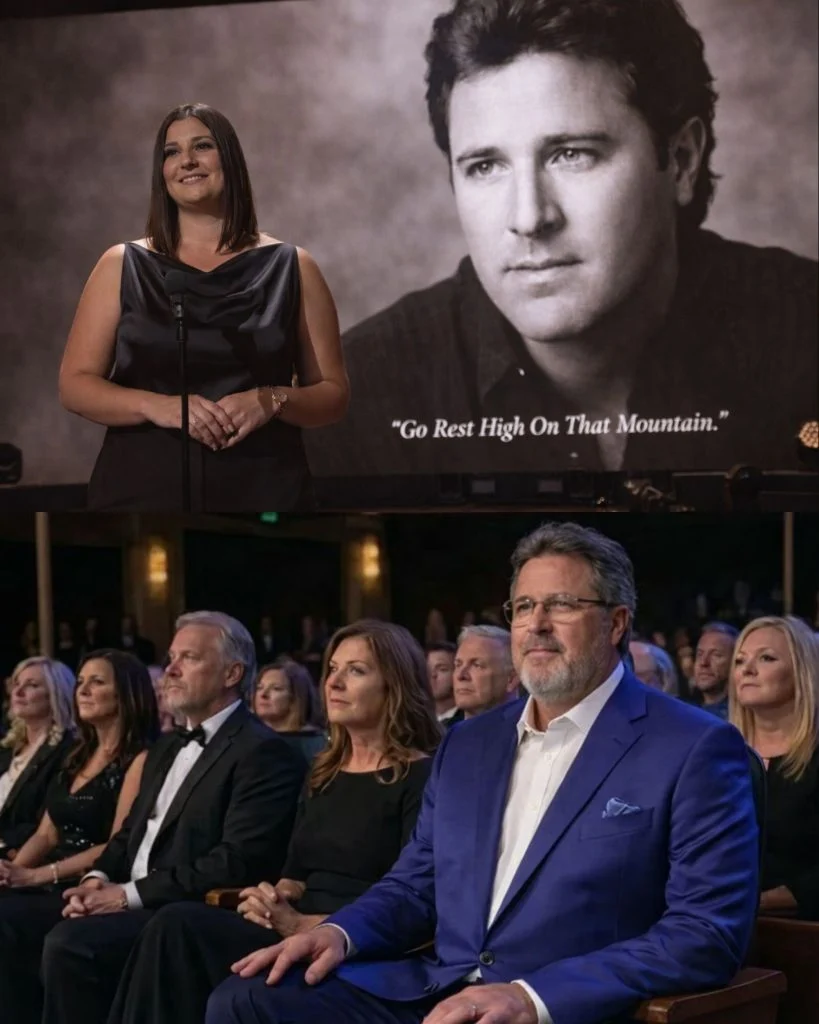
The last note hung in the air like a held breath. Jenny Gill stood alone at the Ryman Auditorium, no band behind her, no introduction before her. She had just finished “Go Rest High On That Mountain,” the song her father, Vince Gill, had carried for thirty years. In the third row, Vince did not move. His hands stayed clasped in his lap. His jaw was set in a hard line. The 20-time Grammy winner was not performing that night. He was simply a father listening to his daughter return a piece of his own heart.
What Jenny did not do mattered as much as what she did. She did not copy her father’s high lonesome sound. She did not reach for his famous vibrato or his easy grace. She sang with the quiet authority of a woman who had watched grief live in her house and had learned its shape from the hallway. She was not only singing a classic. She was acknowledging the scars that helped pay for her childhood.
The song itself began in 1989. After Keith Whitley died, Vince sat down with a guitar and a heart too heavy to finish the thought. He wrote the first lines and stopped. The wound was too fresh. The ink felt too thin for the weight of the loss. Four years later, tragedy closed the circle when his brother Bob suffered a fatal heart attack. Only then did the rest of the words come.
Go rest high on that mountain. Son, your work on earth is done.
Those lines became more than a hit. They became a funeral anthem in Nashville and a prayer for grieving families across America. For three decades, Vince sang the song until his voice cracked under the weight of other people’s sorrow. He had spent years being the one who comforted the world.
Now, for the first time, he was the one being comforted.
At the Ryman, the audience held its collective breath. No one clapped between verses. No one whispered in the balconies. There was only the sound of a legacy passing from one generation to the next, one note at a time. Before the final chorus, Jenny let the silence stretch until the room seemed to remember every loss at once. That pause would become part of the song’s history. Near the end, she let a single note hang in the air. It was not a mistake. It was a bridge between the father who wrote the pain and the daughter who survived it.
Vince closed his eyes. In that moment, he was not a country music icon. He was a man who realized his work was finally and truly done. Songs like this never really belong to the writer. They belong to the people who need them most. That night, the person who needed it most was the man who wrote it.
The song had finally come home. Jenny walked off the stage in the same silence she arrived in, leaving the echoes to do the rest.