
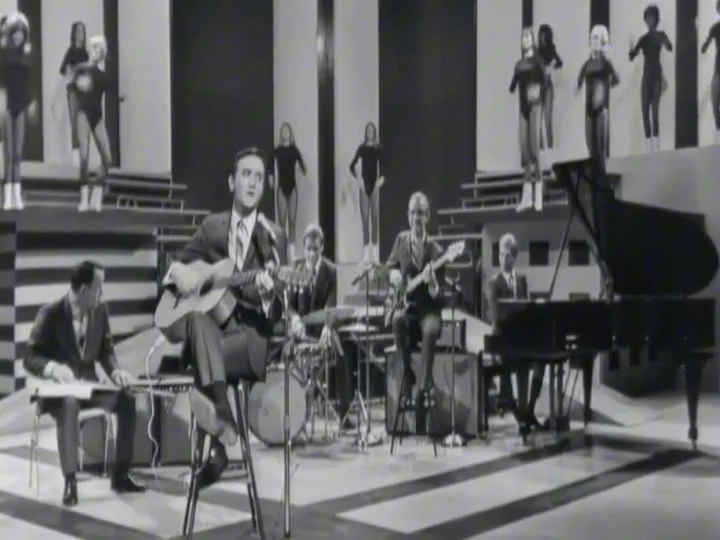
There is a moment in Roger Miller’s song England Swings that sounds like a sigh of relief. Maybe it is the soft brush of the snare drum. Maybe it is the easy stride of the bass. Most likely it is the voice itself. He does not sing the words as much as he shares them. The entire track feels like a confession shared over a table. It is the sound of a man who knows that delight can be distilled into three minutes.
Roger Miller was a rare figure in Nashville. He did not need to shout to be heard. He perfected the art of the conspirator grin and the shrugging melody. By 1965 he already had a string of hits. Dang Me introduced his deadpan wit to the world. King of the Road turned a hobo philosophy into a nationwide proverb. England Swings arrived as part of this golden streak. It landed on his album The 3rd Time Around with Jerry Kennedy guiding the sessions for Smash Records.
The year was 1965. The American charts were glinting with imported guitars and British accents. Roger Miller held up a mirror to that entire phenomenon. He wrote the definitive postcard from Swinging London. He looked at the pageantry from across the ocean. He stamped it with a wink and dropped it into the mailbox of country pop. The song is an American fantasy of London. It captures the glow of the storefronts and the red double decker buses. It does so without a drop of malice.
The arrangement is light enough to float away. The drums tip tap a breezy shuffle. The bass walks with a neighborly stride. It never pulls attention away from the vocal. A spry guitar flicks rhythmic sparks between the lines. A compact piano figure dots the phrases like a familiar streetlamp on a quiet block. There is room for air in this mix. Miller recordings often sound as if the band is playing in a tidy living room. You can hear the room reverb turn the edges into curves. You can hear the attack of the pick against the string.
His vocal skill is remarkable for how little it demands of the listener. He glides between sung and spoken. Each syllable lands with the comic timing of someone who knows where the laugh lives. He never oversells the joke. He lets it breeze by like the bus in the corner of your eye. He leans on certain vowels as if testing the balance of the line. The voice sits forward in the mix. The microphone flatters a conversational volume. The consonants land light.
A little whistle motif floats through the song. It is tossed off like a friend aside. In a different production that motif might have been doubled by strings. Here it is a pocket flourish. It is a sketch. It is not a mural. The track values brevity as a moral good. There is not a single wasted bar.
The song sits in a rich conversation with Miller’s own King of the Road. Both pieces marvel at the idea of freedom. One uses the inventory of the American vagabond. The other uses the montage of the tourist. Both take archetypes and turn them into friendly cartoons. Miller includes himself in the frame of the joke. He is the smiling narrator. He is also the spectator. This is what makes the satire age so well. It is a fond caricature. A listener in 2024 can follow along easily.
From a modern audio perspective, the recording is a masterclass in restraint. The midrange is forward. The bass is present but not club thick. The highs are crisp but not glassy. The vocal rides the front bench. The guitar and keys sit across the aisle. On a good pair of headphones, you can hear the ghostly tail of the room reverb. You can hear the slight swell of breath before a consonant. These small sounds are the fingerprint of the record.
Consider the places where this song lives now. In a late night kitchen the shuffle counters your restless energy. The lyric becomes a posture adjustment. See the world. Grin at its pageantry. Do not take the parade too seriously. On a Saturday afternoon with the windows cracked the whistle turns into a domestic wind chime. You cannot force that effect. You have to write for it. You have to record for it. Roger Miller did both.
Historically, the song is a bridge between worlds. It crossed from country to pop radio. It hovered in the top tier of the Hot 100. It stayed on the country playlists. It is proof of Miller unique position in the era of the British Invasion. He was an American voice that could admire. He could jest. He could synthesize all of it without condescension.
England Swings proves how a featherweight touch can carry a heavyweight idea. Joy is a way of seeing. It is not just a mood.
The final note fades like a door closing on a sunny corridor. You might play it again. It will feel short again. A friend who never overstays their welcome. Not every song needs to be an essay. Some can be a postcard that keeps arriving on time. This is the small marvel of Roger Miller. This is the small marvel of England Swings. It is wry. It is brisk. It is human scaled.
If you want to walk this path further, a few kindred tracks travel the same air. King of the Road by Roger Miller offers kindred wit and an easy rolling groove. Dang Me by Roger Miller is the lean witty template in its purest form. Dedicated Follower of Fashion by the Kinks is a British satire of London from the inside. Mrs. Brown You Have Got a Lovely Daughter by Herman’s Hermits provides soft focus British Invasion pop. Sunny Afternoon by the Kinks offers languid wry social portraiture. A Summer Song by Chad and Jeremy provides a gentle breeze and a pastel mood.