
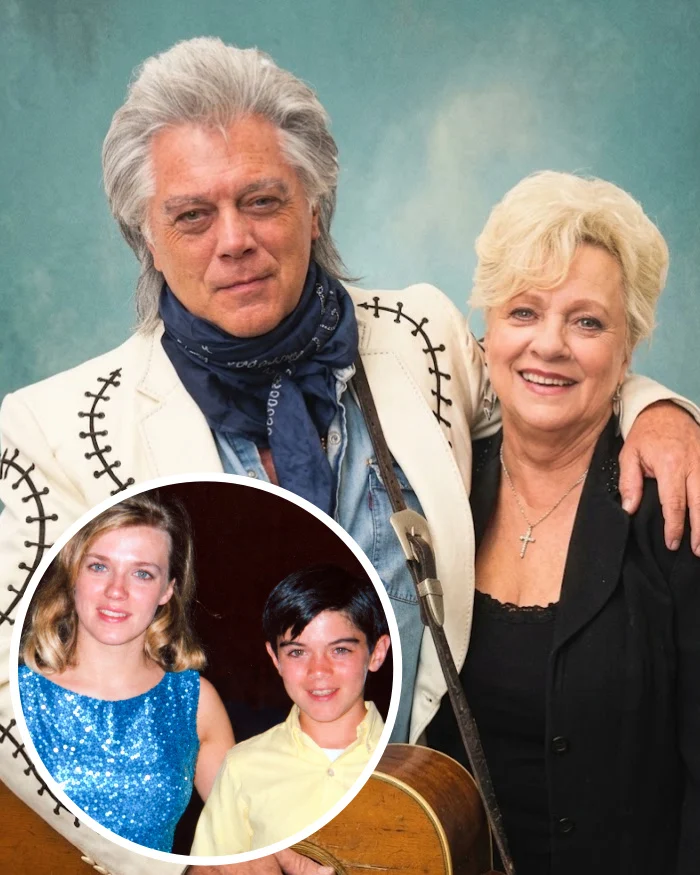

Twenty-seven years after a boy in a bright yellow shirt stood at the edge of a Mississippi stage, he slipped a ring onto the hand of the singer he had once promised to marry.
That promise began on a sweltering July afternoon in 1970. Eleven-year-old Marty Stuart asked his mother, Hilda Stuart, to take him shopping in Philadelphia, Mississippi. He had one goal in mind. He needed an outfit that would not vanish into a crowd of grown adults. Word had reached him that Connie Smith, one of the Grand Ole Opry’s most revered young vocalists, would perform at the Choctaw Indian Fair on the local high school football field. Marty searched the racks until he found a bright yellow shirt.
Hilda did not brush aside the unusual request. She bought the shirt, drove her son to the fairgrounds, and watched him move straight toward the front edge of the stage. Under the Mississippi sun, the bright fabric did its job. Marty pressed against the barrier among hundreds of older fans and kept his eyes on the star until Connie stepped down to meet the crowd. She noticed the boy in yellow, smiled, signed an autograph, and posed beside him for a black-and-white keepsake photograph.
On the ride home, with the signed picture resting on his lap, Marty made a declaration that sounded absurd to anyone with common sense. He told Hilda that one day he was going to marry Connie Smith. His mother did not laugh or scold him. She smiled and kept her eyes on the road.
“One day I am going to marry Connie Smith.”
The yellow shirt never became ordinary clothing. Marty preserved it. He kept the photograph framed and treated both items as talismans of an ambition that reached far beyond childish admiration. Within two years, at age thirteen, he joined Lester Flatt’s touring band as a professional mandolinist and traded school corridors for the grueling realities of bluegrass package tours and late-night highway miles.
Connie’s path moved in another direction. By the mid-1970s, weary of the commercial machinery in Nashville and determined to raise her five children away from the perpetual grind of the road, she deliberately pulled back from the spotlight. She continued to sing gospel and make select appearances at the Opry, but she refused to let touring consume her family life. For more than two decades, the two lived on parallel tracks within the same musical community and occasionally crossed paths backstage as professional acquaintances.
The turning point arrived in the mid-1990s. Warner Bros. approached Connie about recording a major studio comeback album. Executives first pitched a trendy package of celebrity duets, but Connie resisted and insisted on an uncompromising traditional country record. Marty, by then an established solo hitmaker and one of Nashville’s fiercest preservationists of traditional roots, offered his services as producer. He arrived at her home not as a starry-eyed fan but as a craftsman determined to build a project around the pure, weeping resonance of her voice.
Their weekly songwriting sessions at her dining room table revealed an effortless creative kinship. They co-wrote eight of the album’s ten tracks, trading melodies on acoustic guitars and shaping a sound that honored her classic RCA years without feeling dated. Working long hours in Nashville’s tracking rooms, professional respect deepened into mutual affection. They were two road veterans who understood the price of early fame and shared the same sacred view of the music.
When Marty decided to propose, he did not orchestrate a public spectacle. Instead, he drove his mother, Hilda, to the jewelry store and invited the only witness to his 1970 car ride declaration to help him pick out the engagement ring. On July 8, 1997, twenty-seven years after their meeting in Mississippi, Marty and Connie were married in a quiet ceremony on the Pine Ridge Indian Reservation in South Dakota.
Decades after that Mississippi fair, the yellow shirt and the black-and-white photograph remain carefully preserved in Marty’s extensive personal archive. They survive not as souvenirs of childhood celebrity worship but as the quiet beginning of a partnership built on music, patience, and a promise kept across twenty-seven years.