
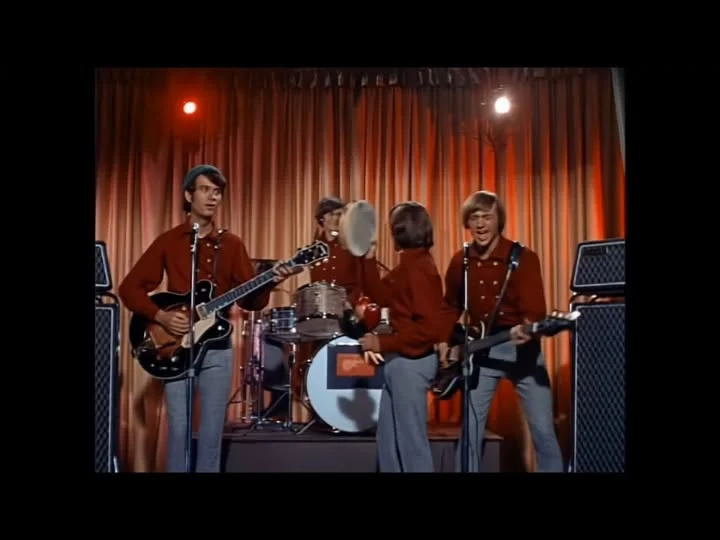
The whistle of a departing train carries a story that has never faded from the American songbook. Few opening guitar riffs in the 1960s can transport a listener straight to a railway platform of longing and anticipation like the first notes of “Last Train to Clarksville”. It is a moment that feels frozen in time, yet each new generation keeps discovering the magic hidden inside this three-minute pop gem.
When The Monkees burst onto the scene in 1966, they were dismissed by some as a television creation designed to ride the coattails of the British Invasion. But the music they released told a different story. Their self-titled debut album, simply called The Monkees, arrived with a single that would become an anthem of its era. The song topped the Billboard Hot 100 and introduced the world to a band that would never be content with being just a fictional act. It was the beginning of a legacy that continues to influence artists and captivate audiences more than half a century later.
The Birth of a Cultural Phenomenon
The album was originally conceived as the soundtrack to a television show about a band, a premise inspired by the success of A Hard Day’s Night. Yet the music quickly outgrew its packaging. Behind the scenes, a rotating cast of talented songwriters and session musicians helped shape a record that felt both fresh and familiar. The result was a collection of songs that balanced youthful exuberance with sophisticated production, and none more so than the lead track that demanded attention from its very first measure.
Songwriters Tommy Boyce and Bobby Hart crafted a narrative that was deceptively simple on the surface but carried layers of meaning beneath its catchy exterior. The opening line paints a picture of urgency, a voice calling out across the telephone wires, pleading for someone to meet a train that may never bring them home. It is a universal emotion wrapped in a pop melody, and it connected with listeners on a level that the writers themselves may not have anticipated.
The Music That Made History
What makes this record so unforgettable is its meticulous construction. The jangly, instantly recognizable guitar work draws you in, echoing the stylistic approach of The Beatles while carving out its own identity. Beneath that riff, the rhythm section pushes forward with a steady, insistent drive that mimics the motion of a locomotive building speed. The bass lines are fluid and melodic, adding a sense of momentum that never lets up.
Layered vocal harmonies weave in and out of the arrangement, creating a rich tapestry of sound that fills every corner of the mix. A subtle tambourine shakes in the background, while muted guitar strums add a rhythmic texture that gives the song its distinctive groove. Then there is the piano, used sparingly but effectively, providing a warm harmonic foundation that supports the lead vocal without overpowering it. Every element feels deliberate, each instrument contributing to the overall emotional arc of the song.
The production values of the time allowed for a level of polish that made the track feel radio-ready while retaining a raw, energetic edge. It was a sound that defined an era, blending pop, rock, and a hint of country twang into something entirely unique. The result was a record that sounded great on the airwaves and even better on a turntable late at night.
A Story of Love and Uncertainty
At its heart, the song is about a man on the verge of leaving, torn between duty and the desperate desire to see his loved one one last time. The lyrics carry a sense of urgency that borders on anxiety, as if the train is already pulling away from the station. While the words never explicitly mention war, the imagery of a soldier saying goodbye to his sweetheart resonated deeply during the late 1960s, a time when the shadow of Vietnam loomed large over everyday life.
“The genius of this song lies in its ability to say so much with so little, leaving listeners to fill in the spaces with their own fears and hopes.”
That ambiguity is precisely what gives the song its emotional staying power. It can be read as a simple love story, a tale of wartime separation, or even a metaphor for the fleeting nature of life itself. The beauty is that it works on all these levels, inviting every listener to find their own meaning within the lyrics. The refrain is both plaintive and defiant, capturing the essence of a generation searching for connection in a world that seemed to be changing at breakneck speed.
The Legacy That Refuses to Fade
After reaching the top of the charts, the song became the foundation upon which The Monkees built their musical reputation. It silenced critics who had dismissed them as puppets and proved that they could deliver performances full of genuine emotion and musicality. The success of the single opened doors for the band to take more creative control over their later work, paving the way for albums like Headquarters and Pisces, Aquarius, Capricorn & Jones, Ltd.
The cultural footprint of this track extends far beyond its original release. It has been covered by numerous artists, featured in movies, television shows, and commercials, and continues to be a staple of oldies radio stations around the world. Its inclusion in playlists alongside the greatest hits of the 1960s is a testament to its enduring appeal. The song has the rare ability to sound both of its time and timeless, a quality that separates the classics from the forgettable pop songs of the past.
Listening Suggestions for the Journey
If this track has captured your imagination, there are several other songs from the same era that are worth exploring. “Daydream Believer” offers a gentler side of The Monkees, with its warm harmonies and nostalgic lyrics. “Paperback Writer” by The Beatles shares that driving, riff-heavy energy that makes “Last Train to Clarksville” so compelling. “California Dreamin’” by The Mamas & the Papas pairs reflective storytelling with lush vocal arrangements, while “Bus Stop” by The Hollies paints a vivid picture through its clever wordplay and jangly instrumentation. And for those who appreciate the narrative depth of the song, “Mrs. Robinson” by Simon & Garfunkel offers a folk-rock perspective that complements the themes explored in the Monkees hit.
A Timeless Departure
Decades after its release, “Last Train to Clarksville” remains a shining example of how music can capture a moment in time while speaking to something eternal. The combination of exceptional songwriting, masterful production, and heartfelt performance creates a listening experience that feels just as vital today as it did in the summer of 1966. It is a reminder that the greatest songs are the ones that make you feel something, whether that is nostalgia, longing, or simply the joy of a perfect melody.
As you listen to the opening chords and hear the story unfold, it becomes clear why this song has earned its place in the pantheon of popular music. It is a journey, a memory, and a promise all wrapped into one. For fans old and new, it remains an essential piece of musical history and a beautiful gateway into the world of The Monkees.
So the next time you hear the whistle blow in the distance, let yourself be carried away to that little station in Clarksville. Let the music take you on a trip through the past, and remind yourself of the power that a simple song can hold.