
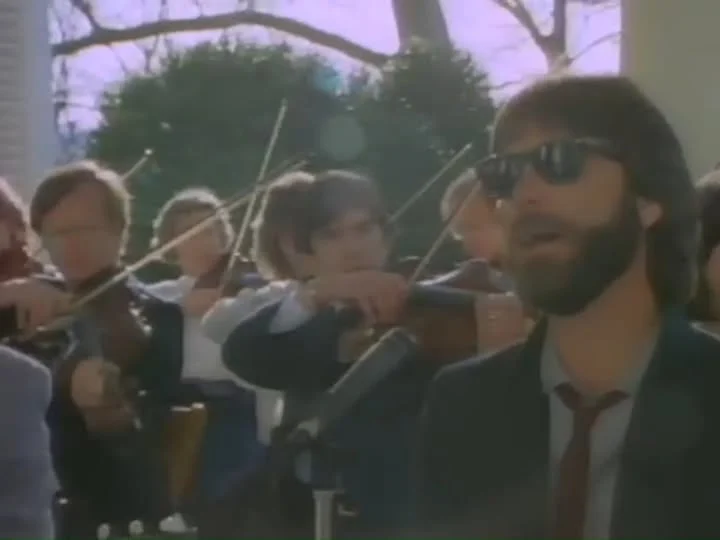
“There’s no way I could ever let you go / Even if I wanted to.” Those words, drawn from the tender chorus of Alabama’s 1985 ballad “There’s No Way,” capture an emotion that feels as timeless as love itself. Decades after it first soared to the top of the country charts, this song still stops listeners in their tracks—a quiet, aching testament to devotion that refuses to fade. It opens with a scene of raw vulnerability: a man seeing his beloved in tears, unsure what to say, yet absolutely certain of one thing—he cannot imagine life without her.
I could tell she had been crying, and it didn’t seem to bother her that I didn’t know just what to say.
From that first verse, the listener is pulled into a world of intimacy and unspoken understanding. The song’s magic lies in its simplicity: a love so deep it defies words, yet so real it needs none. But to fully appreciate this masterpiece, one must first understand the band behind it—a group that helped redefine country music for a generation.
The Architects of a Sound
Alabama—Randy Owen, Teddy Gentry, Jeff Cook, and Mark Herndon—emerged from small bars in the late 1960s to become one of the most successful groups in country history. Over 40 number-one singles and a signature blend of country, southern rock, and pop made them pioneers. Their songs tackled love, work, family, and life with an authenticity that resonated across America. By 1985, they were at the peak of their powers, and “There’s No Way” arrived as a perfect distillation of their artistry.
The Craft Behind the Heartache
The song was penned by songwriters Lisa Palas, John Jarrard, and Will Robinson, and released as a single from the album 40-Hour Week. It quickly climbed to number one on the Billboard Hot Country Singles chart. But the success wasn’t merely commercial—it was emotional. The lyrics speak of a love that isn’t dramatic or idealized, but grounded in everyday devotion. Lines like “I ’ve waited so long just to have you to hold / Now that I’ve got you, I’ll never let go” feel lifted straight from a whispered promise between two people.
Musically, “There’s No Way” is a study in restraint. Gentle guitar riffs, soft percussion, and lush harmonies create a warm, soothing backdrop. Randy Owen’s lead vocal—tender, slightly raspy, achingly sincere—delivers each line as if he means it personally. The harmonies from Gentry and Cook wrap around the melody like a comforting blanket, adding depth without overwhelming the message. It’s a arrangement that lets emotion breathe.
Why It Still Matters
Nearly forty years later, “There’s No Way” remains a staple at weddings, anniversaries, and quiet moments of reflection. Its message—that love can feel so absolute it becomes impossible to imagine letting go—transcends generation and genre. The song’s enduring power lies in its honesty. It doesn’t try to be clever or overwrought; it simply expresses what many feel but struggle to say: “There’s no way I can make it without you.”
There’s no way I can make it without you / There’s no way that I’d even try / If I had to survive without you in my life / I know I wouldn’t last a day.
The final verse, “I never knew until you / What I was missing / Now you say ‘Forever’ / I find my heart, it’s listening,” transforms the song into a promise. It’s a declaration that love isn’t just a feeling—it’s a choice, a commitment that holds firm even when words fail.
A Legacy That Won’t Let Go
Alabama’s gift was creating songs that felt like they belonged to everyone who heard them. “There’s No Way” is one of those rare ballads that becomes personal to each listener. Its beauty is in its universality: it speaks to anyone who has ever loved so completely that losing that love seemed unthinkable. As long as there are hearts that ache and hold, this song will have a home.