
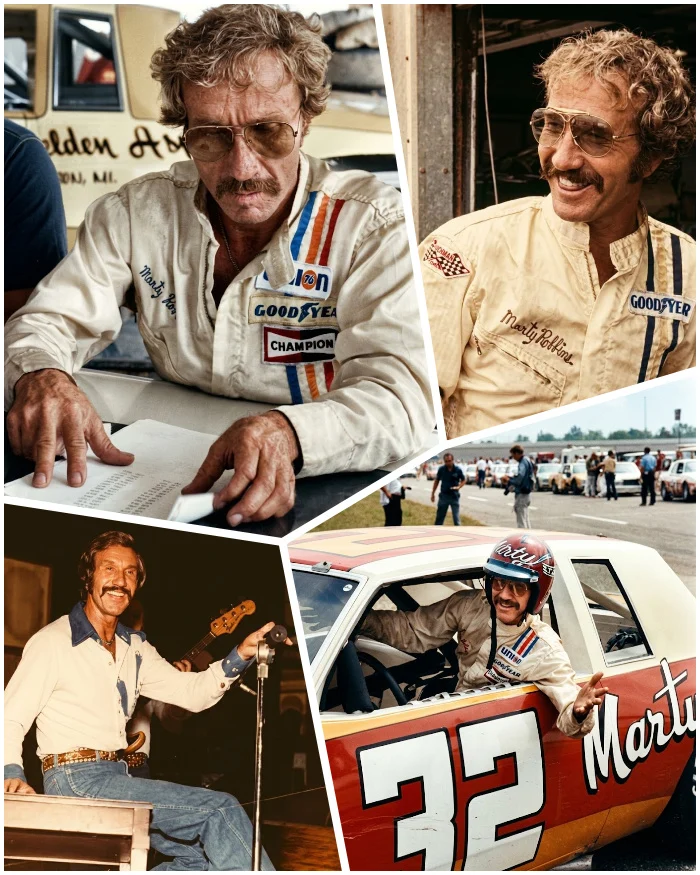
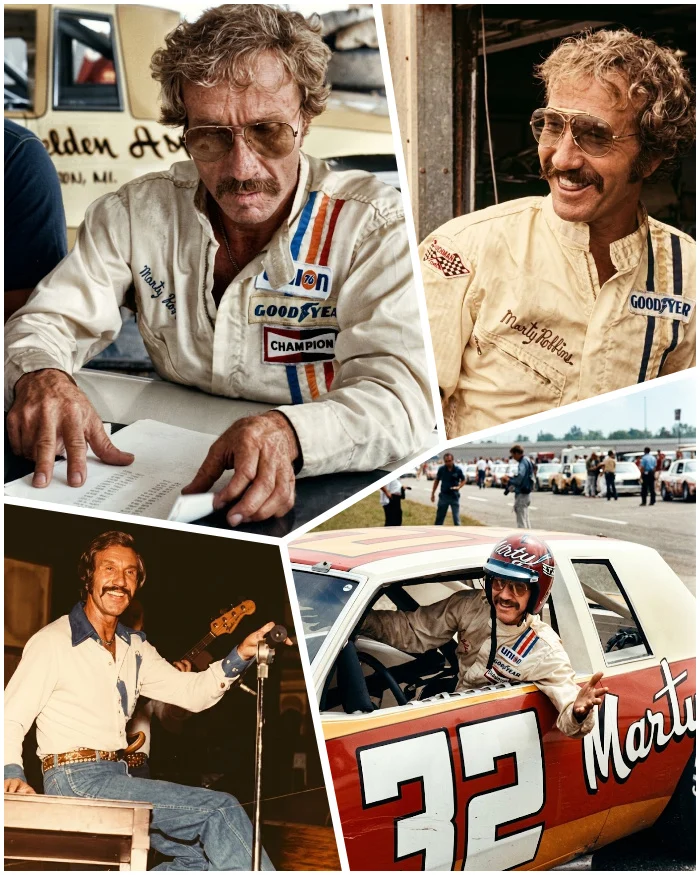
Only thirty one days separated his final NASCAR Cup start from his death. On November 7 1982 Marty Robbins strapped into a No. 22 Buick at Atlanta for his thirty fifth career Cup race and on December 8 he passed away in Nashville at age fifty seven. The man behind that final start had once been trapped inside a burning Dodge at Talladega and had sworn he would never race again.
On May 4 1975 on the 141st lap of the Winston 500 at Talladega Superspeedway Robbins drove his No. 42 Dodge Charger into blinding smoke at nearly 185 miles per hour and nearly 300 kilometers per hour as a multi car wreck involving Ramo Stott and James Hylton unfolded across the banking. He was running in seventeenth place with nowhere to go when his purple and gold Dodge slammed hard into the retaining wall and spinning cars.
The collision tore open the fuel system and ignited gallons of racing gasoline around the cockpit of the crumpled car as it slid against the wall. For Robbins the inferno marked his third consecutive NASCAR Cup Series crash in seven months.
That brutal stretch had started on October 6 1974 during the National 500 at Charlotte Motor Speedway. Robbins turned his car straight into the concrete barrier on the second lap to avoid hitting the stalled Chevrolet of Richard Childress broadside and he took thirty two stitches between his eyes along with cracked ribs and a fractured tailbone. Four months later on February 16 1975 he returned for the Daytona 500 only to get caught in another pileup on the fourth lap that eliminated his car and left him in thirty ninth place.
At Talladega in May Robbins had qualified seventeenth and was running inside the top ten before the lap 141 crash trapped him inside the burning wreckage. In an era when cockpit fires were the worst nightmare of every driver track safety crews reached the car quickly and pulled the forty nine year old singer from the cockpit before the flames could engulf the interior completely.
He was treated at the hospital for burns and smoke inhalation and cracked ribs and a concussion and head injuries. From his hospital bed he faced immediate pressure from his wife Marizona and executives at MCA Records and in Nashville who feared losing the voice of El Paso. Those executives had already watched him survive a major heart attack and triple bypass surgery in early 1970 and his heart had already undergone coronary bypass surgery in 1969. Admitting that three straight superspeedway wrecks were enough and that he was getting too old to keep absorbing the punishment and that his luck had run out Robbins announced his retirement from stock car racing.
Three straight superspeedway wrecks were enough to convince him that his luck had run out and that he was getting too old to keep absorbing the punishment.
Over the next two years Robbins stayed out of the NASCAR Winston Cup starting grid and threw himself back into recording and touring and performing at the Grand Ole Opry. Having recently rejoined Columbia Records he wrote and recorded El Paso City in 1976 and returned to the story of his signature 1959 ballad. The new single reached No. 1 on the Billboard country chart and was followed quickly by another chart topper Among My Souvenirs.
Even with a full concert calendar and Saturday night hosting duties at the Grand Ole Opry friends noticed how restless he grew every weekend when the cars ran at Daytona or Talladega. On May 30 1976 he climbed behind the wheel of a turbocharged Buick V6 to drive the official pace car for the sixtieth Indianapolis 500. Five months later in October 1976 he slipped back into competition at I 70 Speedway in Odessa Missouri and drove a Chevrolet Nova prepared by short track standout Freddy Fryar in the World Cup 400.
By the summer of 1977 the two year hiatus from the top circuit of NASCAR was officially over. On June 19 1977 Robbins rolled his Cotton Owens built 1974 Dodge No. 42 back onto the grid for the CAM 2 Motor Oil 400 at Michigan International Speedway. He started thirty third and drove clean through the afternoon to finish thirteenth.
Two months later on August 7 1977 he returned to the scene of the 1975 fire for the Talladega 500 and ran one hundred three laps before his engine froze during a pit stop. That October at the Nashville Fairgrounds he hosted the inaugural Marty Robbins World Open 500 and had Freddy Fryar qualify his car while he fulfilled a concert date.
For the 1978 season Robbins upgraded to a sleek Dodge Magnum and drove it from a thirty eighth place start to an eighteenth place finish at Talladega in August. The following summer the nineteen year old son of Richard Petty named Kyle Petty prepared to enter the Cup circuit and wanted to drive the traditional family number No. 42. Robbins willingly gave up his famous car number and switched his own Dodge Magnums to No. 6 and No. 36.
He ran four NASCAR Cup races in 1979 and another four in 1980. He turned in one last strong superspeedway performance at Talladega on August 3 1980 and brought his No. 6 Dodge home in thirteenth place.
Even with the memory of the Talladega fire still fresh he could not stay out of the driver seat once his body recovered.
A third heart attack in January 1981 slowed his schedule to a single ARCA start at Talladega that August. Yet he returned to NASCAR for one final season in 1982 driving a Junior Johnson built Buick Regal carrying No. 22. After running the Firecracker 400 at Daytona in July and accepting his induction into the Country Music Hall of Fame in October he rolled that freshly painted presence back onto pit road to handshakes from NASCAR crews one last time. He had gone back on his retirement promise and kept racing until the final weeks of his life.