
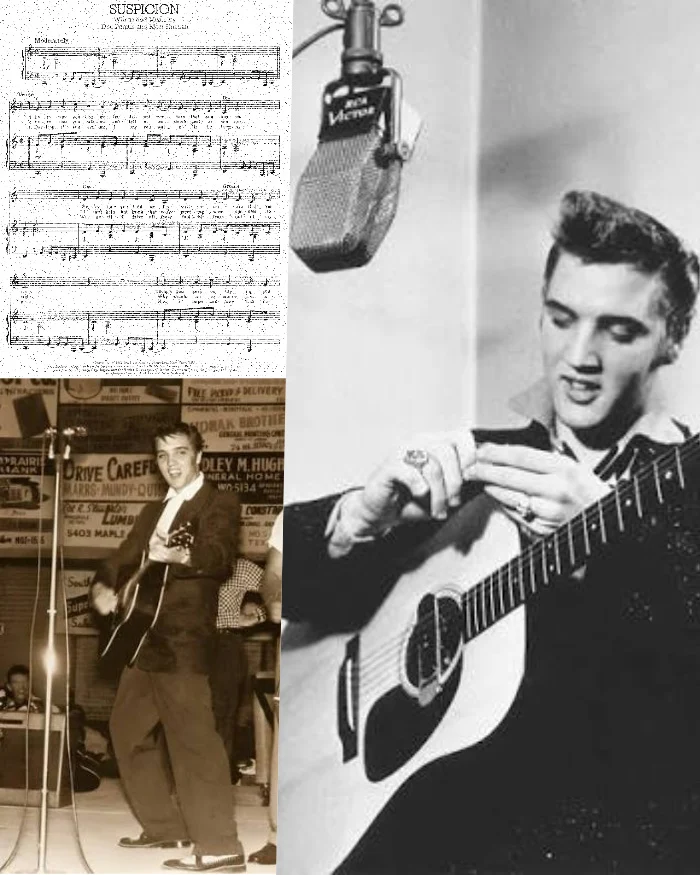

It sounded like a hit that slipped through his fingers. Elvis Presley recorded Suspicion in 1962 and watched another singer carry the same song to number 3 two years later with a voice that sounded remarkably like his own. The strange story behind that missed opportunity still makes the original recording one of the overlooked gems of his early 1960s period.
Introduction And Short Summary Of The Song
Released in 1964 on the album Pot Luck With Elvis though recorded earlier in 1962 Suspicion explores jealousy and mistrust and the fragility of love. Doc Pomus and Mort Shuman wrote the song and became two of the most successful songwriting partners of the rock and roll era. While the track was not initially a single for Presley it gained attention later when the cover version by Terry Stafford in 1964 became a major hit. The original by Presley captures a blend of vulnerability and dramatic intensity and showcases his ability to infuse emotional weight into even a relatively modest pop ballad.
Origins Of The Song
Pomus and Shuman penned Suspicion after already writing several hits for Presley including Little Sister and (Marie’s The Name) His Latest Flame. Presley recorded the song on March 19 1962 at RCA Studio B in Nashville. The recording was initially held back and eventually included as part of Pot Luck With Elvis which was released in 1962 in the United Kingdom and reissued in the United States in 1964 as part of the broader catalog promotion.
The rise of the track to fame in 1964 had little to do with Presley himself. Terry Stafford bore a strong vocal resemblance to Presley and released his version as a single that quickly climbed to number 3 on the Billboard Hot 100. The success of Stafford sparked renewed interest in the original by Presley even though RCA had not prioritized it as a single.
Why Elvis Released Suspicion
At the time Presley was recording large volumes of material for both studio albums and film soundtracks. Suspicion was strong yet it was one of many tracks that got lost in the shuffle. RCA likely viewed it as a solid album cut rather than a potential single especially since the attention of Presley was largely focused on his movie career in the early 1960s.
When the version by Stafford became a surprise hit in 1964 RCA released the recording by Presley as a single to capitalize on the momentum. While it did not match the success of Stafford it highlighted the connection of Presley to the material and reminded listeners of his ability to bring sophistication and depth to pop ballads.
The Message Conveyed In The Song
The lyrics focus on the corrosive effects of jealousy and mistrust in a romantic relationship.
Suspicion torments my heart, Suspicion keeps us apart.
The narrator is consumed by doubts about the faithfulness of his lover despite desperately wanting to believe in her. The tension between trust and suspicion creates emotional turmoil and makes love feel fragile and precarious. The delivery of Presley communicates both vulnerability and desperation. His voice rises in intensity during the chorus and emphasizes the torment of suspicion while the verses are more tender and reflect his yearning for reassurance. The message is universal because without trust love cannot flourish.
The Recording And Musical Characteristics
Suspicion reflects the polished Nashville sound of the early 1960s studio work of Presley. He sings with clarity and control and his phrasing alternates between tender vulnerability and dramatic power. The arrangement includes guitar and piano and bass and light percussion with subtle backing vocals that enhance the emotional atmosphere. The mood is smooth yet intense and blends pop sophistication with hints of his gospel and rhythm and blues influences. Unlike his raw 1950s rock and roll recordings Suspicion represents the more polished and radio friendly style RCA pursued for Presley in the early 1960s. The result is a track that balances commercial appeal with genuine emotional weight.
Even as another singer claimed the hit the blueprint and the emotional power belonged unmistakably to Presley.
Cultural And Commercial Impact
Although Presley recorded Suspicion first it was the 1964 version by Terry Stafford that became the breakout hit and led many casual listeners to associate the song more with Stafford than with Presley. The vocal resemblance of Stafford to Presley only reinforced the connection and his version became one of the biggest hits of the year. When RCA released the version by Presley as a single in April 1964 it peaked modestly at number 103 on the Billboard Bubbling Under chart and landed far below the success of Stafford. Nonetheless it introduced new listeners to the rendition by Presley and highlighted the strength of his original recording. Over time the song has gained recognition as one of the underappreciated tracks of Presley from the early 1960s and has been overshadowed by his bigger hits and his prolific soundtrack work.
Legacy Of Suspicion
Today Suspicion is remembered as a fascinating what if moment in the career of Presley. Had RCA chosen to release it as a single in 1962 or 1963 Presley might have claimed the hit instead of Terry Stafford. Still his version endures as a strong recording that showcases his interpretive gifts and his ability to bring depth to themes of love and doubt and emotional fragility. For fans the song stands as an example of how Presley could elevate even lesser known material into something emotionally resonant. While it never achieved commercial prominence under his name it remains a gem in his vast catalog and is admired for its sincerity and vocal power.
More broadly Suspicion illustrates the richness of the early 1960s studio work of Presley which has been overshadowed by his 1950s rock and roll breakthroughs and his 1968 and 1969 comeback. It serves as a reminder that even during his so called quiet years Presley was recording material of real quality and depth. More than sixty years after its recording Suspicion continues to resonate as a timeless exploration of jealousy and love carried by one of the most expressive voices in popular music history.