
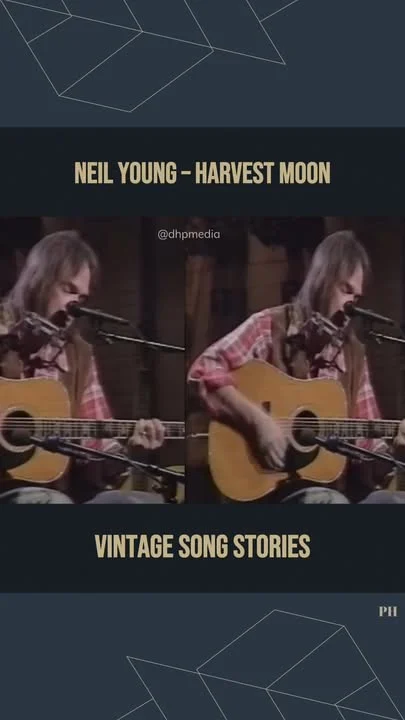

There are songs that simply exist and then there are songs that feel like a warm embrace across the decades. Harvest Moon by Neil Young belongs to the latter category. Released in 1992 as the title track of his folk revival album, the song continues to glow with a quiet, intimate power. It is a meditation on love that has weathered time, a gentle invitation to dance under a luminous sky. The track opens with the softest of calls, almost a whisper across a quiet room, and immediately the listener is drawn into a world of reflection and tenderness.
The album itself marked a significant homecoming for Young. After a decade spent exploring electric experiments and rock landscapes, he returned to the stripped down acoustic roots that first defined his voice. The Harvest Moon album became a critical triumph, but the title track became something more. It captured a moment of artistic clarity, a songwriter looking back on his own life and relationships with a newfound sense of grace. Young wrote the song during a period of deep introspection, and the result is an ode to enduring love, to the kind of bond that deepens with age rather than fades.
Because I’m still in love with you, I want to see you dance again
Those lines carry the weight of years. The lyrics are built around the imagery of a harvest moon, that full autumnal orb that hangs low and golden in the night sky. It symbolizes both the fullness of a life lived together and the fleeting nature of time. Young sings of watching his partner from afar when they were strangers, of loving them fully when they were lovers, and now, in the quiet of late night, wanting to celebrate that enduring connection. The song does not rush. It breathes with the rhythm of two people who have learned to be comfortable in silence and in shared memory.
Musically, Harvest Moon is a masterclass in subtlety. The arrangement features soft acoustic guitars, a gentle piano, and the occasional harmonica that drifts like a sigh through the verses. Backing vocals add warmth without overwhelming the intimacy. Young’s voice, gravelly and unadorned, carries every syllable with an honesty that feels almost confessional. The production is deliberately sparse, allowing each instrument to breathe. It creates a soundscape that is dreamy yet grounded, nostalgic yet present. Every note seems to invite the listener to lean in closer, as if sharing a secret only the moonlight can hear.
The cultural footprint of Harvest Moon is vast and enduring. Though the album did not reach the commercial heights of some of Young’s earlier work, the song became an anthem for weddings, anniversaries, and quiet moments of reflection. It has been covered by numerous artists and featured in films and television shows, each time reinforcing its universal appeal. The themes of love and aging resonate across generations. Younger listeners discover its beauty through playlists and streaming, while those who first heard it in 1992 find it carries new layers of meaning as the years pass.
What makes Harvest Moon timeless is its refusal to be anything other than genuine. It is not a song about the frenzy of new love but about the steady glow of a love that has endured. It acknowledges that relationships evolve, that the harvest moon rises and sets, but the dance continues. For Neil Young, it stands as one of his most serene and honest creations. It is a reminder that the best music emerges from the simplest truths, from a heart that has learned to sing even as the seasons change.
In a world of constant noise, Harvest Moon remains a quiet sanctuary. It invites listeners to step outside, to look up at the sky, and to remember that love is not a destination but a journey best taken hand in hand under the light of a harvest moon.