
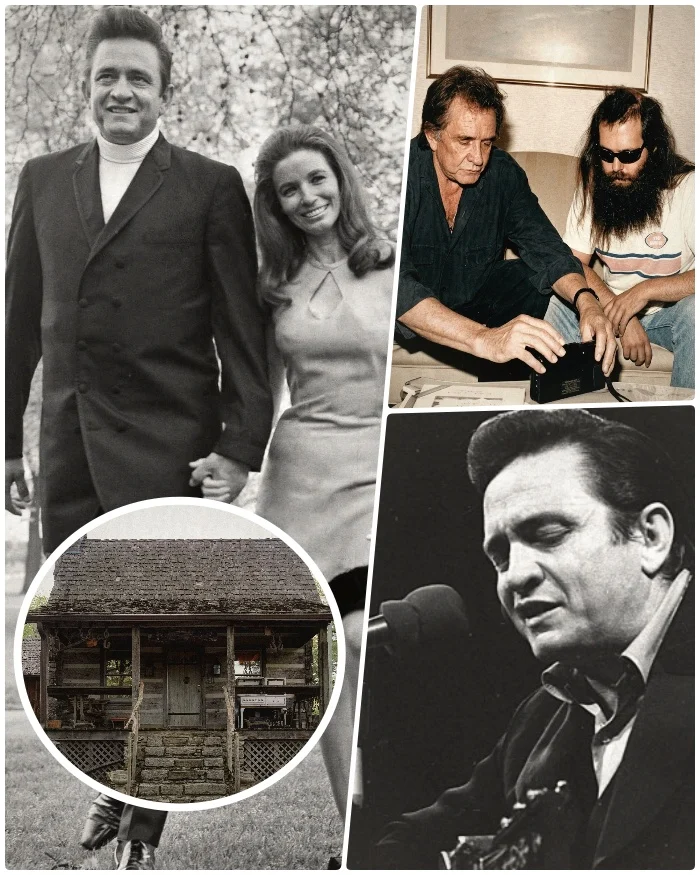

Seven days before the world lost him, Johnny Cash gathered the last of his strength, gripped the microphone stand with trembling hands, and sang one final heartbreaking note into the silence June Carter Cash left behind.
For decades, he had been pure thunder. Johnny Cash sold over ninety million records and became a towering giant in black who sang about prisons, faith, and unbreakable defiance. His powerful baritone could shake the concrete walls of Folsom Prison and bring massive arenas to a sudden and breathless standstill. He was an American myth and a legend carved from stone.
By September 2003, that stone was crumbling. June had been gone for four long months, and her absence created a heavy and suffocating quiet that followed him into every room. Without her steady light, the Man in Black looked profoundly and irreversibly tired.
He was held back by a failing body that could barely cross the floor. Diabetes had stolen his vision and slowly drained his physical strength while the people closest to him watched his health collapse in real time. They gently suggested that he put down the guitar and finally rest.
He did not answer with words. In the silence that followed, he picked up the phone, called producer Rick Rubin, and asked for a microphone.
He was not singing to the producer in the room or to the world. He was singing to the empty space where June used to be.
The Final Session
He arrived at the studio frail, with his hands shaking and his knuckles turning white against the arms of his wheelchair. The recording space had been stripped of its usual industry noise. There was no grand audience waiting, no cameras flashing, and no applause. There was only a solitary stool, a microphone stand, and a silence that felt heavier than grief.
He sat down in the quiet room while breathing became a brutal daily battle. His illness had worn him down to a fragile whisper of the towering giant he once was, and he could no longer sing for hours as he had during his golden years. He would record a single take, close his heavy eyes in pure exhaustion, and wait until he found the strength to try again.
Everyone in the room held their breath as they watched his chest heave with every lyric. They knew exactly what this final effort was costing him, but he was not singing for the men behind the glass and he was not singing to preserve his musical legacy.
He chose an old folk ballad called “Engine 143.” When the red recording light clicked on, his physical frailty seemed to vanish for a moment. The studio walls melted away and left only an old man surrounded by a lifetime of ghosts. The roaring thunder of his youth was gone, replaced by grief, absolute exhaustion, and complete acceptance.
He had run out of time and he had nothing left to hide.
Seven days later, Johnny Cash passed away at seventy-one. The world mourned the loss of a king while headlines celebrated his decades of rebellion and triumph. Those who were in the room during that final week remembered something entirely different.
He did not spend his final hours fighting the inevitable or hiding from the approaching dark. He spent them working and pushing out one final heartbreaking note before stepping back out of the light. He knew the heavy curtain was falling, yet he refused to leave the stage quietly.
Looking back, his last recording does not sound like a man making plans for a tomorrow he knew he would never see.
It sounds like a quiet and dignified surrender.
It remains a final and fragile message left on an empty chair, waiting to be found by the only person who truly mattered.