
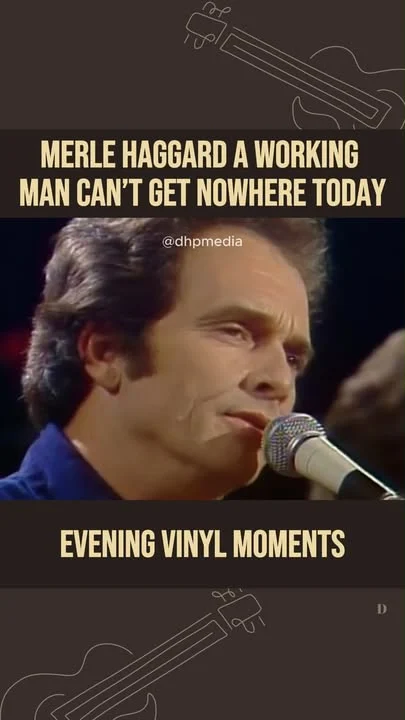
There is a specific kind of tired that a life of hard work breeds. It settles deep in the bones. It lives in the hope you have left. Country legend Merle Haggard knew this exhaustion intimately. In 1977, he gave it a voice on the album Ramblin’ Fever. The song is A Working Man Can’t Get Nowhere Today. It is a raw, unflinching look at the crumbling promise of the American Dream for the blue-collar worker.
The music swerves to match the message. The guitars twang with a resignation that feels like a sigh. The fiddles cry out in a melancholy that sounds familiar to anyone who has watched a paycheck fail to stretch far enough. Haggard‘s baritone voice wraps around the words with a sincerity that feels like conversation. He is not preaching. He is testifying.
The story opens with the start of a long day.
‘Well, I wake up every mornin’, kiss my wife goodbye / Headed off to work beneath the bright blue sky’
It feels like a classic beginning. A man in love. A man with a duty. But the song pulls the rug out from under this idyllic scene. The work is not a noble venture. It is a cage.
‘Well, I don’t get no time for livin’, I’m workin’ all the time / And when it’s quittin’ time, I’m too tired to have a good time’
The very act of living becomes a luxury the job cannot afford.
This is where Haggard‘s genius shines through. He does not just complain. He documents a systemic failure. The worker does everything right. He gets up. He goes to work. He provides for his family. And still, the world tells him he cannot get anywhere.
‘But a workin’ man don’t get nowhere today’
The line is delivered as a bitter truth. It is an anthem of solidarity for everyone stuck in the same cycle.
Despite the heavy weight of the topic, the song refuses to drown in self-pity. It finds strength in shared experience. It reminds the listener that the struggle is communal. Knowing that others feel the same exhaustion can be a powerful balm. It is a quiet call for resilience and a sharp critique of the systems that keep people down.
Why does this song still feel so current decades later? Because the experience of looking at a full week of work and seeing an empty wallet never goes out of style. The specifics change but the core remains. Haggard tapped into a universal truth about labor and dignity. He honored the pride of the working class while mourning the lack of appreciation for it.
In the end, A Working Man Can’t Get Nowhere Today is a masterpiece of empathy. Merle Haggard offered the world a chance to sit with the reality of the people who build and serve and maintain. He turned their struggle into art. He made their quiet dignity visible. The song remains a poignant landmark in music history, a reflection of a battle that is still being fought every single morning.