
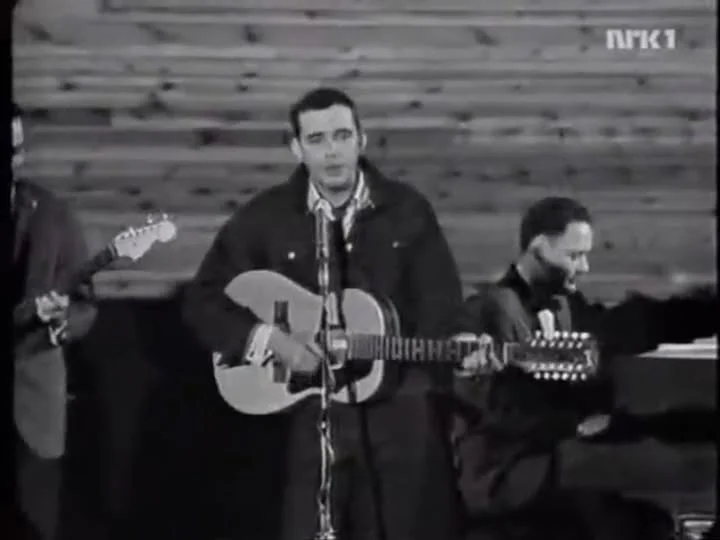
That long, desperate whistle—it cuts through static like a scar. When it first pierced American airwaves in the autumn of 1963, it carried not the thrill of departure but the weight of surrender. Bobby Bare stepped into history with his rendition of “500 Miles Away from Home,” transforming a simple folk ache into a symphony of dignified sorrow. This was the Nashville Sound at its most luminous, a polished mirror held up to the dusty tracks of the American heart.
I remember discovering this track not on vinyl but through a crackling FM signal on a late-night highway. The song grabbed me by the collar and whispered a truth I did not want to admit: sometimes we cannot go home because we have become strangers to ourselves. Hedy West crafted the melody that would define generations, but it was Bare who gave it wings. His recording became the title track of his debut RCA Victor album in December 1963, a moment that shifted his career from pop curiosity to country royalty.
Chet Atkins stood behind the board, and his touch is unmistakable. The Nashville Sound he pioneered replaced raw honky-tonk with orchestral grace, and here that transformation reaches its apotheosis. The arrangement opens with the ghost of a train whistle, then settles into a processional rhythm that mimics the relentless churn of iron wheels. A stately bass line anchors the journey while strings shimmer like heat rising from distant rails. This is not folk music dressed up for radio; it is folk music given the dignity of a cathedral.
Bare does not sing these lyrics so much as confess them. His baritone carries the warmth of late afternoon light, but beneath it runs a current of shame that cuts deeper than any money trouble. Listen to how he shapes the line about not going home. That pause, that emphasis on the word cannot—it reveals a man who has failed not just his family but himself. The microphone captures every catch in his breath, every moment of hesitation, turning vulnerability into art.
He told me he kept a copy of this song on an old cassette, a relic he’d only play late at night, somewhere in the middle of a desert state.
The instrumentation operates like a quiet conversation. Acoustic guitar provides a steady pulse, the heartbeat of the traveler, while piano appears sparingly like flashes of memory in a long night. The string section does not overwhelm but surrounds, creating a space vast enough for loneliness to breathe. This is production as storytelling, every element calibrated to deepen the ache rather than mask it. The reverb suggests a cavernous waiting room, a place where voices echo and silence settles like dust.
I met an old truck driver once who carried this song across forty years of highways. He played it only when the road stretched empty through desert states, when the distance from who he thought he would become grew unbearable. That is the power of this recording: it does not judge. It simply acknowledges the whistle, confirms the leaving, and makes room for the sorrow. In an age of music streaming subscriptions, the song reaches new ears daily, but I still recommend hunting down a high-fidelity vinyl rip to feel the full spaciousness of that 1963 studio magic.
A young professional I know once told me this became the anthem of her hardest year in a new city. Not financial ruin, but career failure so complete she could not bear to face her parents. The train has become a plane, the shame now lives in social media scrolls, but the distance remains the same. Bare’s steady, non-judgmental delivery makes the song a refuge. He is not offering advice; he is simply sitting beside you in the waiting room of your own life.
That 1963 single climbed the Billboard charts across country, pop, and adult contemporary categories, proving that old folk melodies could resonate far beyond their origins when given the velvet touch of a master producer. Bobby Bare did not write the song, but he claimed its sorrow and made it permanent. He took the dust of the road and the ache of the whistle and turned them into something that would outlast every train that ever ran.