
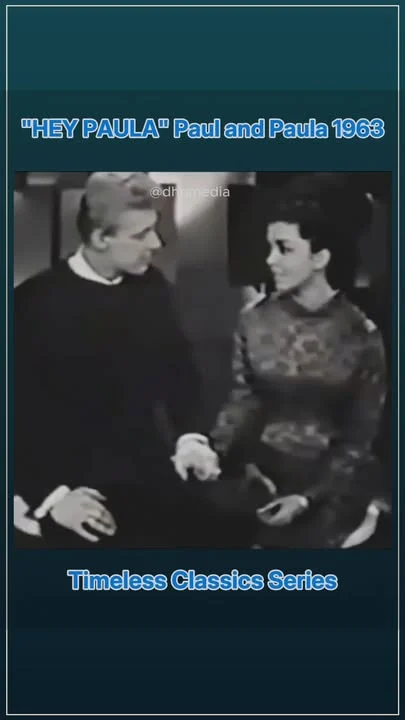
It begins with the soft fuzz of a hollow-body electric guitar and the earnest voice of a young man who sounds like he is standing on a front porch, not in a recording studio. “Hey, hey Paula, I wanna marry you.” For millions of listeners in early 1963, that line was not just a lyric but a promise whispered into the static of a transistor radio. The song Hey Paula by Paul and Paula remains a snapshot of a world on the cusp of change—a world that still believed in skipping stones, soda fountains, and waiting until after graduation to start a life together.
What many forget is that the duo were not seasoned pop stars but two college students from Texas named Ray Hildebrand and Jill Jackson. The record industry gave them the stage names Paul and Paula, and their one defining hit came together through a string of accidents that bordered on magic. Ray wrote the song after hearing Annette Funicello sing “Tall Paul,” and he and Jill performed it on a local radio show. The phones rang off the hook. That response sent them to a Fort Worth studio where producer Major Bill Smith was waiting. The session musicians had actually been booked for another artist who never showed up. So in that makeshift, rushed atmosphere, with the clock ticking and tape rolling, Hey Paula was captured.
The arrangement is deceptively simple. A rhythm section of Guy Parnell on bass and Ronnie Dawson on drums holds a steady pulse. Little Caesar on piano plays block chords that feel less like jazz licks and more like a gentle heartbeat. The guitar, handled by Marvin Montgomery, strums a soft pulse through a warm tube amplifier, giving the track a slight, organic fuzz. Listening on good home audio equipment, you can almost sense the small room, the musicians huddled together, the mono sound field that makes everything feel intimate and immediate.
The real genius lies in the call-and-response structure. Ray’s character Paul is earnest and slightly reedy, a high school boy trying to sound like a man. Jill’s character Paula answers with a mirror of his sentiment: “Hey Paul, I’ve been waiting for you / Hey, hey, hey Paul, I wanna marry you too.” They sing for each other, not for the audience. We are merely eavesdroppers on a perfect moment of mutual youthful promise. The voices are mixed dry and close, as if the two are sitting side by side on a porch swing, sharing a secret that the whole world is privileged to overhear.
The sincerity of its duet structure and the simplicity of its arrangement allowed ‘Hey Paula’ to become the universal soundtrack for every couple who ever dreamed of running away together before graduation.
The song climbed to the top of the Billboard Hot 100 in February 1963 and stayed there for a significant run. It was quickly packaged onto the debut album Paul & Paula Sing for Young Lovers. This was the last clean breath of pre-Beatles American pop—a gentle, wholesome sound that would soon be swept away by Merseybeat and long hair. Yet the song’s power endures precisely because it is not complicated. It is a two-minute-twenty-seven-second dose of unfiltered emotional honesty.
Today, listening to Hey Paula is like opening a time capsule. It reminds us of a moment when pop music felt linear and uncomplicated, when the biggest worry was whether the prom date would show up. The chord progression is so straightforward that instructors often use it as a teaching example for students taking piano lessons. But the real lesson is not musical theory. It is that sometimes the most sophisticated device is pure, relatable sincerity. For an entire generation, this recording was the soundtrack to tentative first kisses and whispered future plans. It makes you wonder about Paul and Paula—not Ray and Jill, but the characters they sang into existence. Did they marry? Did it last? The song leaves you in the perfection of that immediate, unquestioning yes.
To hear it on its own terms is to understand a world that believed in forever. For those who want to explore similar slices of early-sixties pop, consider these companions:
The Everly Brothers – “All I Have to Do Is Dream”: Shares the intimate acoustic approach and close harmonic duet style.
Lesley Gore – “It’s My Party”: Adjacent mood and era, representing the clean slightly dramatic early 60s production style before garage rock grit.
The Rooftop Singers – “Walk Right In”: Another massive simple hit from the immediate pre-Beatles era built around simple compelling instrumentation.
Connie Francis – “Where the Boys Are”: Captures a similar innocence and focus on the hopeful gentle side of teenage romance.
Frankie Valli & The Four Seasons – “Candy Girl”: Though vocally more complex, it is another slice of 1963 pop perfection focused squarely on young love.
Brian Hyland – “Sealed with a Kiss”: Features the same delicate acoustic arrangement and theme of patient devotion in a school-time context.