
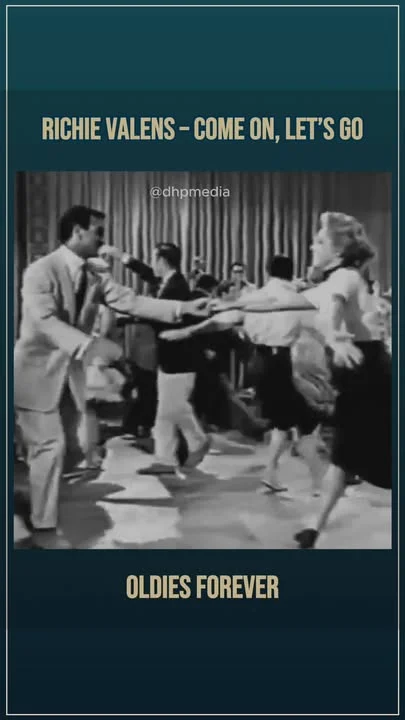
The date was February 3, 1959, when the music world lost three bright stars in a single Iowa cornfield. Among them was a seventeen-year-old from Pacoima, California, whose entire professional career spanned barely longer than a single school year. Yet in those fleeting months, Ritchie Valens had already carved his name into rock and roll history with a sound that felt both impossibly urgent and timeless.
That urgency was never more perfectly captured than in his debut single, a track that clocks in at just under two minutes and changed everything it touched. Come on, Let’s Go arrived in May 1958 on Del-Fi Records like a declaration of war against everything polite and predictable in popular music. It was not a ballad. It was not an orchestrated production. It was raw, breathless, and completely undeniable.
This song is about a moment of now that simply cannot wait. It embodies the high-octane thrill of a night out, the desperation of youth, the feeling that if you don’t seize this one second, it will slip away forever.
The man behind the magic was Richard Valenzuela, a self-taught Chicano kid who learned guitar by watching his older brothers and listening to the radio. He played left-handed on a right-handed guitar strung backwards, a quirk that gave his sound a distinctive edge. When he walked into Gold Star Studios in Los Angeles with producer Bob Keane, neither of them could have predicted they were about to capture lightning in a bottle.
The recording session was intense, almost feverish. Keane, credited as R. Kuhn on the songwriting credits, pushed for a sound that was immediate and stripped down. The result was a sonic document engineered for visceral impact rather than hi-fidelity refinement. There is a palpable closeness to the microphones, a sense of everyone leaning in and pushing toward something electric. The kick drum hits dry and insistent. The snare cracks like a whip at the end of every phrase. The entire arrangement operates at maximum intensity from the very first note.
What makes the track endure, even after all these decades, is the narrative tension embedded in its relentless velocity. Listen to it today on premium audio equipment and the pleasing distortion reveals itself the band rode right up to the edge of the red, never pulling back. This is not polished music. This is sweat and grit and the sound of a garage band about to take on the world.
The structure itself is a masterclass in economy. Valens delivers his vocals with clipped urgency, more command than melody. Well, come on, let’s go, let’s go, let’s go, little darlin is not a request but a demand, a desperate plea for forward motion that perfectly captured the restlessness of post-war American teenagers. The call-and-response backing vocals, that ever-present echo of come on, come on, let’s go, are utterly infectious in their simplicity.
Beneath the shouting, the rhythm section operates as an absolute marvel of propulsion. The bass provides a relentless throb that glues the beat to the pulse of a fast dance. The piano, often buried slightly beneath the crackle of the recording, plays a boogie-woogie inspired rhythmic figure that locks in with the drums to create an unyielding foundation. It provides the percussive swing that separates this rock and roll from its more restrained R&B cousins.
Then there is the guitar work. Valens plays with a scrappy, trebly sound, full of choppy palm-muted strokes that cut through the mix like a serrated edge. The solo is brief, less a melodic invention and more a furious coiled lick that bursts forth with nervous energy. It shows a young man fully embracing the electric potential of the instrument, pushing the limits of what he had with remarkable confidence.
The tragedy of Ritchie Valens makes the urgency of his music an unintended heartbreaking commentary. He was discovered, recorded, toured, became famous, and was gone all within a compressed dizzying timeframe. Come on, Let’s Go peaked modestly in the US Pop Top 50, but its influence far exceeds its chart position. It became a foundational text in the history of Chicano rock and a key element in the late 1950s rock lexicon.
The song’s power lies in its simplicity a four-chord structure that countless aspiring musicians have sought when looking for beginner guitar lessons material. It is an accessible roar, a universal invitation. You do not need to understand anything beyond the beat and the command in his voice to feel the magnetic pull.
The true genius of Come on, Let’s Go is that it sounds exactly like the inside of a teenager’s frantic beautiful mind.
Decades later, when the world is saturated with auto-tuned perfection and sprawling psychedelic epics, the two-minute blitz of this track serves as a vital reset. It reminds listeners that sometimes all you need is a primal rhythm, a shouted phrase, and the feeling that time is running out. Give it a spin. Turn it up loud. Try not to move.
Listening recommendations for those who feel the pull
Buddy Holly captured similar manic compressed studio energy with Rave On. Eddie Cochran channeled the same primal rock and roll simplicity and teenage rebellion in Summertime Blues. The Crickets delivered a driving straight-ahead beat with Oh Boy that demands to be shouted along. Little Richard brought rhythmic intensity and vocal exclamation with Keep A Knockin. The Champs demonstrated the potent simple power of the rhythm section dominating the mix with Tequila. And Chuck Berry used the rhythm guitar as a key propulsive metallic force in Roll Over Beethoven.
Each of these tracks shares DNA with what Ritchie Valens created in that studio session in 1958. Each carries forward the spirit of a young man who changed the world before he was old enough to legally buy a drink. His voice still echoes through the decades, still demanding that we come on, let’s go.