
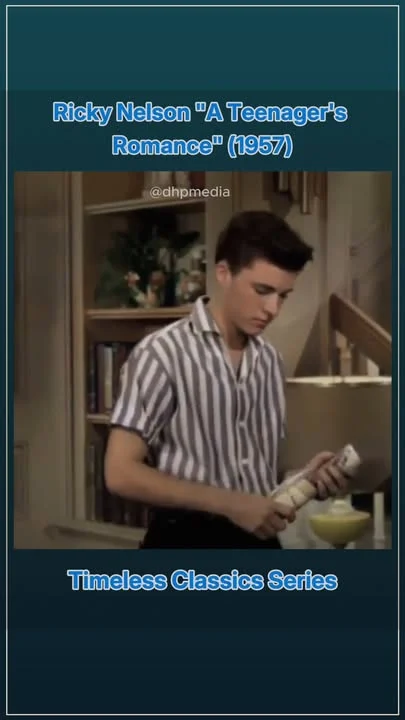
In the soft glow of a 1950s jukebox, a voice as gentle as a summer breeze whispered the heartbeats of an entire generation. That voice belonged to Ricky Nelson, and the song was A Teenager’s Romance. It wasn’t just a hit—it was a validation of every stolen glance, every trembling first kiss, and every crushing heartbreak that defined youth in an era of innocence. Decades later, this track remains a shimmering time capsule, offering a touch of bittersweet nostalgia for anyone who remembers what it felt like to love without caution.
The story behind the song is one of spontaneous desire. In 1957, Nelson, then a teenager himself, was not originally aiming for a music career. He was a beloved face on his family’s television show, The Adventures of Ozzie and Harriet. But to impress a girlfriend, he stepped into a recording studio. The result was a cover of Fats Domino’s I’m Walkin’, and on its B-side sat a quiet gem penned by songwriter David Gillam. That B-side—A Teenager’s Romance—would become the cornerstone of his identity as a teen idol.
The magic of the song lies in its lyrical simplicity. Nelson begins with a line that encapsulates the entire teenage emotional spectrum:
A teenager’s romance is fickle or true; a teenager’s romance is red hot or blue.
Within those words, the thrill and the ache of young love live side by side. There is no adult sophistication, no cynical distance—only raw, honest feeling. The chorus casts love as a daring gamble: If we’re gonna start a romance, we’ll take our chance. For a generation just beginning to assert its independence, this was an anthem of fearless emotion.
Where other performers of the era, such as Elvis Presley, commanded the stage with explosive energy, Ricky Nelson offered something different. His delivery was understated but sincere. He felt like the boy next door, someone who could sing directly to a listener’s private hopes. His voice, smooth and unhurried, perfectly matched the song’s tender simplicity. The production stripped away all distractions—a gentle guitar and a relaxed tempo—leaving no barrier between the singer and the audience. It was as if he was confiding a secret to each listener alone.
The impact of A Teenager’s Romance went beyond chart success. It arrived at a pivotal moment in American culture. The post-war boom had created a new teenage identity, one with spending power and a hunger for expression. Music became the lifeline of that youth culture, and this song was a touchstone. It did not lecture teenagers about growing up; it honored their emotions as valid and profound. In a world that often told them they were too young to understand love, Nelson’s voice said, You are not alone. Your heart knows what it knows.
Even as Ricky Nelson later evolved into a more rock-oriented artist, blending folk and country influences, this early track remained a signature part of his legacy. It is a window into a time when love seemed less complicated, when optimism colored every romance. Listening to it today, we are transported back to malt shops, drive‑ins, and the electric buzz of a first date. The song’s purity stands in stark contrast to modern portrayals of teenage romance, which often lean into irony or angst. Here, there is only sincerity.
A Teenager’s Romance endures because it captures a universal truth: first love feels both enormous and fragile. Whether you lived through the 1950s or discovered the song decades later, its gentle chords still resonate. It is a reminder that some feelings are timeless, and that the heart of a teenager, with all its highs and lows, deserves to be celebrated.