
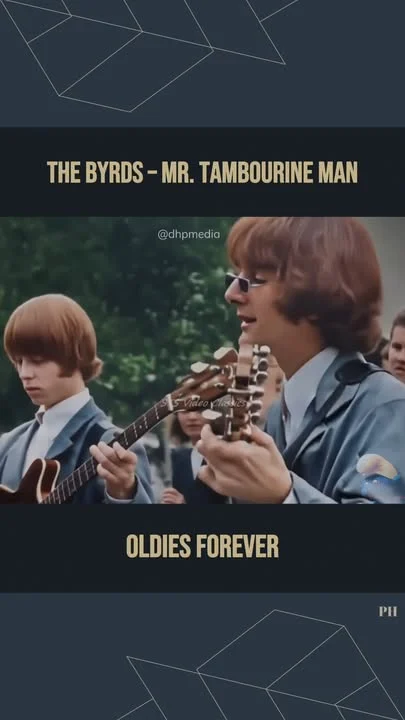
In the summer of 1965, a shimmering cascade of guitar strings forever altered the landscape of popular music. The Byrds’ electrified rendition of “Mr. Tambourine Man” did more than top charts on both sides of the Atlantic; it crystallized a moment when folk’s poetic soul found a new heartbeat inside rock’s amplified pulse. The song still rings out like a waking dream, and its story is as layered as McGuinn’s 12‑string jangle.
The Byrds had not yet transformed into the band that would define a genre when they entered the studio. Their debut album, also titled Mr. Tambourine Man, hit shelves in June 1965 and immediately staked a claim as a folk‑rock landmark. While the title track skyrocketed to number one in both the United States and the United Kingdom, the album itself showcased the band’s own inventive writing—songs like “I’ll Feel a Whole Lot Better” and “All I Really Want to Do” proved they were more than Dylan interpreters. Still, it was the Dylan cover that changed everything. It introduced a generation to the poet’s complex imagery while wrapping it in a radiant, radio‑friendly arrangement.
“Take me on a trip upon your magic swirling ship.”
That line, lifted from Dylan’s original acoustic meditation, became a universal invitation. The Byrds trimmed the song down to its chorus and a single verse—making it punchier, brighter, and perfectly suited for AM radio. Some purists bristled, but the strategy paid off: the song’s wistful yearning, carried by Roger McGuinn’s plaintive vocal and the band’s layered harmonies, turned a cryptic folk poem into an anthem of imaginative escape.
What truly set the track apart was its sound. McGuinn’s 12‑string Rickenbacker electric guitar, drenched in compression and reverb, produced that unmistakable jingle‑jangle texture—a tone that would inspire everyone from Tom Petty to R.E.M. The session musicians of the Wrecking Crew—drummer Hal Blaine and bassist Larry Knechtel—provided a rock‑solid foundation, while producer Terry Melcher polished every detail to a clean, shimmering sheen. The slightly faster tempo compared to Dylan’s version gave it an urgency that felt both hypnotic and alive.
The legacy of “Mr. Tambourine Man” extends far beyond 1965. It proved that folk’s lyrical depth could coexist with rock’s dynamism, paving the way for acts like Simon & Garfunkel, The Mamas & the Papas, and Crosby, Stills & Nash. Its influence rippled through decades: the jangly guitar became a signature of countless bands, and the song itself remains a cultural touchstone for anyone who has ever felt the pull of artistic freedom or the need to simply wander away.
For those who want to follow the trail further, these tracks echo the same spirit:
“Turn! Turn! Turn!” by The Byrds – another Bible‑inspired folk‑rock classic from the same band.
“Blowin’ in the Wind” by Bob Dylan – a poetic, socially resonant companion piece.
“California Dreamin’” by The Mamas & the Papas – lush harmonies and evocative imagery.
“For What It’s Worth” by Buffalo Springfield – politically charged but equally poignant.
“Losing My Religion” by R.E.M. – a later but unmistakable descendant of the Byrds’ jangle.
“Mr. Tambourine Man” endures not just as a song but as a doorway. It captures a moment when music dared to merge introspection with electricity, and in doing so, it gave a generation—and every generation since—a reason to follow that jingle jangle morning.
Hey, Mr. Tambourine Man, play a song for me
I’m not sleepy and there ain’t no place I’m goin’ to
Hey, Mr. Tambourine Man, play a song for me
In the jingle jangle morning, I’ll come followin’ you