
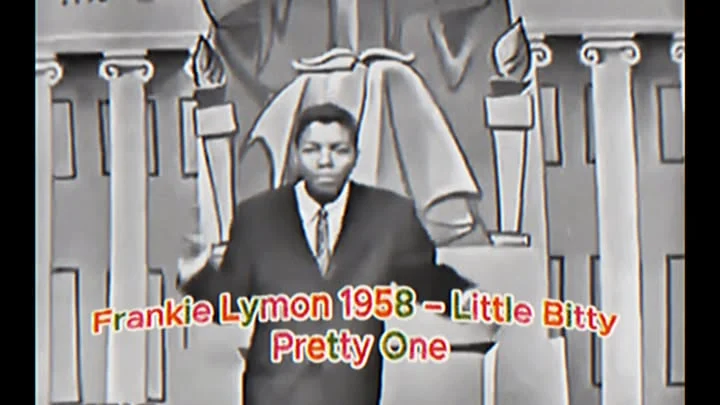
The late-night static crackles and then, suddenly, a perfectly preserved slice of 1950s rock and roll bursts through the air. You are in a dimly lit diner, or maybe driving down a deserted highway, and that impossibly high, pure voice of youth takes hold. It is Frankie Lymon, the former boy soprano sensation, giving a final, exuberant shout to the charts with Little Bitty Pretty One.
This is not a story of a triumphant debut. It is, instead, a poignant tale of a coda. The year was 1958 when Lymon recorded this vibrant cover of the Bobby Day composition, a song that had already been a huge hit for Thurston Harris just one year prior. By the time Lymon version was released as a single in 1960, the landscape of his career, and the entire music world, had dramatically shifted. He was no longer the global superstar leading The Teenagers. He was a young man attempting to navigate the treacherous waters of a solo career, his soaring voice having famously begun its unwelcome descent into a lower register.
The sheer weight of expectation following Why Do Fools Fall in Love was enough to crush any artist, let alone a boy barely into his mid-teens. Lymon solo path began in 1957. This specific piece of music, Little Bitty Pretty One, was cut during this vulnerable period. It found its initial home on his 1958 Roulette Records album, Rock and Roll with Frankie Lymon. The decision to release it as a single two years later speaks volumes about the label hope and Lymon urgent need for a hit.
The original album was conceived to cement his transition from doo-wop leader to a broader rock and roll stylist, though his youthful energy remained his core appeal. This track stands out because it consciously leans into the established, energetic rock and roll idiom pioneered by the original version. The arrangement for this recording is reportedly handled by Rudy Traylor, whose work provides the track with its infectious, swinging foundation.
It is a curious chapter in Lymon story. The single release was a modest success, his highest-charting solo track, reaching a respectable position on the Billboard Hot 100 pop chart in 1960. Yet, for an artist who had previously ruled the charts, peaking outside the Top 50 felt less like a stepping stone and more like a gentle push off the main stage. The track itself vibrates with an energy that seems to contradict the creeping decline in his commercial fortunes.
Lymon version of Little Bitty Pretty One is an exercise in dynamic, classic rock and roll production. It eschews the raw edge of some R and B contemporaries for a clean, almost pop-perfect sound that was starting to define the early 1960s. The instrumental bedrock is tight, driven by a relentlessly simple bass line and a drum performance centered on a crisp backbeat that locks the entire arrangement into a quick, danceable tempo.
The rhythm section forms a cohesive pocket, where the guitar is largely relegated to simple, rhythmic chord chops rather than lead melodies. This keeps the focus squarely on the vocal performance. Crucially, the presence of a buoyant piano provides the classic rock and roll chime, hitting those joyful, syncopated off-beats that define the era. The instrumentation is full without being muddy, a credit to the production quality of the era more established New York studios.
The dynamics are handled masterfully. Lymon voice, still possessing its trademark high-end clarity but with a noticeable deepening, executes those characteristic squeals and whoops with practiced precision. He uses his vocal acrobatics as texture, darting above the backing chorus that provides the all-important doo-wop counterpoint. The trade-off is seamless, an echo of the group dynamics he had recently left behind. The backing vocals, though not officially credited to The Teenagers on his solo recordings, carry the unmistakable warmth and precision of a seasoned vocal ensemble, lifting the track from a simple solo piece to a rich tapestry of harmony.
The emotional core of this song is Lymon vocal phrasing. His delivery is pure, unadulterated youthful excitement. Listen closely to the sustained notes. There is a slight, almost imperceptible tremor in his vibrato that speaks to the transition he was undergoing. It is the sound of the world most famous boy-singer trying desperately to sound like a man, yet still clinging to the brightness of his signature register. For those of us who appreciate high-fidelity sound, playing this recording on quality home audio equipment reveals the delightful interplay between the rhythm instruments and the vocal layers, often flattened in less careful mastering.
The bittersweet irony of Little Bitty Pretty One is that it is a song about fleeting, innocent affection delivered by an artist whose innocence was already long gone. This is where the music transcends its time.
The bittersweet irony of Little Bitty Pretty One is that it is a song about fleeting, innocent affection delivered by an artist whose innocence was already long gone.
I remember hearing this track on a scratchy oldies station during a late-night drive, halfway across the state. The sheer speed and joy of the rhythm section forced my foot to press harder on the accelerator. It is pure momentum captured on tape, a two-minute burst of euphoria that makes you forget your present burdens. It is the kind of song that soundtracks the memory of a first kiss, not the reality of the heartbreak that inevitably follows.
My friend, a veteran dance instructor, uses this track constantly in her rock and roll dance classes. She once told me that the tempo is perfect, but what captivates her students is the rhythm refusal to slow down.
It is relentless joy,
she said. It is the musical equivalent of a frantic, youthful crush, all-consuming and blindingly fast. The energy of the track itself is the ultimate sales pitch.
I often use songs from this era when reviewing equipment. This one, in particular, is a great test for midrange clarity. Through a pair of professional studio headphones, the separation between Frankie lead vocal and the layered responses of the backing group is beautifully exposed. The subtle complexity of the arrangement shines through, revealing Traylor skill in balancing the exuberant vocals with the driving band.
This single, released two years after its recording, represents a critical juncture. It is the moment when the rock and roll train, which Lymon had helped to build, was starting to pull away from him. He had already achieved peak cultural saturation. No subsequent track, however polished or energetic, could fully recapture the seismic shock of Why Do Fools Fall in Love. This 1958 recording is a ghost of that original stardom, a powerful echo caught on the tail end of his pop relevance.
The song is a testament to Lymon enduring, almost heartbreaking vocal talent. He attacks the cover with conviction, turning a popular standard into something uniquely his own, full of quick, acrobatic vocal runs that seem to defy his age. The production is clean and professional, lacking the raw grit of some R and B records, leaning toward the emerging sound of polished New York pop. It is a beautifully realized piece of music, a vibrant, optimistic shout against a personal future that was already darkening.
More than six decades later, the infectious pulse of Little Bitty Pretty One remains undiminished. It forces a smile, encourages a spontaneous, shoulder-shaking movement, and reminds us of the dazzling, yet ultimately tragic, flash of talent that was Franklin Joseph Lymon. We listen not just to the notes and the beat, but to the spectral presence of a brilliant career taking its final, magnificent bow on the pop stage.
For those who wish to explore the song legacy further, several versions offer contrasting perspectives. Thurston Harris original 1957 recording provides essential context for understanding the competitive chart landscape. The Jackson 5 delivered a funkier take in 1972, with a young Michael Jackson showcasing the song timeless appeal across generations. Danny and the Juniors hit At the Hop from 1957 shares a similar up-tempo, youthful party energy. Bobby Day own Rockin Robin from 1958 features the same buoyant, playful vocal style from the original composer. Little Richard explosive Good Golly Miss Molly from 1958 captures the era raw exuberance. And Clyde McPhatter powerful 1962 version demonstrates how established R and B singers approached the material in later years.