
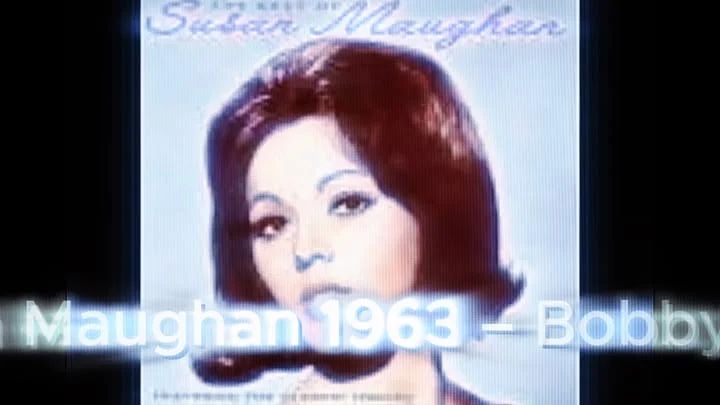
She stopped mid-sentence, a woman in her seventies, her eyes fixed on a distant memory while the antiquated home audio system crackled to life. The song that emerged from the speakers was not just a tune, it was a sensory flashback, the scent of cheap perfume and the thrill of a nervous school dance rushing back. She softly mouthed the words, He wears his class ring. In that crowded coffee shop, the timeless longing of Susan Maughan‘s rendition of Bobby’s Girl bridged decades in a single breath.
That moment encapsulates the magic of a record released in late 1962 on the Philips label. When the American hit crossed the Atlantic, Maughan was ready to deliver the definitive UK version, a transformation that turned a teenage lament into a cinematic declaration. The song rapidly ascended the UK charts into 1963, peaking at No. 3 and defining her career. It became the centerpiece of her debut album, I Wanna Be Bobby’s Girl But…, released on Philips in late 1963, reportedly produced by John Franz with the exquisite arrangements of Wally Stott and His Orchestra and Chorus.
But to understand why this song still shimmers over six decades later, you must go back to the rehearsal room where the air was thick with cigarette smoke and the restless energy of a band waiting for its moment. It was the early 1960s, a volatile time of thrilling change in British music. The rock-and-roll explosion of the previous decade was giving way to something cleaner, brighter, more polished, yet still infused with a yearning teenage heart. Into this shift stepped Susan Maughan, having cut her teeth in the dance-band circuit with Ronnie Hancox and the Ray Ellington Quartet. She possessed a vocal control and maturity that many of her teen-pop contemporaries lacked, making her a sophisticated alternative to singers like Helen Shapiro, a bridge between big-band polish and pure emotional pop.
The orchestration on Bobby’s Girl is less about accompaniment and more about embodying the hopeful, soaring feeling of the unrequited crush.
What sets Maughan’s version apart from Marcie Blane‘s original is its sheer sonic richness. Where the original had a raw, teenage feel, Maughan’s rendition is cinematic. The song bursts to life not with a spoken teenage lament, which Maughan wisely dropped, but with the full-throated assurance of the chorus. This immediate vocal presence transforms the piece from a private confession into a grand declaration. The arrangement, courtesy of Wally Stott, is a masterclass in early sixties pop orchestration. It rides on lush sweeping strings that carry the melody with an almost operatic swell, creating a feeling of romantic inevitability. The rhythm section maintains a restrained but insistent tempo, drums offering subtle brushwork rather than harsh backbeats. The piano provides harmonic anchors and glittering upper-register fills, its clean bright timbre contrasting beautifully with the warm dark color of the strings.
Listen closely to the dynamics. The verses are delivered with controlled vulnerability, Maughan’s clear voice exhibiting a slight expressive vibrato. The entire production seems to inhale, gathering emotional tension before the chorus. Then on the line I wanna be Bobby’s girl, the orchestra releases a sudden beautiful wave of sound, a dynamic swell that captures the ecstatic nature of a teenage crush. A muted clean guitar line peeks through the mix, providing a counter-rhythm more country-pop than rock. For those investing in premium audio equipment today, the layering of the orchestra, the separation between vocals and instrumental chorus, is simply breathtaking, a sonic monument to a time when pop singles were miniature symphonies.
The genius of the song lies in its universal yet specific emotional landscape. It speaks of the desire to possess a coveted status, to be the chosen one, a theme that transcends any particular era. A younger listener, perhaps learning guitar lessons through a tablet today, might stumble across this track and find that the emotional core, that yearning for attention from a charismatic figure, is exactly the same as the anxieties filling their social media feeds. Context changes, but the heart’s rhythm remains constant. Maughan’s sophisticated vocal take gave the song gravitas, delivering the dream not just the drama. Her subsequent career, while never repeating the magnitude of this hit, was defined by an ability to deliver standards and contemporary pop with equal finesse, showing a rare depth of musicality.
Ultimately, Bobby’s Girl is not just a nostalgic echo. It is a beautifully constructed dream of glamour and acceptance, still shimmering over six decades later. For those seeking similar sonic doorways, the listening recommendations below offer further journeys into that golden era of British studio craftsmanship.
Helen Shapiro – Walkin’ Back to Happiness (1961): Mature vocal delivery over sophisticated swinging orchestral backing.
Petula Clark – Sailor (1961): Dramatic cinematic orchestral sweep and yearning romantic theme.
Billie Davis – Tell Him (1963): Blend of pop enthusiasm and professional studio shine.
Connie Francis – Where The Boys Are (1960): Hopeful vulnerable teenage romanticism with lush arrangement.
Lesley Gore – It’s My Party (1963): American teen tragedy with production elevating emotional narrative.