
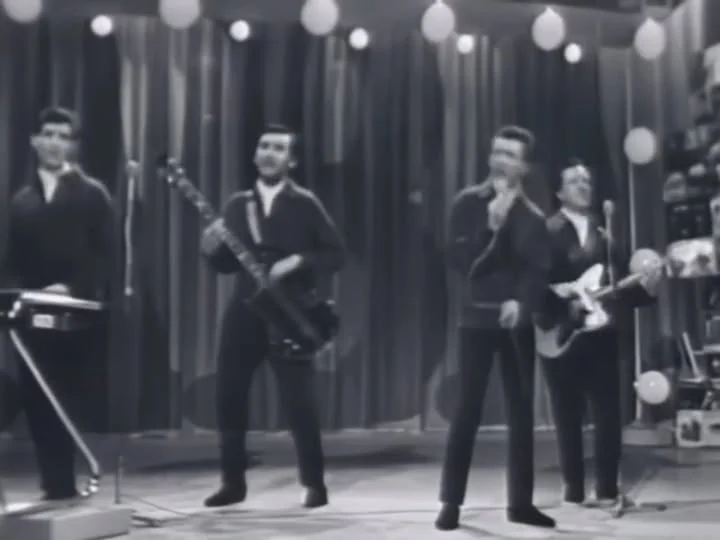
Regret is a heavy engine. It rarely drives the music forward without a lot of friction. But every now and then, a song captures the exact sound of a man trying to overcome his own worst instincts. The Four Seasons found that sound in early 1966.
The song is Working My Way Back To You. Frankie Valli delivers the vocal performance of a lifetime. He starts in the lower registers, thick with dust and regret. Then the chorus hits. His falsetto does not soar. It screams. It is the sound of a man throwing his voice against the wall of his own failures, hoping someone on the other side is still listening.
The single arrived during a curious era for the group. The British Invasion was rewriting the rules of pop music. The Four Seasons, an American institution, chose not to adapt. They doubled down on their signature blend of doo wop and orchestral pop. The result was a song that felt both timeless and intensely modern. It was the title track for the album Working My Way Back to You and More Great New Hits but it had been recorded the previous year.
The song came from the powerhouse songwriting team of Denny Randell and Sandy Linzer. Producer Bob Crewe orchestrated the tension perfectly, matching a raw, confessional lyric with an arrangement that sounded like a man bracing himself for the long walk home. Charles Calello handled the arrangement and even filled in on bass during the recording sessions.
The arrangement by Charles Calello is a masterclass in structured tension. It begins with a drum beat that does not swing. It marches. The guitars chop rhythmically. The piano provides the harmonic bedrock. When the brass and strings enter for the chorus, the dynamic lift feels like the sun breaking through heavy clouds. The backing vocals, sung by Bob Gaudio, Tommy DeVito, and Charles Calello, form a complex, angelic stack that perfectly counterpoints Frankie Valli lead.
I remember talking to a drummer about the song decades later. He learned the beat to replicate it. He found no flashy fills. The beat relied on unrelenting precision. He looked up and made a simple point.
It is the sound of someone trying to be a better man. The song cannot waver or the story falls apart.
He understood the assignment perfectly. That unblinking sonic consistency reinforces the narrative of focus and a plan.
The song has since transcended its era. It is no longer just a relic of the sixties. It is a universal soundtrack for anyone trying to rebuild. A ruined friendship, a derailed career, or a fractured relationship. The mandate remains simple. Keep moving. Keep working.
The track is not just a memory of heartbreak. It is a detailed plan for the slow work of earning trust back.
It reached the US top 10. It secured The Four Seasons place as serious artists capable of complex emotion dramatically arranged. In a decade dominated by The Beatles, this was one American group that could hold its own. They understood that the most powerful glamour is simply telling the truth. A re listen to the track today confirms its status as an enduring statement of remorse and resilience.
Fans of this track should explore The Righteous Brothers song You’ve Lost That Lovin’ Feelin’ for a similar wall of sound. Gene Pitney song Only Love Can Break a Heart offers the same dramatic regret. The Beach Boys track God Only Knows shares the innovative orchestral pop structure. Frankie Valli solo hit Can’t Take My Eyes Off You follows the exact emotional arc. Finally The Walker Brothers song The Sun Ain’t Gonna Shine Anymore captures the same cinematic hopelessness.