
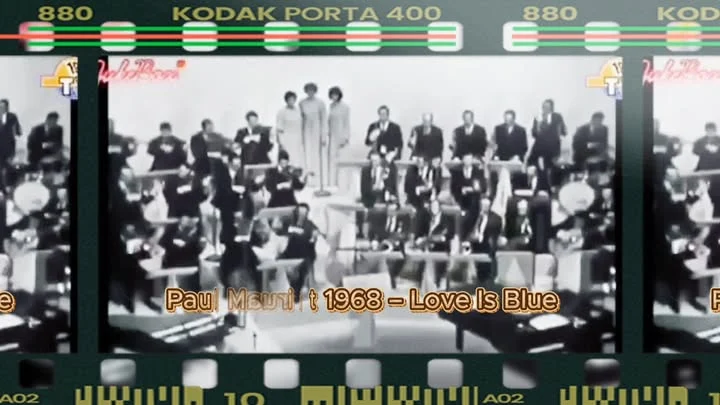
Five weeks at the top of the American charts with no singer and no words. A harpsichord carried the melody while strings swept in like a Mediterranean breeze. That was the unlikely sound of 1968, when Paul Mauriat’s arrangement of “Love Is Blue” sat at number one on the Billboard Hot 100 and refused to leave.
For listeners old enough to remember, the record became the quiet soundtrack to hotel lobbies and dinner parties in the more traditional corners of suburbia. It was the sound of European glamour drifting into American living rooms through the family home audio system. In a season dominated by fuzz-drenched guitar riffs and acid soaked studio experiments, this polished instrumental felt almost like a rebellion of elegance. It proved that a beautiful melody and a confident orchestra could still conquer a rock and roll world.
The achievement was historic as well as musical. This was the first recording by a French artist to claim the top spot on the American singles chart. Mauriat had transformed a sad Eurovision ballad into a shimmering, wordless symphony that captured the imagination of a generation split between parents and children who rarely agreed on music.
The story began a year earlier at the Eurovision Song Contest in 1967. Luxembourg entered “L’amour est bleu,” a tender French ballad performed by Vicky Leandros. The music came from André Popp and the lyrics from Pierre Cour, who painted love through color and elements, with blue for water and grey for sand. The vocal version finished fourth, a respectable result that gave little hint of the global journey ahead.
Mauriat was already a seasoned arranger and conductor, having spent years as musical director for French icons like Charles Aznavour. He had built a reputation through a series of instrumental albums for Philips, each one showing his gift for taking popular songs and turning them into rich orchestral canvases. When he heard the melody of “L’amour est bleu,” he heard something far beyond its contest presentation. He stripped away the words and rebuilt the piece as a dynamic instrumental, featuring it on his 1968 album Blooming Hits. As the credited arranger and conductor, and reportedly the producer as well, he gave the melody a sunlit elegance that left the original’s melancholy far behind.
The arrangement announces itself instantly. A bright harpsichord plucks out a crisp baroque pattern that is both playful and precise. That riff becomes the song’s rhythmic and harmonic anchor, setting a tone that feels classical yet completely modern. When the strings enter, they glide through the melody with a rich, controlled vibrato, soaring as one voice while avoiding any syrupy excess. Light shakers and toms keep the pulse alive underneath, and a delicate bass line adds depth without stealing focus. At key moments, celeste or glockenspiel bells shimmer above the texture, while the piano works quietly in the middle as a harmonic and rhythmic support rather than a solo voice. The recording itself has a clean, open clarity that makes it a wonderful test case for studio headphones, since each section of the orchestra remains easy to follow.
What makes the track so captivating is its emotional restraint. It rarely rises to a true fortissimo. Instead it swells, peaks, and retreats with the logic of a master filmmaker. The beauty comes from the sheer number of strings moving together in warm accord, all speaking a unified musical language with a distinct French accent. Listening to it is like watching a slow tracking shot along a sunlit Riviera coastline, where every focus shift feels natural and inevitable.
In an era when rock bands pushed boundaries with concept albums and extended jams, Mauriat offered something completely different. His record was polished, accessible, and instantly memorable. It bridged the generational divide, appealing to parents who recognized its classical grace and to younger listeners who simply loved the melody. The song was licensed and pressed onto compilations everywhere, becoming one of the defining easy listening records of the decade.
For musicians, studying this arrangement is like attending a private masterclass. Its complex voicings could be transcribed into sheet music to reveal the inner workings of orchestral pop construction. It remains a triumphant fusion of continental classicism and universal pop sensibility, a track that sounds both completely of its time and utterly timeless. It cemented Paul Mauriat’s place as a global superstar of the easy listening genre.
“The genius of Paul Mauriat was in recognizing that a great melody needs not a singer’s voice, but a perfectly tailored orchestral garment to truly soar.”
That influence never disappeared. Film soundtracks and lounge music revivalists continue to echo the sound Mauriat perfected. He proved that in the middle of the rock era, a sophisticated wordless symphony could still command the airwaves and hold the attention of millions. The song remains a blue that is anything but sad. It is the blue of a Mediterranean sky reflecting on a perfect afternoon, vivid and calm, inviting the listener to dive in again and again.
For those who love this brand of orchestral elegance, several other recordings belong on the same shelf. Bert Kaempfert offers a similarly clean and precise arrangement with his 1962 track Afrikaan Beat, where brass and a subtle driving rhythm take center stage. Ray Conniff delivers lush multi-tracked voices and strings on Somewhere My Love from 1966, a signature moment in mid-century orchestral pop. Percy Faith remains the essential easy listening predecessor with Theme from A Summer Place, a soaring romantic string melody from 1960. Franck Pourcel brings another French touch to pop standards with Only You from 1959, polished with European gloss and charm. The Carpenters blend precise piano work with rich structured pop arrangements on Close to You from 1970, even with vocals included. Finally, Manuel and the Music of the Mountains reach for classical grandeur on Rodrigo’s Guitar Concerto De Aranjuez, a romantic favorite in the easy listening world.
The original 1968 recording of Love Is Blue by Paul Mauriat is still easy to find and remains a perfect introduction to his art. Let the harpsichord begin, and the rest of the world fades away.