
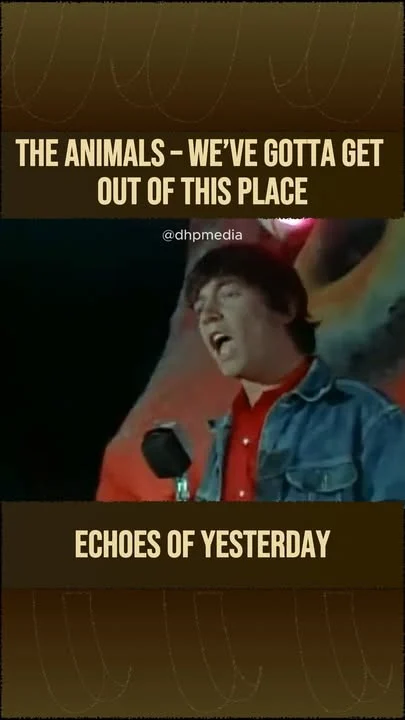
There is a moment in every person’s life when the walls seem to close in and the only thought that matters is a desperate need to break free. For a young soldier crouched in the humid jungle of Vietnam, the scratchy sound of a transistor radio might have been the only connection to a world that made sense. In 1965, a British rock band named The Animals released a song that gave voice to that raw, universal longing. “We’ve Gotta Get Out of This Place” did not arrive with the polish of a pop anthem. It came with grit, sweat, and a vocal performance so aching that it still cuts through the static of modern life.
More than half a century later, the song refuses to fade. It lives on in movies, in cover versions, and in the hearts of people who have never seen a rice paddy or a Huey helicopter. Its power lies in its simplicity. The title itself is a complete statement, a cry that needs no explanation. It speaks to the part of us that dreams of open roads and second chances.
What makes this song so remarkable is its accidental universality. The music was crafted by the celebrated songwriting pair Barry Mann and Cynthia Weil, two New Yorkers who originally had the American market in mind. But it was The Animals, a group of working-class lads from the industrial north of England, who discovered its true pulse. They had already stunned the world with the brooding drama of “House of the Rising Sun.” Yet this track felt different. It carried the weight of their own childhoods, the smoke-stained skies of Newcastle, and the quiet desperation of families just getting by.
“In this dirty old part of the city where the sun refused to shine, people tell me there ain’t no use in tryin’.”
Those opening lines are more than just scenery. They capture the hopelessness of a blue-collar existence that feels like a dead end. The song’s narrator is watching his own future slip away. He sees a father figure worn down by years of thankless labor, and he refuses to accept the same fate. The chorus becomes a vow, a pledge that echoes through generations:
“We gotta get out of this place if it’s the last thing we ever do. We gotta get out of this place, girl, there’s a better life for me and you.”
While it was never written as a protest song, the tune became an accidental soundtrack for a generation trapped in the horrors of the Vietnam War. American soldiers adopted it with a ferocity that surprised even the band. Tapes and radios played it from the jungle base camps to the decks of aircraft carriers. For the men and women stationed thousands of miles from home, the song was not about a rundown city block. It was about the dust, the fear, and the nightly possibility of not waking up. The lyrics distilled their only ambition into a single urgent desire, to survive, to return, to walk on familiar soil again.
That military connection cemented the song’s place in the canon of anthems. It stood alongside protest classics like “Fortunate Son” and “Blowin’ in the Wind,” even though it never wore its politics on its sleeve. Instead, it found its power in emotional truth. In the decades that followed, its meaning would stretch and morph to fit new struggles. A dead-end job, a worn-out relationship, a town with no opportunities, the song refuses to stay pinned to any single era.
This ability to adapt is the secret to its longevity. The world has changed dramatically since the mid-1960s, but the feeling of being trapped has never gone away. In 2024, we speak of economic anxiety and social isolation, but the emotional core remains the same. The music of Eric Burdon still carries that raw, urgent edge. His voice does not soothe. It pleads and it demands. It sounds like a man standing at a crossroads, refusing to take the easy road.
The legacy of The Animals is often tied to this one song, and rightfully so. The band may have broken up not long after its release, but the song’s impact grew larger than the group itself. It has been covered by artists from every corner of the musical spectrum, and it has appeared in countless films and television shows. In 2016, the Rock and Roll Hall of Fame placed it on its list of the “500 Songs That Shaped Rock and Roll,” a formal recognition of its enduring influence.
Yet official honors only scratch the surface. The real legacy lives in the personal stories of those who leaned on the song during their darkest moments. A teenager stuck in a small town, a single parent working double shifts, a prisoner counting down the days. They all hear something different in the melody, but they all feel the same spark of defiance. It is a reminder that getting out is not a fantasy. It is the first act of courage.
For many, the song remains a beacon of hope wrapped in a gritty, uncompromising sound. It does not offer easy answers or sugarcoated promises. It simply validates the struggle and then dares the listener to move forward. That is why it still resonates. That is why it will keep resonating long after we are gone.
“We’ve Gotta Get Out of This Place” is more than a track from the golden age of rock and roll. It is a map out of the darkness. It is a hand reaching back to lift someone up. It is the voice of a generation and the whisper of every person who has ever dared to dream of something better. The place we need to escape may change, but the song will always be ready to lead the way.