
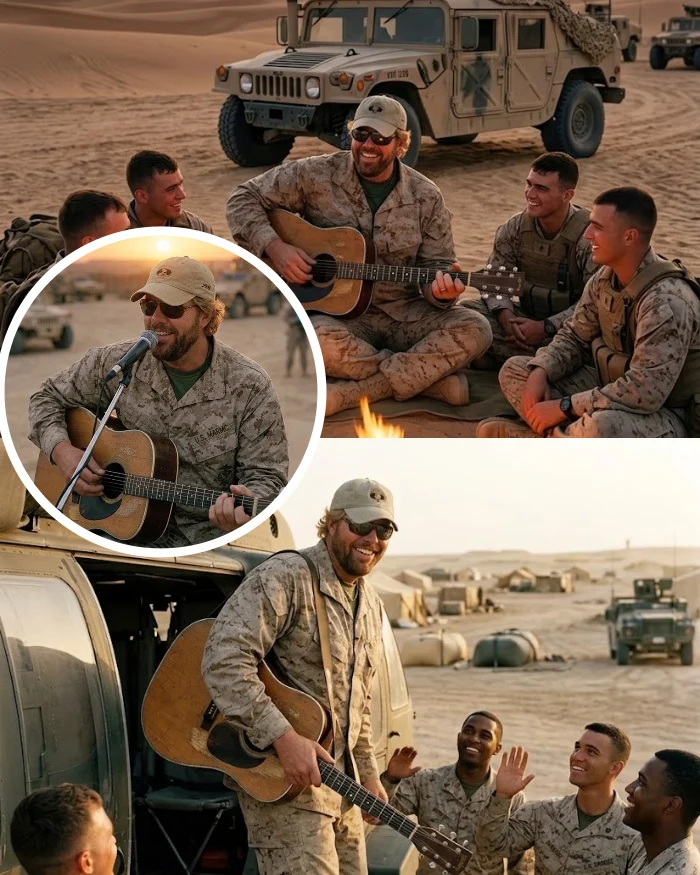
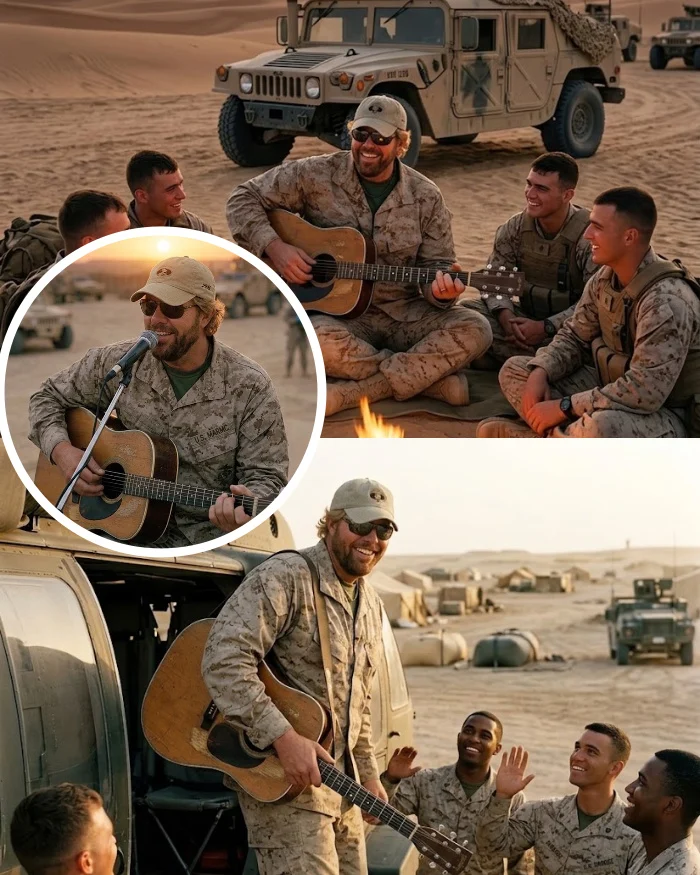
When the mortar alarm shattered the desert night in Kandahar, the crowd scrambled into concrete bunkers. But Toby Keith did not stop. He carried his acoustic guitar into the shelter, sat on a bench, and kept singing under the beam of a single flashlight until the all-clear sounded. That moment captures the essence of a man who turned every stage into a mission.
Between 2002 and 2013, Keith undertook 11 USO tours spanning 17 countries and territories. From forward operating bases in Iraq and Afghanistan to remote outposts in Bosnia and Kosovo, he delivered nearly 300 free shows to more than 250,000 service members. His daily schedule often packed three to five performances into a twelve-hour window, with travel aboard military helicopters and tactical transport planes where he caught brief naps on the metal cargo floors of C-130 aircraft.
Keith’s commitment was personal. His father, H.K. Covel, served in the United States Army during the Korean War, instilling a deep respect for those in uniform long before his recording career began. That upbringing turned his annual overseas journeys into a duty rather than a promotional effort. Base commanders noted that he never left a base early. He stayed until he had shaken every hand, hugged young troops, and signed dusty Kevlar helmets, body armor vests, and creased family photographs pulled from uniform pockets.
He made it clear to base commanders that he had not traveled across the world to cut a set short.
The logistics demanded relentless endurance. Operating under strict operational security, his arrival times and locations were often withheld until hours before landing to minimize risks. Stages were improvised from wooden ammunition crates or flatbeds of tactical trucks parked in open gravel lots. In mess halls and along perimeter security lines, Keith spent hours listening to young enlisted soldiers talk about home, hometown football scores, and family milestones they were missing.
In 2014, the USO formally recognized his decade of frontline dedication by presenting him with the Spirit of the USO Award. Base commanders and civilian organizers praised his willingness to travel to outposts where security risks were highest and conditions most demanding. While his career produced stadium records and chart-topping anthems, the legacy that endures is the memory of a man with a guitar, staying until the last handshake on a quiet flight line.