
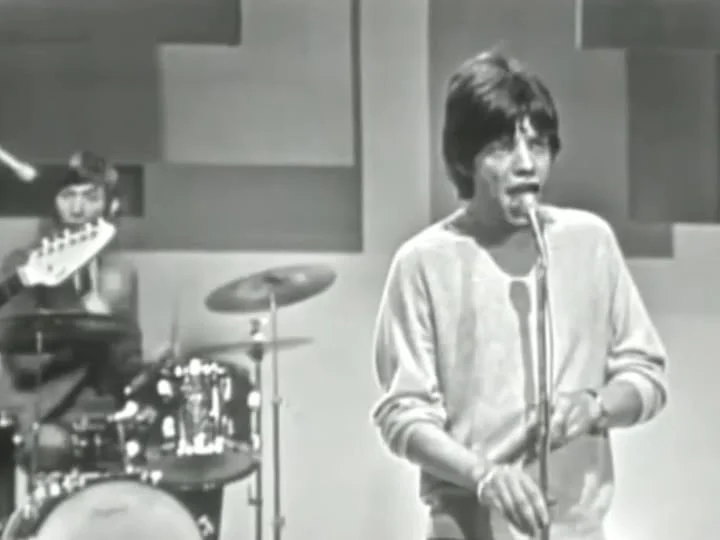
Patience becomes power in this song—the arrangement holds its breath just long enough to make belief feel inevitable.
The Rolling Stones were still hungry and unsure when they first stepped into a borrowed tune and claimed it with an ease that feels like fate.
How does a song travel from a jazz trombonist’s studio in 1963 to become an anthem of quiet resilience for millions? The answer lies in the peculiar alchemy of “Time Is On My Side.” Written by Jerry Ragovoy under the pseudonym Norman Meade, the track first surfaced as an instrumental by Kai Winding before Irma Thomas transformed it into a soulful R&B confessional. When The Rolling Stones encountered it in 1964, they recognized something deeper: a slow-burning promise that didn’t need to shout.
The Stones recorded the song twice that year. The earlier cut, featured on the American album 12 x 5, opens with a soft organ that feels like a room inhaling deeply. That version climbed into the U.S. Top Ten, marking a pivotal early success for the band. Later, in Chicago, they tightened the arrangement, swapping the organ for a guitar-led intro that felt more declarative. Both versions share the same unhurried tempo, but each finds a different weather pattern for the same sky.
Mick Jagger’s vocal anchors the track with a remarkable balance of sweetness and grit. He stretches vowels with controlled ease, never pleading or crowing, simply promising. The rhythm guitar economies echo the lyric’s core idea: wait, and truth will show itself. Background vocals wordlessly hum like friends who know when to nod and when to stay quiet. Producer Andrew Loog Oldham favored proximity over polish, placing listeners in the same radius as the instruments, close enough to hear the air.
This song opened American doors for the band, proving that restraint could carry as far as rebellion. It stands mid-span between the Stones as voracious interpreters and the authors of a sprawling original canon. From here, the path to “(I Can’t Get No) Satisfaction” and “The Last Time” makes more narrative sense.
Consider the small pleasures in the first version: the organ drawing soft halos around chords, guitars conversing in brief sentences, drum accents hesitating like someone leaning against a doorframe. The arrangement refuses to be needy, letting every line sit down when it finishes. There is confidence in that courtesy.
Over decades, listeners have attached this song to reunions, reconciliations, and stubborn optimism. One reason it works in modern stadiums is that it gives everyone the same magnetic center: hold steady, and time will choose sides.
If you’ve never sat with the track closely, try a deliberate listen. Let the intro unfold. Follow the bass notes as they step across bar lines. Notice how the vocal saves its sharpest consonants for the ends of phrases like punctuation that doesn’t need to shout. The payoff is not a high note but a feeling that the center has held.
“Time Is On My Side” proves that durability begins with patience. The Rolling Stones, still learning their weight, chose to wait—and in doing so, found a tone that carried them for decades. For all the noise rock and roll can make, sometimes the most persuasive move is the soft one.
Listening Recommendations
Irma Thomas – “Time Is On My Side” (1964) – The luminous R&B template that inspired the Stones’ reading, complete with a spoken passage and gospel-tinged backing.
The Rolling Stones – “It’s All Over Now” (1964) – From the same period as 12 x 5, a swaggering cover that shows the band’s early command of American R&B forms.
The Animals – “Bring It On Home to Me” (1965) – A British Invasion take on American soul that pairs restraint with gravelly intensity.
The Zombies – “The Look of Love” (1965 live/various comps) – For the patient pulse and keyboard glow, a study in how quiet dynamics move a room.
The Rolling Stones – “As Tears Go By” (1965) – A ballad-tempo statement of poise and maturity that favors space over spectacle.
Otis Redding – “That’s How Strong My Love Is” (1965) – A masterclass in measured delivery and unforced conviction.