
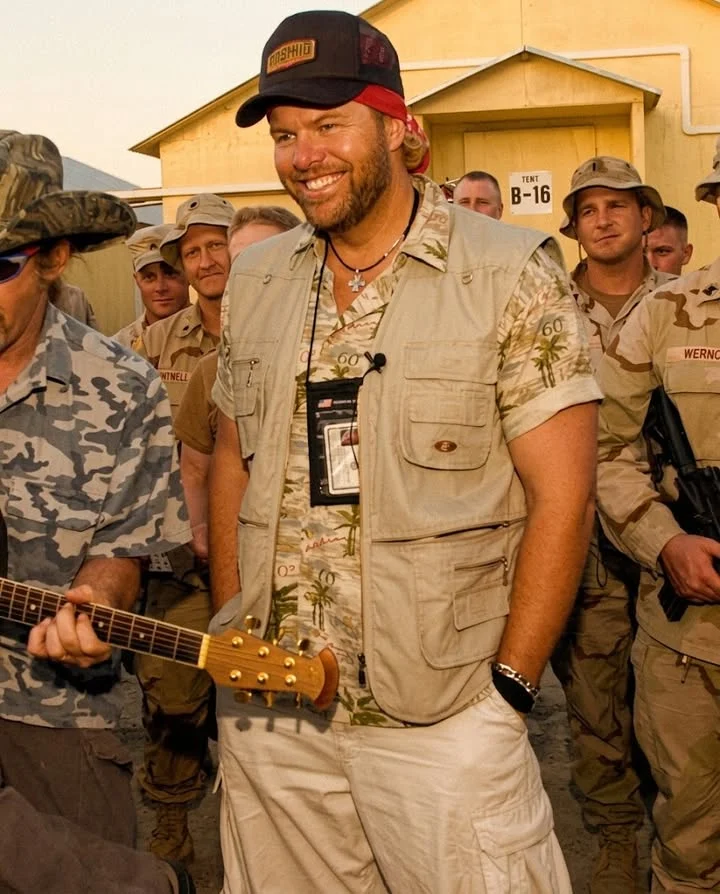
Toby Keith stood in a concrete bunker in Kandahar while warning sirens screamed around him. Mortars had fallen on the base during a 2008 performance, and the country superstar was sheltering beside the troops he had just been singing for. Most entertainers would have called for an emergency flight out. Keith instead pulled out a marker and spent the lockdown signing autographs and taking pictures with young service members. When the all-clear sounded, he walked back to a stage made from flatbed trucks and ammunition crates, picked up his guitar, and finished the show.
That moment captured why Keith gave up the biggest arenas in America every year. While many entertainers visited secured headquarters, he carved out at least two weeks of his schedule for more than a decade to travel overseas with the United Service Organizations. He did not stay in safe areas. He flew into the front lines of Iraq and Afghanistan.
He refused all compensation for his first seven years and turned down millions in stateside tours and commercial sponsorships during the absolute peak of his career. It was never a business decision. His motivation ran deeper than a public relations move. He was the son of Army veteran H.K. Covel, who lost his right eye in combat, and that upbringing gave him a quiet but profound respect for the uniform.
Over 11 USO tours Keith performed for more than 250,000 troops across 18 countries. He grew frustrated with the standard entertainment route that only reached large heavily guarded military installations. He insisted on FOB hopping, a logistical nightmare that involved moving a country music band into active combat zones.
He packed his musicians and gear aboard Blackhawk helicopters and C-130 transport planes to reach the most remote and isolated Forward Operating Bases. There were no stadium acoustics, green rooms, or rider requests waiting for him at those outposts. His stages were built from flatbed trucks and ammunition crates, set up in blinding desert dust under the harsh Middle Eastern sun.
He traded his signature stage wear for heavy body armor and field rations. The danger was never hypothetical. During the Kandahar attack, Keith and his band were rushed into the bunker alongside the troops they had just been singing for. He stripped away the superstar image and stood beside young men and women as just another American.
He proved his patriotism with dirt on his boots and a willingness to share the risk
Those harsh outposts created silent bonds that ran far deeper than any platinum record. In the middle of an active war, surrounded by exhaustion and uncertainty, his familiar baritone became a temporary flight home. He gave isolated soldiers a brief moment of peace and a reminder that someone remembered exactly where they were. He earned smiles and cheers that he later called the greatest paycheck of his life. The awards, record sales, and sold-out arenas define his career on paper. For the troops who watched him refuse to leave a bunker until every photo was taken, his true legacy was the day he brought home to them.