
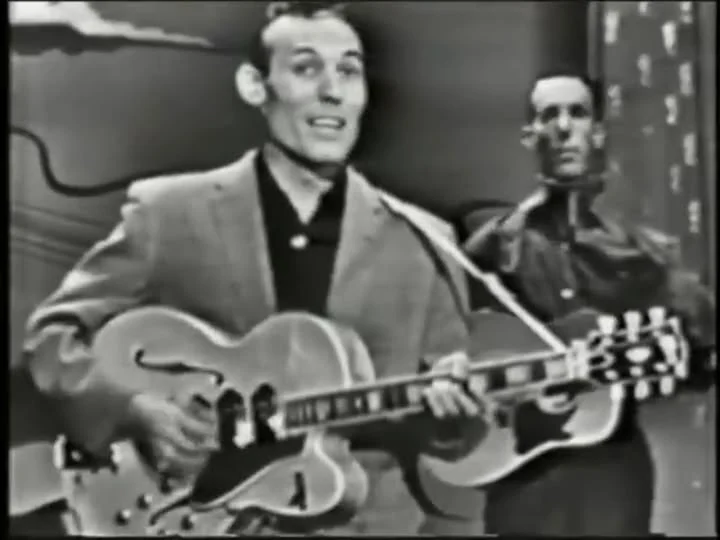
Everything changed on a dark highway in 1956. Carl Perkins was rushing toward the biggest moment of his life, a national television appearance that could have made him the face of rock and roll. Then came the crash. The tour bus flipped, bones broke, and the future suddenly belonged to someone else. The song in question was Blue Suede Shoes, and it had already become a phenomenon. But the accident changed everything. Or did it? The song refused to die.
That is the power of a true cultural detonation. Long before Elvis Presley touched it, Carl Perkins had crafted a two-minute and fifteen-second blast of dignity and danger. It was recorded in late 1955 at Sun Studio, 706 Union Avenue in Memphis, with Sam Phillips at the console. Phillips was no ordinary producer. He was a sonic prospector, panning for new gold in the humid air thick with old wood, vacuum tubes, and ambition. He had already found it in Howlin’ Wolf and a young Elvis Presley. And then he found it again in a sharecropper’s son from Tennessee.
The idea for the song came from an unlikely source. Johnny Cash, a fellow Sun artist and friend, told Perkins about an airman he met in Germany who referred to his military-issue footwear as his blue suede shoes, warning everyone to keep their distance. Perkins, who knew the sting of having almost nothing, understood the sentiment immediately. When you have next to nothing, the few fine things you own are your armor. He scribbled the lyrics on an empty potato sack in the middle of the night, a humble origin for a song that would conquer the world.
Sun Records released the single in the first days of 1956. It eventually landed on Perkins’ first album, Dance Album of Carl Perkins, but its life began as a standalone 45 RPM promise. The track’s construction feels both primitive and perfect. It begins with Perkins’ voice alone for a split second, issuing a warning. Then the band kicks in. It is not a flood of sound but a controlled fire. The instrumentation is sparse, a blueprint for rockabilly. Clayton Perkins on upright bass lays down a rhythmic pulse that is more felt than heard. W.S. Holland’s drumming is minimalist and sharp, a simple driving shuffle that pushes the beat without cluttering it.
And then there is the guitar. Carl Perkins was not just a singer but an innovator. His playing on Blue Suede Shoes is a masterclass in economy and expression. The opening riff is a modified blues lick, bent and twisted into something new, a sound that was simultaneously country and rhythm and blues. He coaxes a bright, cutting tone from his electric guitar, drenched in the famous Sun slap-back echo that gives the recording its ghostly, cavernous atmosphere. Unlike the rollicking boogie-woogie that would soon define rock and roll, there is no piano here to round out the edges. The absence is critical. It leaves a wide-open sonic space for Perkins’ guitar to slash through, making the track feel sharper, more dangerous, and more direct. This is the sound of a trio in a room, locked in and feeding off a shared, kinetic energy.
The song is a talisman, a two-minute, fifteen-second blast of dignity and danger.
The genius of the lyrics lies in their simple, escalating list of transgressions. You can knock him down, step on his face, slander his name all over the place. These are profound violations of personhood. Yet all of it is permissible, forgivable even. The one unforgivable sin? Treading on his shoes. It is a brilliant piece of misdirection, a boast wrapped in a joke that conceals a very real truth about status and self-worth. This piece of music became one of the first records in history to simultaneously climb the Pop, Country, and R&B charts, proving that the walls between genres were crumbling. For a moment, Carl Perkins was poised to become the undisputed king of this new musical kingdom.
But fate had other plans. While driving to New York to perform the song on national television, the kind of career-making appearance that had launched Elvis into the stratosphere, Perkins and his band were in a horrific car accident. While he recovered, the world kept spinning. RCA, Elvis Presley’s new label, saw the unstoppable momentum of Blue Suede Shoes and had their star record a cover. Elvis’s version is fantastic, a more muscular and polished recording with booming production and the lush backing of the Jordanaires. It is the version many people know first. But it is fundamentally a different song. Where Perkins’ original is a tense warning from a man you might not want to cross, Presley’s is a jubilant invitation to a party. The danger is gone, replaced by pure charisma. Perkins’ recording sounds like it was made in a garage. Presley’s sounds like it was made in a Hollywood studio.
Imagine a teenager today, scrolling through a vast library on a music streaming subscription. They have heard the Elvis version, maybe even the Buddy Holly or Eddie Cochran takes. Then the algorithm serves up the original. The effect is jarring. The raw immediacy of the Sun recording, the sheer unvarnished nerve of Perkins’ vocal, cuts through decades of audio polish. It is a direct transmission from the birth of the cool. The DNA of that opening riff is everywhere. It is a foundational text for so many artists who would follow, a rite of passage for anyone taking up the instrument. To this day, it remains one of the first licks aspiring rockabilly players try to master in their guitar lessons, a deceptively complex blend of fingerpicking and bluesy bends. The song’s raw power has lost none of its potency, sounding just as urgent blasting from a high-fidelity home audio system as it did from a tinny car radio in 1956.
Carl Perkins would go on to write and record other incredible songs like Matchbox and Honey Don’t, becoming a revered elder statesman of rock and roll. But Blue Suede Shoes remains his definitive statement. It is the sound of a cultural shift, a moment when the disenfranchised youth of post-war America found a voice and an attitude. It is more than a song about footwear. It is a line drawn in the sand. Go back and listen to the original. Listen for the echo in the room, the snap of the snare drum, and the defiant twang in Carl Perkins’ voice. You are not just hearing a classic hit. You are hearing the spark that started a fire.
If you want to explore that fire further, here are some essential listening recommendations from the same era and spirit. Elvis Presley – Mystery Train showcases Sam Phillips’ legendary slap-back echo and a haunting, propulsive rhythm. Eddie Cochran – Summertime Blues takes a similar approach to teenage frustration and identity, wrapped in a classic rockabilly structure with an unforgettable guitar riff. Gene Vincent – Be-Bop-A-Lula captures the same blend of raw energy and simmering, slightly dangerous swagger as Perkins’ original. Johnny Burnette and the Rock ’n Roll Trio – Train Kept A-Rollin’ is the snarling, amplified evolution of that distorted guitar tone. And Wanda Jackson – Let’s Have A Party delivers the same unbridled energy with a powerful female vocal performance that matches the men of Sun. Finally, Johnny Cash – Get Rhythm shares the same chugging, minimalist rhythm section and working-class lyrical perspective from a fellow Sun artist.