
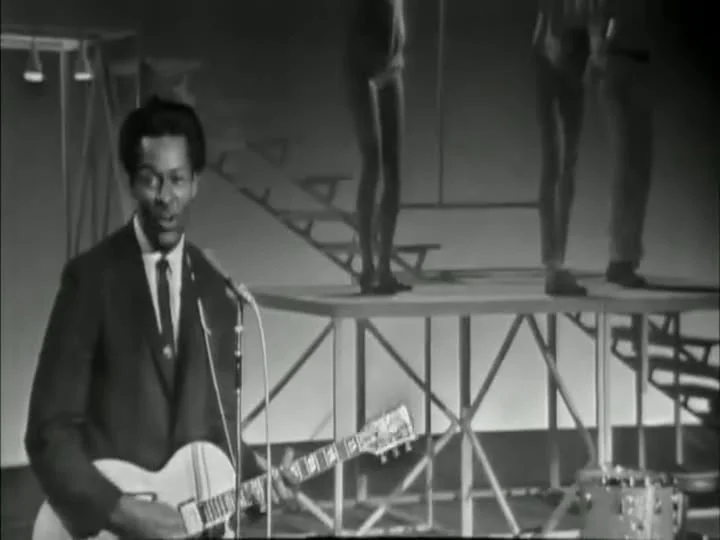
There is a song that escaped Earth and now drifts through the cosmos, carrying the sound of a guitar riff that changed everything. Long before it traveled beyond the stars, Chuck Berry introduced “Johnny B. Goode” to the world in 1958. That opening burst of guitar still lands like a lightning bolt, daring every listener to dream a little bigger. This was not just a hit record. It was a promise that talent could come from anywhere and echo everywhere.
The story inside the song begins deep in the Louisiana woods, not far from New Orleans. A boy named Johnny lives in a log cabin made of earth and wood. He cannot read or write, yet his hands find magic on a guitar. The lyrics paint a picture of a self-taught musician whose gift cannot be denied. Friends and neighbors see it too, and the chorus urges him forward with the chant “Go, Johnny, go!”
“Deep down in Louisiana, close to New Orleans,
Way back up in the woods among the evergreens,
There stood a log cabin made of earth and wood,
Where lived a country boy named Johnny B. Goode.”
That young man’s journey mirrors the American Dream at its purest. Johnny rises from obscurity through sheer passion and persistence, a message that struck a deep chord in the 1950s and has never stopped resonating. For teenagers of that era, the song was more than a dance floor favorite. It was a personal anthem of hope, ambition, and the belief that anyone could make their mark on the world.
Berry himself understood that dream from the inside. Raised in a working-class family in St. Louis, Missouri, he had been building his sound for years. Tracks like “Maybellene” and “Roll Over Beethoven” had already shown his genius for blending rhythm and blues with country and western. But “Johnny B. Goode” was something different. It carried a piece of its creator, a semi-autobiographical nod to his own rise. At the same time, the character of Johnny belonged to everyone. He was every young person with a gift and a hunger to be seen.
Musically, the record shattered expectations. The electric guitar had appeared in popular music before, but Berry turned it into a lead voice full of attitude and fire. That famous opening riff, fast and shimmering, became a challenge to every guitarist who followed. The song ran on a classic 12-bar blues structure, yet it felt entirely fresh and explosive. It showed that rock and roll could be both wildly fun and deeply skilled. George Harrison and Keith Richards have both pointed to that sound as a reason they picked up the instrument in the first place. The fingerprints of this track can be heard across decades of rock music.
Its cultural reach only grew with time. Countless artists, from Jimi Hendrix to The Grateful Dead to Judas Priest, have taken their turn with the song, each bringing something new while keeping its wild heart intact. A whole new generation met Johnny in 1985 when Michael J. Fox performed the track during the iconic dance scene in Back to the Future. That moment introduced the classic to teenagers who had never spun a 45 rpm record. Then in 1977, NASA placed the song on the Golden Record aboard the Voyager spacecraft, choosing it as a snapshot of life on Earth. It became one of the only rock and roll songs to represent humanity in deep space, a profound honor for any piece of music.
More than sixty years after its release, “Johnny B. Goode” remains a living piece of rock and roll history. It still carries that joyful energy, that sense that the next great guitar hero might be practicing in a garage right now. Chuck Berry gave the world a song about the transformative power of music, and that gift has never dimmed. Whether you first heard it on an old record, at a school dance in the eighties, or through a sci-fi movie marathon, the effect is the same. It makes you believe that somewhere, a kid with a guitar is about to change the world again.