
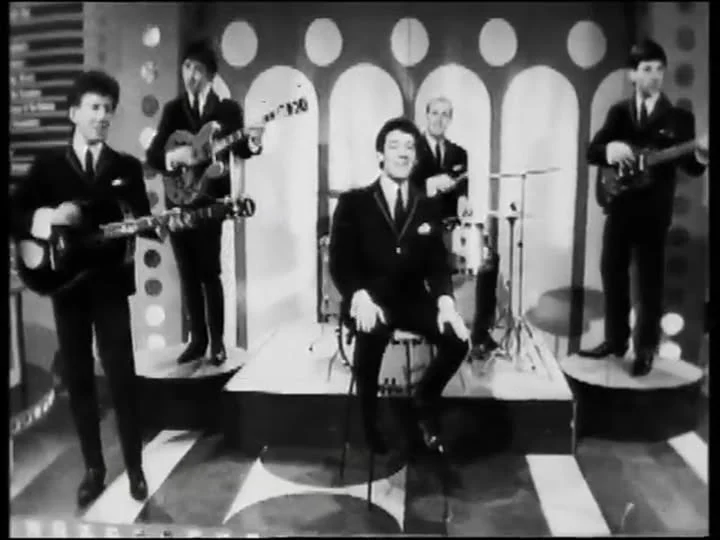
Just One Look begins not with a slow fade in but with a brisk, confident guitar stroke. It is a sound that announces itself like a handshake. Within seconds, the three voices of Allan Clarke, Graham Nash, and Tony Hicks rise together, blending into a single radiant chord. That moment, a perfect triadic stack, captures a feeling that has remained fresh for over sixty years.
This is the opening of a song that, in two and a half minutes, tells an entire story of love at first sight. The Hollies did not write it. The R&B singer Doris Troy and Gregory Carroll had already given it life in 1963. But the Mancunian group reshaped it, stripping away the raw edge and replacing it with gleaming harmonies and jangling guitars. Their version, released in February 1964, climbed to No. 2 on the British charts and became a defining sound of the British beat boom.
It is the pop equivalent of a perfect haiku.
The journey of this track across the Atlantic reveals how differently the music industry worked on either side. In the United Kingdom, the single was paired with the B-side Keep Off That Friend of Mine and later gathered onto an EP. In North America, Imperial Records folded it into the debut album Here I Go Again, a retitled and re‑sequenced version of the British LP Stay with the Hollies. That American release, issued in June 1964, added Just One Look to capitalize on the song’s Stateside momentum. Yet the single initially barely touched the Hot 100, landing at No. 98. A 1967 reissue pushed it to No. 44. It was a reminder that even the British Invasion needed time to conquer every shore.
Behind the scenes, the producer Ron Richards shaped the sound. Working at EMI Studios in London, he focused the band’s assets without over‑ornamenting the frame. The arrangement is a study in restraint. The lead vocal sits forward in the mono image, dry but with a faint halo of chamber reverb on sustained notes. The three‑part backing vocals enter like a curtain rising on the chorus, tight enough to feel like a single instrument yet allowing each singer’s grain to be heard. Tony Hicks played his guitar with clarity, not distortion. Eric Haydock anchored the bass with smooth steps, and Bobby Elliott drove the backbeat with crisp snare accents and splashes of ride cymbal. Tambourine and handclaps added lift without clutter.
What is missing is equally important. No heavy reverb. No double‑tracked lead guitars. No baroque keyboard layers. The song radiates a confidence that comes from knowing exactly what to leave out. Every second earns its place. At about two minutes and thirty‑one seconds, it says its piece, tips its hat, and leaves the stage.
The B‑side, Keep Off That Friend of Mine, hinted at the band’s growing songwriting muscle. Credited to Bobby Elliott and Tony Hicks, it proved that while the group initially broke through with covers, original material was already bubbling. That track later appeared on the American album, evidence that the US market wanted to package A‑sides and B‑sides together as a coherent experience.
The vocal chemistry of Clarke, Nash, and Hicks has been discussed for decades, and with reason. Clarke carried the dramatic line. Nash added sheen without strain. Hicks rounded the middle so the stack never turned brittle. This human EQ curve is why the hook lands with such sweetness. It is not unlike a small horn section voicing chords with precision while retaining the breath and grain of rock singers.
The song’s durability extends beyond its original moment. Linda Ronstadt revived it in 1979, turning it into a radio staple that climbed the charts again. The through‑line from Troy’s soul template to the Hollies’ beat‑pop to Ronstadt’s AOR sparkle speaks to the song’s modular architecture: you can swap the rhythm texture and vocal color, and the hook keeps shining. This elasticity has made it attractive for soundtracks and commercials, keeping it visible to new generations without dulling its mystique.
For listeners who value economy and unison of purpose, there is much to savor. The lyric’s directness echoes the best country storytelling, while the voice‑leading in the harmonies rewards an ear that delights in a well‑voiced Bach chorale. The Hollies never sound academic, yet the way they distribute chord tones across parts is textbook smart. You can practically see the triads moving.
If this track pulls you into the golden age of British harmony, consider exploring Here I Go Again (the other early‑64 calling card), Look Through Any Window (with its more sophisticated guitar figures), or kindred songs by The Searchers, The Zombies, and The Beatles. And if you want to hear how the same composition can be reframed, Linda Ronstadt’s 1979 version is a glossy companion piece.
In the end, Just One Look endures because it understands the physics of pop. A winning melody. A hook that declares itself. A vocal blend that feels like community. And a band arrangement that is both muscular and tidy. In a world that can overcomplicate both production and emotion, this song remains a reminder that the direct path is often the most memorable. Start here. Then let that harmony stack lead you forward through the catalog.