
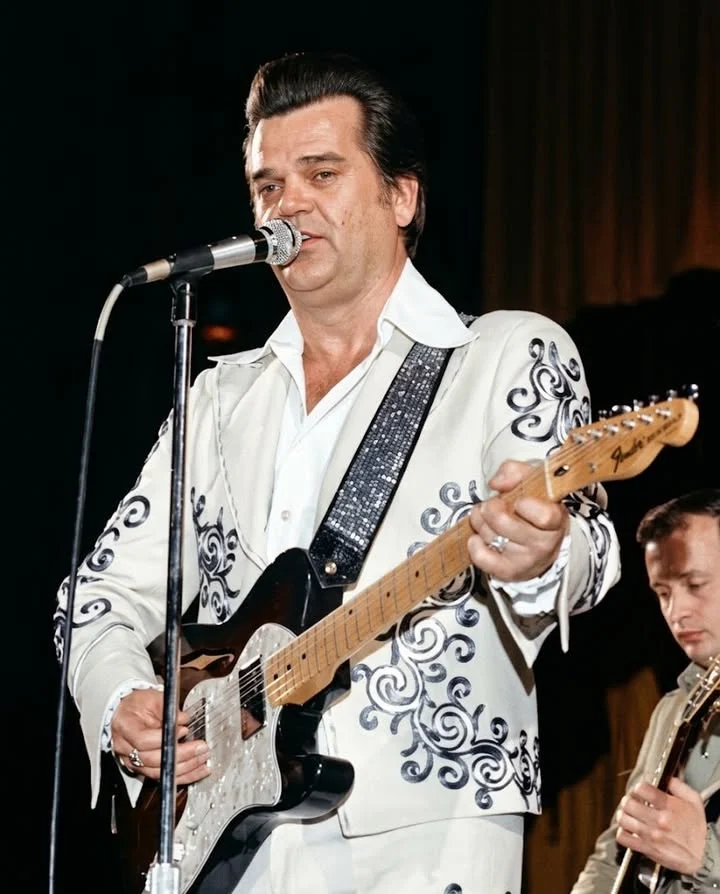
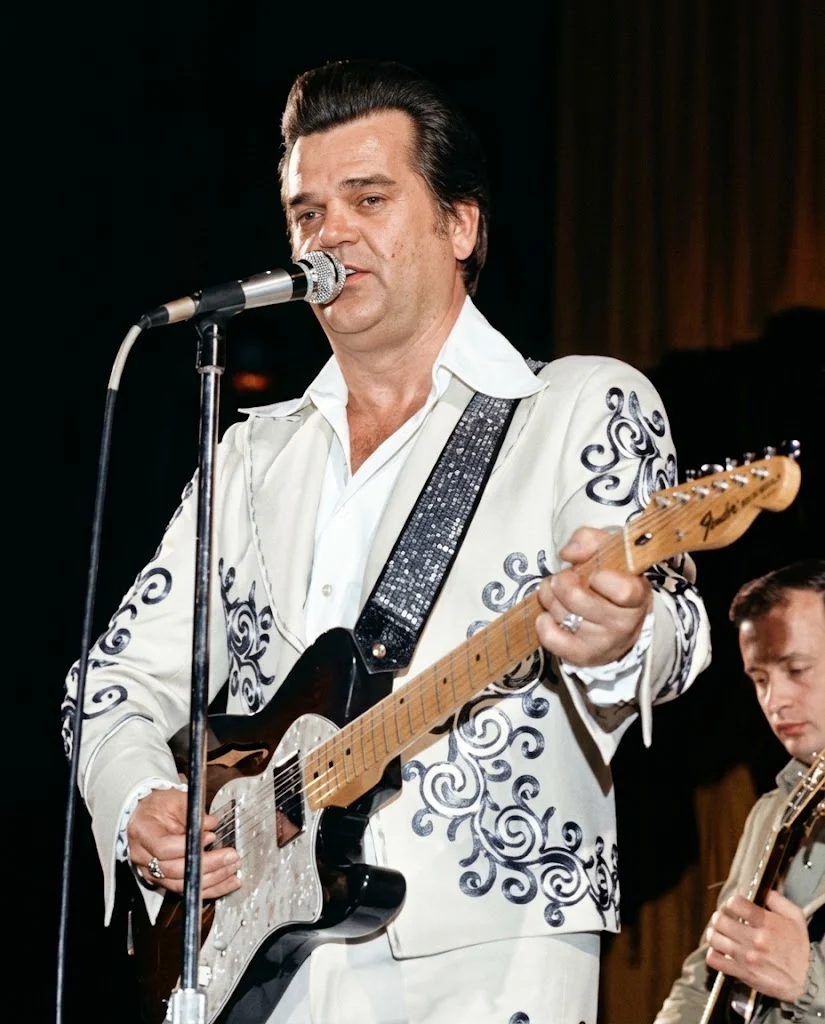
Imagine hearing a voice so familiar that millions swear the King of Rock and Roll is hiding behind a fake name.
That was the electric mystery around Conway Twitty in the summer of 1958.
His new song “It’s Only Make Believe” had just landed on the airwaves through MGM Records, and the single steadily climbed the pop charts.
The deep brooding vocal style sent fans and radio disc jockeys into a feverish guess.
Elvis Presley had just been drafted into the United States Army, and his absence left a huge hole in pop music.
Listeners convinced themselves that Presley was secretly recording under another name while wearing a uniform.
The truth was far more personal.
The singer was Harold Jenkins, a young man from the Mississippi Delta who had changed his name to Conway Twitty.
He had written the song while sitting on a fire escape outside a hotel in Hamilton Ontario, hungry for a breakthrough.
The rockabilly rhythm and heavy delivery matched Presley so closely that the rumor became national.
When Twitty performed the song live, crowds erupted, and many half expected him to peel off a rubber mask on stage.
For a struggling artist, that mistaken identity was a roaring compliment.
He had the power to ride the rock and roll wave and hold a global audience.
Yet his heart pulled him elsewhere.
He refused to live in another man’s shadow
At the peak of his pop success, Twitty chose Nashville over the charts.
He left guaranteed money behind and started again in a town that did not want him.
In the mid-1960s, Music Row protected its boundaries fiercely.
Country radio disc jockeys treated a former teen pop idol as a threat.
Some gatekeepers threw his new promotional records away without even listening.
Years of door-knocking, the backing of producer Owen Bradley, and a contract with Decca Records finally broke through.
His first country number one came in 1968 with “Next in Line”.
That hit was more than a song.
It was validation for a massive gamble.
Over the next two decades, Twitty built a catalog of fifty-five number-one hits.
His signature “Hello Darlin’” became a permanent fixture in American culture.
The song tells of a man meeting an old flame and hiding enduring heartbreak beneath a proud casual greeting.
Listeners can find the full licensed lyrics by searching for the song on Google.
He could have coasted on the echo of Presley’s style and filled rock arenas for decades.
Instead he chose the harder road and rebuilt his identity.
Leaving that guaranteed money behind to start completely over was the exact moment Conway Twitty became himself