
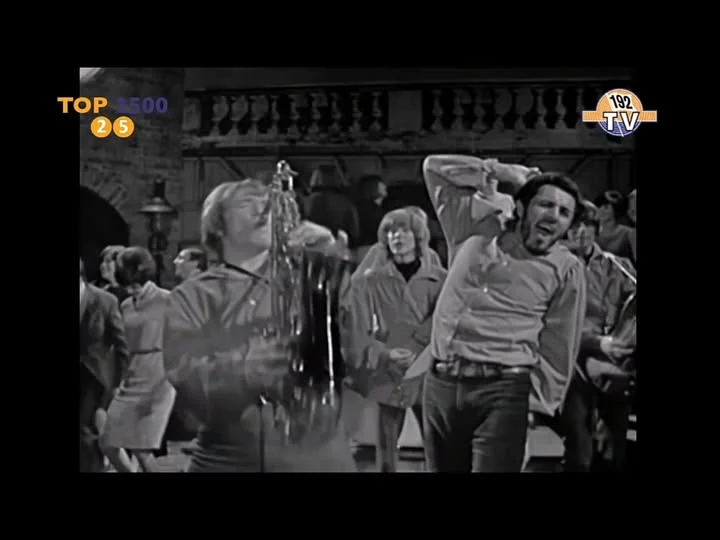
It starts with a bilingual countdown that cuts through the night like a knife, a guttural shout that could wake the dead from the deepest sleep. “Uno, dos… one, two, tres, cuatro!” The static of a late-night AM radio suddenly sharpens into something raw, urgent, and gloriously reckless. This isn’t the polished pop of 1965; it’s a garage door slamming open, a burst of unfiltered energy that refuses to be tamed. The sound is a stranger wearing a turban and driving a hearse straight into the heart of the mainstream. That stranger was Sam the Sham & The Pharaohs, and the song was “Wooly Bully.”
The track, born from the fertile musical soil of Memphis and filtered through the Tex-Mex sensibilities of its frontman Domingo “Sam” Samudio, became an unlikely cultural juggernaut. Initially released as a single in late 1964 and then reissued by MGM in 1965, it anchored their debut album of the same name and tore through the charts with a ferocity that even the British Invasion couldn’t match. Billboard ultimately crowned it the Number One song of 1965, a distinction that speaks volumes about its staying power and commercial dominance. It wasn’t just a hit; it was a statement—a loud, proud, defiantly American counterpunch.
Dig into the musical anatomy, and you’ll find a masterpiece of minimalism. Producer Stan Kesler, a veteran of the Sun Records orbit, captured the band at Sam C. Phillips Recording Studio with a sound that’s gloriously unvarnished. There’s no studio sheen here, only the crackling urgency of a band locked in the moment. Jerry Patterson’s drumming is a relentless, simple backbeat, while David A. Martin’s bass guitar pulses with a driving, repetitive line that never lets up. The track is built on a 12-bar blues progression, but it’s treated with a wild abandon that transforms it from a formal structure into a skeleton for a party.
The true star, however, is Samudio’s Farfisa organ. That thin, buzzing, trebly riff is the song’s signature, cutting through the mix like a serrated blade. It’s the sound of budget and brilliance colliding—a cheap electronic instrument elevated to anthemic status. The way it fights against the rhythm creates a tension that’s both exhilarating and infectious. Ray Stinnett’s guitar work is economical, mostly providing rhythm chugs and color, but it steps forward for the simplest, most effective riffs. Butch Gibson delivers a frantic, honking saxophone solo that matches the overall air of barely-controlled mayhem. The whole arrangement clocks in at a lean two minutes and twenty seconds—long enough to make you move, short enough to leave you wanting more. It’s a masterclass in ‘less is more.’
Lyrically, “Wooly Bully” is a glorious puzzle. The tale of Matty and Hatty and a mysterious creature called the “Wooly Bully” is delivered with such slurred, shouted intensity that the words become almost incidental. This ambiguity led to bans by some radio programmers who suspected the unintelligible lines were risqué. But that mystery only fueled its appeal. On a tinny AM radio, the song became a Rorschach test for youthful rebellion. The interjections—“Watch it now, watch it now, here he come!”—give it a primal call-and-response energy, rooted in rhythm and blues but uniquely laced with the borderland’s conjunto rhythms. Samudio was fusing rock and roll with his own Tejano heritage, creating something entirely fresh.
“The greatest hits often aren’t perfect recordings, they are simply perfect moments captured on tape.”
That moment in ’65 was a watershed. The polished teen idols of the early sixties were giving way to raw, self-contained bands. “Wooly Bully” proved you didn’t need a symphony or a huge budget to dominate the airwaves—just an undeniable three-chord hook. For a generation of musicians who later studied guitar lessons, the real lesson from this track was how to maximize impact with the fewest possible notes. It became a template for garage rock, a sound that prized energy and attitude over technical precision.
Today, the song remains a living document of an era’s spirit. Its swaggering refusal to be tidy is its enduring charm. It’s joyous, reckless, and deeply authentic—the sound of a band reveling in the sheer kinetic pleasure of making noise. It peaked at number two on the Billboard Hot 100, kept out of the top spot by The Beach Boys and The Supremes, but its year-end ranking as the biggest song of 1965 tells the real story. This wasn’t a flash in the pan; it was the soundtrack to an entire summer, a constant, driving pulse that never dipped.
Revisiting “Wooly Bully” is to be transported back to a time when the margins ruled, when artists who looked and sounded like nobody else could simply drive straight into the collective consciousness. It’s a reminder that the best music often comes from the edges, unfiltered and unapologetic. So the next time you hear that countdown, don’t just nod along—stand up, shout the gibberish, and let yourself be carried by the raw, unforgettable pop art that is “Wooly Bully.”
Listening Recommendations
If you’re craving more of that gritty, organ-driven garage sound, dive into these classics:
“96 Tears” – ? and the Mysterians (1966) – That Farfisa organ is the hook, pure and simple.
“Hang On Sloopy” – The McCoys (1965) – A mid-sixties anthem with an infectious melody and unpolished vocals.
“I Fought the Law” – The Bobby Fuller Four (1966) – Raw production and a three-chord structure rooted in Sam Phillips’ Memphis lineage.
“Do Wah Diddy Diddy” – Manfred Mann (1964) – High-energy simplicity with those call-and-response vocals.
“Louie Louie” – The Kingsmen (1963) – The ultimate predecessor, sharing the deliberate ambiguities and cheap production that defined the genre.