
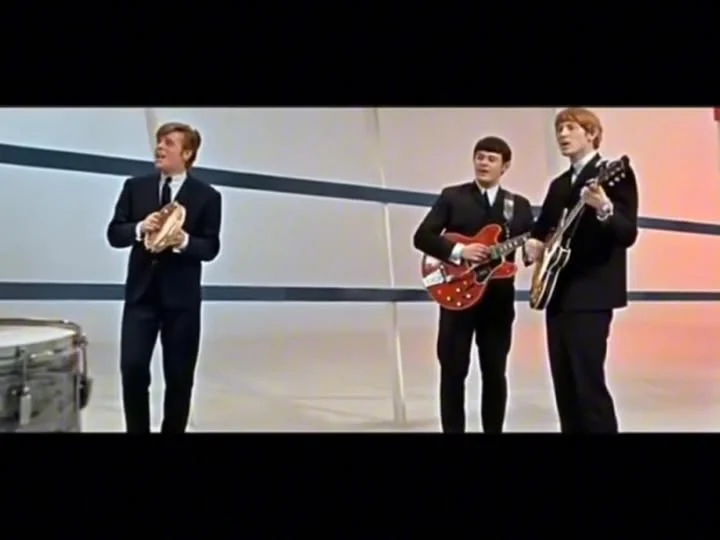
In the sprawling story of the British Invasion, one quiet masterpiece often slips through the cracks. It arrives not from the cauldron of Liverpool or the polished studios of London, but from Birmingham in late 1964. The Rockin’ Berries, a band whose name conjured images of Chuck Berry’s raw energy, instead delivered something unexpected and breathtaking: a symphonic wall of vocal anguish wrapped in pristine pop craftsmanship. That singular moment, captured forever, is the single “He’s In Town.”
I remember the first time I truly heard it, years ago, when I began to understand that the era’s greatest treasures often came from groups who never achieved household names. This wasn’t merely a record; it was a time capsule, frozen in that fleeting period when the album played second fiddle to the 45 RPM single, and one carefully chosen cover could define an entire career. For the Berries, this song became their defining moment, soaring to number three on the UK charts and proving that the beat boom had room for both melodrama and technical mastery.
By 1964, The Rockin’ Berries had been grinding through the circuit for years. They followed the familiar script of the era: residencies in Germany, a couple of forgotten singles for Decca, and a strategic move to Pye Records’ Piccadilly imprint. Their first chart entry, “I Didn’t Mean To Hurt You,” barely dented the lower reaches. But then came a suggestion from American producer Kim Fowley, who reportedly urged them to tackle “He’s In Town.”
The song itself was born from the legendary Brill Building partnership of Carole King and Gerry Goffin. It had been a minor US hit earlier that year for The Tokens, carrying the unmistakable DNA of New York pop: structurally tight, melodically rich, and focused on the intimate devastation of adolescent heartbreak. Under the direction of producer-manager John Schroeder, the Berries took that sturdy skeleton and dressed it in a distinctly British, high-harmony sheen. This was a calculated departure from the R&B template that had fueled the invasion. It highlighted the group’s true strength: the dual vocal prowess of Clive Lea and, most crucially, Geoff Turton. Turton’s soaring, anguished falsetto became the song’s emotional epicenter, a high-wire act that cuts through the arrangement with devastating clarity.
“The vocal falsetto of ‘He’s In Town’ is not an embellishment. It is a scream of elegant, contained despair, perfectly polished for the dance floor.”
The Berries’ rendition stands as a masterclass in soft-beat arrangement. It rejects the garage-rock ethos entirely, prioritizing polish and vocal clarity above all else. From the opening notes, the recording possesses a pristine quality—the kind of tightly controlled studio environment that feels surprisingly modern, especially when experienced through a good pair of studio headphones. The rhythm section is clean and driving, yet deliberately restrained. The drums offer a steady, reverb-soaked backbeat that never overwhelms the lead vocals. The piano, likely played by an uncredited session musician, underpins the harmony with round, percussive warmth, particularly in the brief, bright chords that punctuate the refrain.
The most electrifying instrumental element is the guitar, often credited to Bryan “Chuck” Botfield. It is not a frantic solo or a barrage of power chords, but a beautifully restrained, almost tremolo-laden counter-melody that weaves around the voices. The tone is clear, bright, and slightly metallic, creating necessary tension against the soft, mournful vocals. This is not a guitar designed for stadium destruction; it is engineered to elevate a romantic lament. The true focus, however, remains the vocal arrangement. The dynamics tell the story with surgical precision. The initial verses are intimate, delivered by the lower voice of Clive Lea, sounding slightly resigned and heartbroken. Then the tension ratchets up for the chorus, where Turton’s falsetto enters, transforming private sorrow into grand, public tragedy. The stacked backing vocals swell in perfect unison, executing the close-harmony arrangements that became the Berries’ signature—an obvious nod to American groups like The Four Seasons and The Beach Boys, filtered through an unmistakably English pop sensibility.
The lyrics are simple, almost brutally direct. The narrator speaks to a girl, telling her he knows she is leaving him because his rival—”He”—is back in town. The song’s power lies in the passive resignation of the narrator: “You don’t have to tell me. He’s in town. He’s back in town.” There is no fight, no anger, only the quiet, awful realization of being the temporary replacement. This resignation, delivered through such potent emotion, is what gave the piece of music its staying power. It connects deeply with that moment of first, overwhelming rejection—the time we all realize, with chilling clarity, that we were never the main character in someone else’s story. It is a moment of total vulnerability, immortalized in a three-minute pop song.
It is worth considering this song’s legacy. Groups like the Berries, who embraced harmony pop and cabaret appeal, were often denied the “credibility” afforded to the more rock-focused bands of the day. Yet their ability to take a strong sheet music composition from the Brill Building and execute it with such technical precision is a testament to their musicianship. It is a reminder that pop music, at its highest level, is an art of supreme craft. For those beginning their exploration of the 1960s beat sound, this is an essential primer. It sits on the cusp—too melodic for purist rock bands, too vibrant and immediate for the later cabaret circuit they would pursue. It remains their defining statement, a perfect encapsulation of mid-sixties pop sophistication, proving that a smooth, sorrowful sound could stand shoulder-to-shoulder with the loudest R&B hits of the day.