
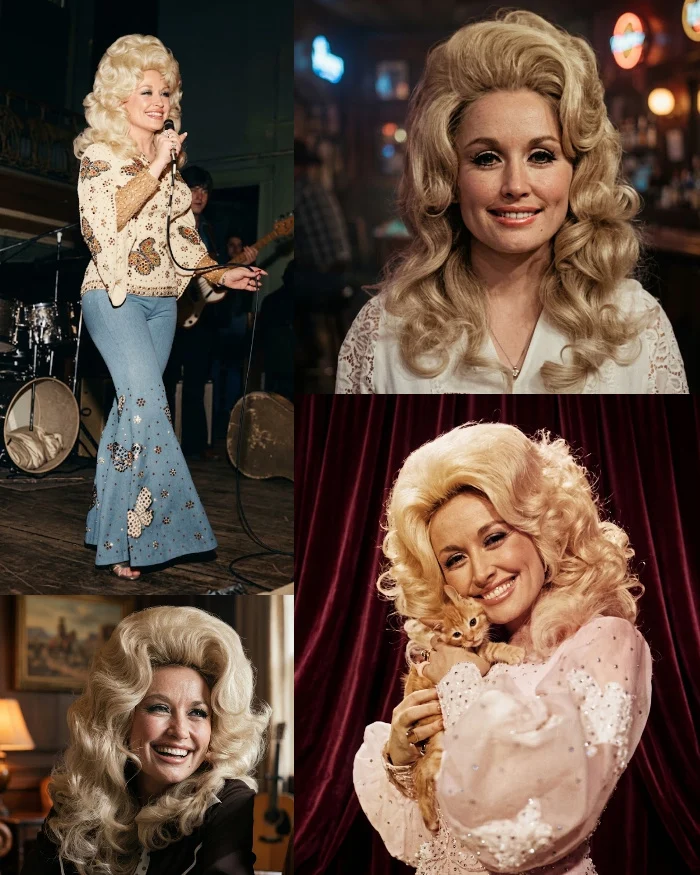
A dry cleaning receipt became one of the most important scraps of paper in Dolly Parton’s life. On a tour bus in 1971, a sudden wave of homesickness pushed her to write “Coat of Many Colors” in the margins of that receipt. The song carried the memory of a Tennessee cabin with no electricity, a mother’s love stitched into scraps, and a girl who learned dignity before she learned fame.
Long before the world knew her as a country music icon, Dolly Parton lived inside the hard boundaries of Locust Ridge, Tennessee. She shared a rustic one-room wooden cabin with eleven siblings. Running water and electricity were absent. Still, the cramped home overflowed with faith, storytelling, and music.
Her artistry did not begin beneath dazzling stage lights. It began when Uncle Bill Owens placed a first guitar in her hands. He did not merely offer kind words. He drove his young niece down the mountain to Knoxville radio and television stages, including The Cas Walker Show. He stood by the stage and helped a rural girl believe her voice could travel beyond the foothills.
That belief became her compass. In the spring of 1964, the morning after she received her high school diploma, the 18-year-old packed her few belongings into a cardboard suitcase. She boarded a bus for Nashville with no record deal, no safety net, and no family beside her. She carried only raw melodies and a relentless drive.
Her first days in Music City were terrifying. She lived in cheap boarding houses. She sometimes survived on leftover room service trays left in hotel hallways. She walked up and down Music Row with Uncle Bill Owens, pitching handwritten songs to publishing companies.
Even amid that fear, a quiet miracle happened. On her first afternoon in town, while washing clothes at a local Wishy Washy laundromat, a young man named Carl Dean stopped to talk to her. That brief meeting became a marriage lasting more than half a century. It gave her a steady anchor while the industry tested her spirit.
By 1967, her clear mountain voice reached country television host Porter Wagoner. He brought her onto his nationally syndicated show and introduced her to millions of viewers. The girl who grew up without a television was now performing on screens across America.
As her career rose, her most powerful memory remained the patchwork coat her mother sewed from scraps of corduroy. Her mother stitched every seam while telling the biblical story of Joseph. Classmates mocked the homemade garment. Dolly wore it with pride. The coat became proof that poverty could not steal human dignity.
“The coat of many colors was not a symbol of shame. It was a symbol of love.”
Years later, nostalgia struck on a tour bus. With no notebook nearby, she grabbed a dry cleaning receipt for one of Porter Wagoner’s elaborate stage suits and wrote the lyrics to “Coat of Many Colors.” In April 1971, she recorded the song in RCA’s historic Studio B in Nashville. Surrounded by seasoned session musicians, she stripped the arrangement down to raw acoustic emotion.
The song reached number four on the country charts. Its cultural impact went far beyond chart position. She turned a literal coat of rags into a permanent piece of American music history. Today, the original dry cleaning receipt and a replica of the coat rest behind glass in her museum, far from the cold winds of Locust Ridge.
Dolly Parton left for Nashville to chase a future. The voice that captured the world was built from the pieces of her past.