

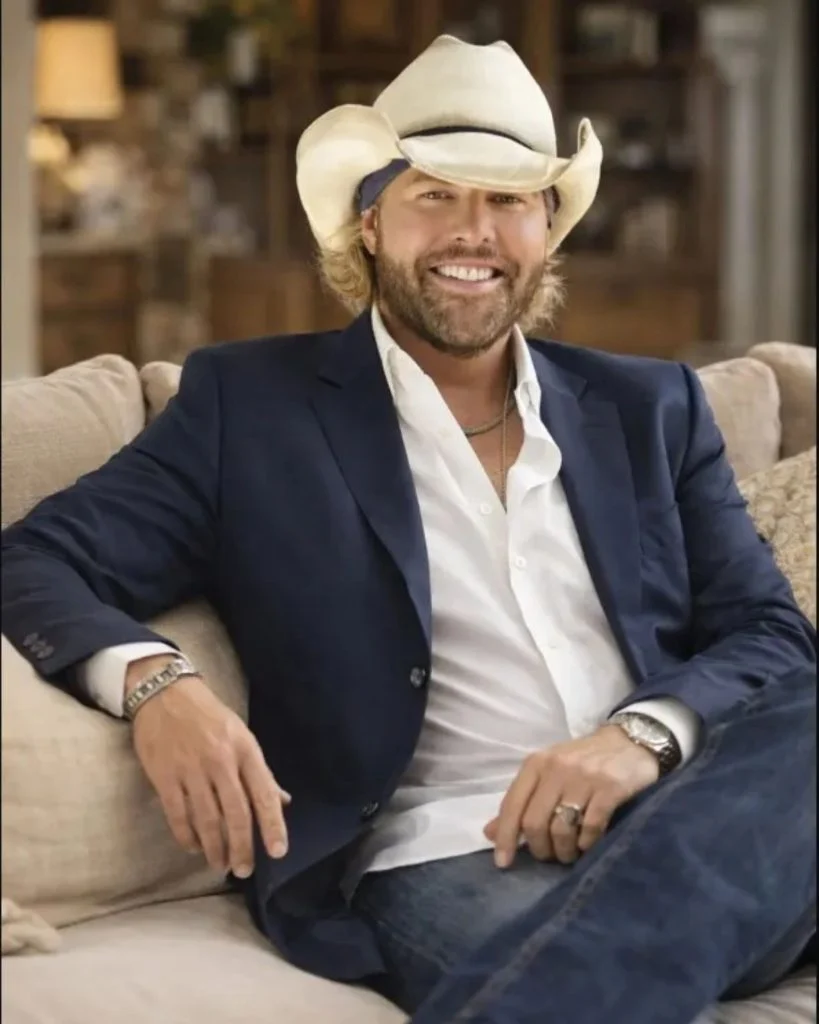
The room was quiet, but Toby Keith did not ask it to stay that way.
Near the end, after years of battling stomach cancer, he offered the people closest to him a request that felt less like a farewell and more like a hand on the shoulder.
Don’t cry for me — just sing.
Six words. No long speech. No attempt to make the moment larger than it was. For the people in that room, the hardest part was not the silence. It was the calm.
Those closest to him say the steadiness had been there long before the diagnosis. He joked when others grew too serious. He softened rooms before they could collapse into grief. Even as his body weakened, he kept looking for a way to make things easier for everyone else.
That was Toby Keith.
For more than three decades, he built a career on songs that felt direct, unpolished and honest. His anthems played in trucks, bars, stadiums and backyard speakers, but they also became tied to people’s own memories. His voice showed up during deployments overseas, long drives home, weddings, heartbreaks and late nights that lasted longer than they should have.
That kind of connection does not disappear quietly.
He sold millions of records and became one of country music’s biggest names, yet he never seemed interested in sounding delicate or carefully managed. Fans trusted him because he rarely hid behind performance. Whether people agreed with him or not, they believed the man singing the song was the same man backstage after the lights went dark.
That consistency stayed with him at the end.
There were no dramatic final declarations about legacy. No attempt to summarize a lifetime. The people closest to him remember smaller things instead. A tired half-smile. A brief joke. A look that seemed more concerned with comforting others than himself.
Just Toby. Quietly trying to make the room easier to carry.
What makes those final words linger now is how little they asked from anyone. He did not ask people to stop hurting. He did not pretend loss would feel beautiful. He simply refused to let grief become the loudest thing left behind.
So the music kept moving.
After his passing, those words traveled far beyond the room where they were first spoken. Fans repeated them online. Musicians quoted them before tribute performances. Old songs suddenly felt heavier, not because they changed, but because listeners understood them differently now.
Especially the quieter ones. The songs about loyalty. About hometown pride. About standing tall when life turned difficult.
People went back and listened again. And somewhere inside those lyrics, they could still hear the same man who chose one more chorus over one more goodbye.
Maybe that was Toby Keith’s final gift. He reminded people that music does not end when the singer disappears.
It keeps showing up in ordinary places. On old jukeboxes glowing in corner bars. On radios during empty highway drives. In crowds singing every word a little too loudly.
The voice fades eventually. Every voice does. But the song keeps finding new people willing to carry it forward.
And perhaps that is why those six words still echo long after the room went quiet. They were never really about death. They were about continuation.