
The marriage did not end under flashing cameras. It ended in a quiet November morning argument that put two families on a collision course and forced a father to choose the home he had fought for over the spotlight he had mastered.
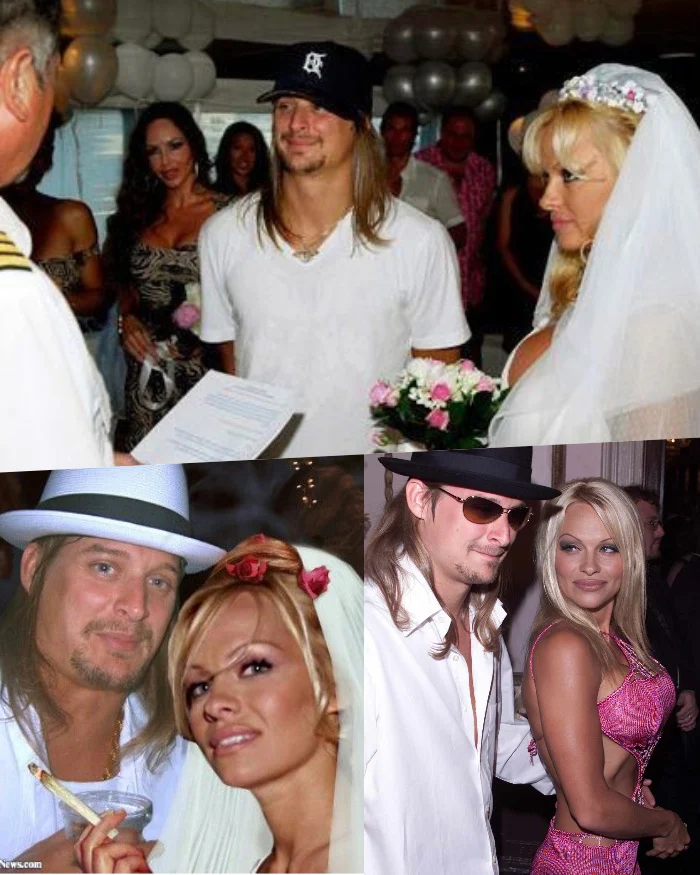
In the summer of 2006, Bob Ritchie, the Detroit rocker known worldwide as Kid Rock, and Pamela Anderson turned their romance into a multi-continental media event. They began with a lavish party on a yacht in St. Tropez, where Anderson wore a white bikini and Ritchie stood shirtless in his signature fedora. They added a legal ceremony at a Beverly Hills courthouse. Then they took over a Nashville stage and declared their commitment before thousands of fans.
The images traveled farther than the vows ever could. Magazine covers celebrated the French Riviera spectacle, and the three ceremonies looked like a fairy tale built for cameras. Yet the public performance could not solve the private mismatch between two lives moving in opposite directions.
Long before the stadium tours and diamond-certified records, Ritchie was a struggling musician who fought a grueling family court battle in the 1990s. He won full legal custody of his infant son, Robert Jr. He raised the boy alone in a cramped Michigan basement while taking odd manual labor jobs and sweeping floors to pay for diapers and winter heating bills.
That struggle made the peace inside his house nonnegotiable. Ritchie had built a fiercely loyal foundation for his son, and he soon saw that the Hollywood lifestyle he had briefly married into was fundamentally incompatible with that reality. Three separate ceremonies across the globe became an attempt to hold together a relationship already fracturing under the weight of those differences.
The final break came in November 2006. According to Ritchie’s later account of the divorce, the breaking point arrived when Anderson made insulting remarks about the two most important women in his life, his mother and his sister. For a man whose world revolved around protecting his blood relatives and honoring his roots, that crossing of family lines was an absolute violation.
He did not walk away from fame. He walked toward the safe, grounded life he had spent years building for his son.
When the rising tension threatened that quiet reality, Ritchie made an immediate choice. His protective instinct outweighed any attachment to the celebrity spotlight. To shield his son from a drawn-out media spectacle, he seized control of the legal process. On the morning the divorce began, his petition was filed at the Los Angeles courthouse fifty-three minutes before Anderson’s representatives could file theirs. He demanded a clean and swift exit on his own terms.
The loud, untouchable persona he showed on stage often hid his reality as a devoted father. Every aggressive guitar riff of his early career had been fueled by the primal urge to provide for his family, and that same instinct drove him to dismantle his high-profile marriage once it became toxic. He refused to let the chaos of the entertainment industry bleed into the quiet life he had built behind closed doors.
The St. Tropez yacht photographs will remain a defining symbol of mid-2000s celebrity illusion. But the rapid divorce papers that followed told a more enduring story. A man looked at the absolute peak of Hollywood fame, recognized a threat to his household, and chose to go home.