
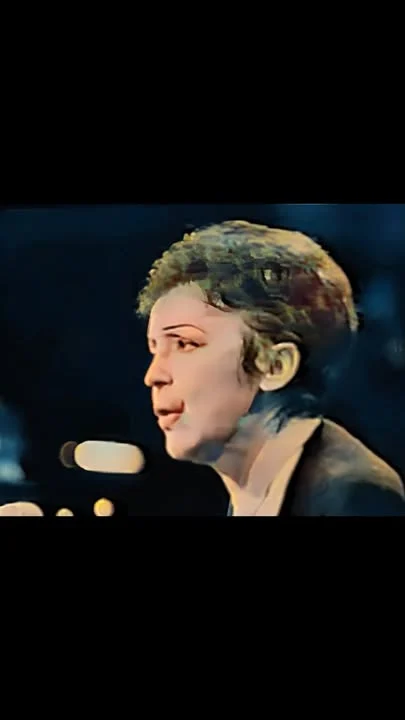
She threw her head back, the single spotlight catching the silver in her hair, and tore the final syllable from somewhere deep and broken inside her. “Avec toi!” The note hung in the air, a raw, impossibly high cry that seemed to push against the walls of the recording studio and echo into history. It was the sound of a woman who had stared into the abyss and decided to step forward anyway. This was Édith Piaf, at the end of her tether, transforming a lifetime of wounds into a battle cry that would outlive her.
In the autumn of 1960, the woman known as La Môme Piaf was a shadow of the legend she had once been. Her body, ravaged by years of addiction and a grueling suicide tour, had betrayed her. She had collapsed on stage more than once, and the press had already written her obituary. Her finances were a wreck, her reputation for being difficult was legendary, and the future looked nothing short of bleak. It was precisely here, in this moment of crushing vulnerability, that composer Charles Dumont and lyricist Michel Vaucaire arrived at her Parisian apartment for what they were told would be a final, futile audition.
“That’s me! That’s my life!”
What they played for her, on a tired piano, was a melody originally titled “Non, je ne trouverai rien”—”No, I will not find anything.” Vaucaire, however, had the foresight to flip the lyric, changing the title to a defiant refusal of regret. When Piaf heard it, she stopped them. She knew instantly that this was the anthem her legacy required. The song was recorded in November 1960, released as a standalone single the following month on the Columbia label, and promptly shot to the top of the charts across Europe.
Sonically, the record is a masterclass in dramatic tension. It opens not with a bang but with a quiet, mournful swell from the lower strings. Piaf’s voice enters in a hush, almost conversational, with the words “Non, rien de rien / Non, je ne regrette rien.” There is a profound spaciousness around her, the premium audio quality of the original mono recording capturing the slight rasp of her breath and the intimate proximity of the microphone. The arrangement, crafted by Robert Chauvigny, is deliberately sparse at first—a dark foundation of double basses and cellos, with no guitar to lighten the texture.
But the song is a slow-burning fuse. As Piaf sings of sorrows and pleasures being swept away—“Balayés les amours / Et tous leurs trémolos”—the orchestra begins to stir with a disciplined, military precision. A tight snare drum enters, like the measured steps of a regiment, and the brass section begins to simmer. The pivot comes in the middle section, where the sparrow transforms into a lioness. Her phrasing, always a marvel of emotional control, shifts from a mournful recounting of the past to a fierce declaration of the future: “Car ma vie, car mes joies / Aujourd’hui, ça commence avec toi!”
“She sings over a sparse, classical arrangement. The bass register of the string section, perhaps double basses and cellos, provides a dark, deep foundation.”
The final thirty seconds are a revelation. The brass explodes into a blazing, triumphant fanfare, the strings swell into a thick blanket of sound, and the tympani rolls announce the climax. Piaf’s voice, raw and slightly frayed, rises above the din with the force of a thunderclap. The high note on “avec toi” is not a musical flourish but a release—a tearing of the sky that carries every ounce of pain, love, and defiance she had ever possessed.
This is not merely a love song. It is a universal hymn to absolute self-acceptance, a refusal to look back. Piaf herself dedicated the song to the French Foreign Legion, who adopted it as their anthem of defiance during the 1961 Algiers putsch. The Legion’s spirit of loyalty and reinvention found a perfect mirror in a song that proclaims a fresh start built on the ashes of the past. It is a sentiment that transcends nationality and genre, speaking to anyone who has ever needed to burn their history to survive the present.
When the final orchestral chord fades, leaving only the memory of that remarkable voice, the effect is nothing less than catharsis. Piaf was gone just three years later, at the age of 47, but this recording remains her most enduring testament. It is the sound of an artist seizing control of her narrative, turning scandal into scripture, and weakness into the ultimate source of strength. It is not just a song. It is an ultimatum, delivered to the world, and it has never stopped reverberating.
Further Listening Recommendations
- Jacques Brel – “Ne me quitte pas” For a similarly devastating, melodramatic chanson that uses vocal intensity to convey ultimate heartbreak.
- Charles Aznavour – “La Bohème” Captures the bittersweet nostalgia and grand Parisian spirit of the same era with elegant orchestration.
- Judy Garland – “Over the Rainbow” Shares the quality of a small voice carrying an immense, life-affirming emotional weight through pain.
- Maria Callas – “Casta Diva” (from Norma) To appreciate a powerful vocal instrument achieving a similar dramatic, theatrical intensity.
- Billie Holiday – “Gloomy Sunday” If the listener seeks another piece driven by a fragile, world-weary voice that carries profound gravity and sorrow.
- Frank Sinatra – “My Way” It is the American counterpart in theme—a final, proud affirmation of a life lived on one’s own uncompromising terms.