
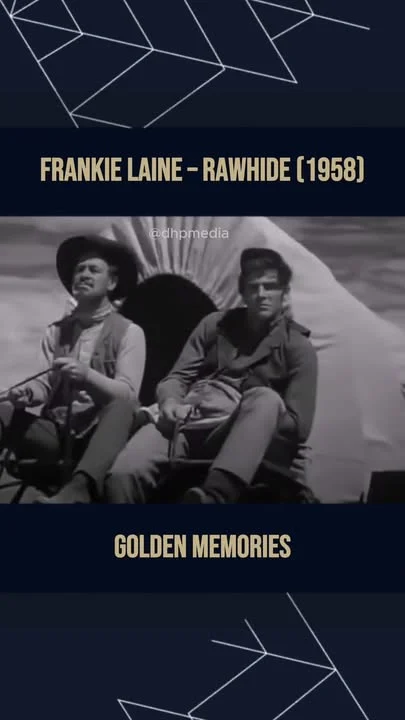
Some songs enter through the ears, but this one arrives through the bones. Picture a warm late evening, the windows down, a radio signal that keeps dissolving into static as if distance still mattered. Then four thumping strokes of timpani roll out of the darkness, a rhythm so primal it feels less like a melody and more like a summons. Boom-boom-BOOM-BOOM. Before a single word is sung, Frankie Laine has already taken command with Rawhide, the 1958 Columbia Records single that turned a television Western into a full-bodied musical ritual. With a sharp arrangement from Jimmy Carroll, and a voice that earned Laine the nickname Mr. Rhythm, the song has never stopped sounding urgent.
This was never just another release. It was a deliberate move by a singer who had already claimed the cinematic West with earlier hits like High Noon and Gunfight at the O.K. Corral. The CBS television series did not premiere until January 1959, yet the record arrived a few months before it, acting as a two-minute prologue for a cowboy renaissance. Laine had watched the big band era fade and the first charge of rock and roll arrive, and he responded with an elastic style that could bend to any musical weather. The Western theme became his great advantage, a space where his oversized voice could tell stories of tension, toil, and wide open horizons.
Behind the microphone, the arrangement built by Ned Washington and Dimitri Tiomkin shows a rare kind of focus. Those timpani drums do not just keep time. They imitate the march of exhausted workers and the steady shuffle of cattle, while a whip crack cuts through the air with a sharp, tactile snap. The low brass section, rich with trombones and tubas, never stops chugging, creating an almost hypnotic drone beneath the melody. Strings enter not to swoon but to slice, their high register adding a thin layer of anxiety that hangs over the whole performance. This is music built for dusty trails and aching feet, not for the comfort of a ballroom.
The vocal sits above it all like a man on the edge of collapse. Laine attacks the song with the energy of someone who has been running for miles and cannot stop now. Rollin, rollin, rollin is not a pretty phrase but a survival chant, repeated until it loses meaning and becomes pure momentum. His famous vibrato gives weight to every syllable, and when he belts Move em on, head em up, he sounds less like a studio singer and more like a trail boss shouting against the wind. There is even a moment when his voice cracks, the kind of controlled break that feels honest rather than accidental. On a high quality audio system, every breath and strain stands out, reinforcing why so many listeners called his instrument steel tonsils. Sparse guitar lines punctuate the song with sharp, defiant twangs, while the piano stays low and patient until its moment arrives.
Then comes the song’s most subtle twist. For a few seconds, the storm retreats. Laine softens just enough to mention good vittles, love and kissing waiting at the end of the ride. The bass carries the weight, the piano adds a quiet minor color, and the listener gets a glimpse of something tender inside the toughness. It is a masterful moment of restraint. When the full orchestra returns with Laine bellowing at full force, the song feels like a landslide, even more powerful because of the calm that preceded it.
He created a sound that was at once operatic in its scope and utterly primitive in its emotional punch.
That line has followed the record through the decades, and it still captures the mystery of Frankie Laine. He could handle aching ballads and aggressive rhythm numbers with equal skill, and his turn toward Western material on Columbia was more than a career strategy. It was a natural home for his theatrical delivery. He took the cowboy song out of the novelty corner and pushed it into the center of mainstream pop drama. Original sheet music from Rawhide remains popular among vocal coaches and students who want to test their range, which says a great deal about how carefully the piece was constructed.
Earlier hits like Mule Train had already shown his ability to turn physical labor into spectacle, but Rawhide did something larger. It became a blueprint for the entire genre. Music supervisors, television composers, and future artists all learned from its economy, its tension, and its refusal to sound dated even as the years pile up. The song was originally released as a standalone single rather than part of a dedicated Laine album, and it eventually appeared on the 1961 collection Hell Bent for Leather!. That album title itself says everything about the image Laine had carved out for himself.
What makes Rawhide endure is its shape. It works like a two-minute play in three acts, the urgent call to action, the flicker of hope, and the final burst of energy that carries through the last bars. Every element, from the whip to the timpani to the voice, serves the larger story of forward movement. It does not ask you to understand the cowboy life. It drops you directly inside it.
Sixty years of noise have not been able to bury that opening rumble. If anything, the distance makes it more magnetic. Turn the volume up, give yourself over to the dust, and let Frankie Laine remind you what relentless motion sounds like.
If you want to follow the path that leads back to this song, begin with High Noon (Do Not Forsake Me) by Tex Ritter from 1952, a striking piece from the same songwriting team. Mule Train by Frankie Laine from 1949 delivers the same rhythmic intensity and whip crack energy. Ghost Riders in the Sky by Vaughn Monroe from 1949 moves the Western myth toward the supernatural. Don’t Fence Me In by Bing Crosby and The Andrews Sisters from 1944 offers a lighter, smoother take on open-range freedom. The Tennessee Waltz by Patti Page from 1950 highlights the softer pop landscape that Laine was working against. And Big Iron by Marty Robbins from 1959 carries the same grim storytelling power with a country accent. Together they paint a complete picture of an era when popular music could still make the frontier feel dangerously alive.