
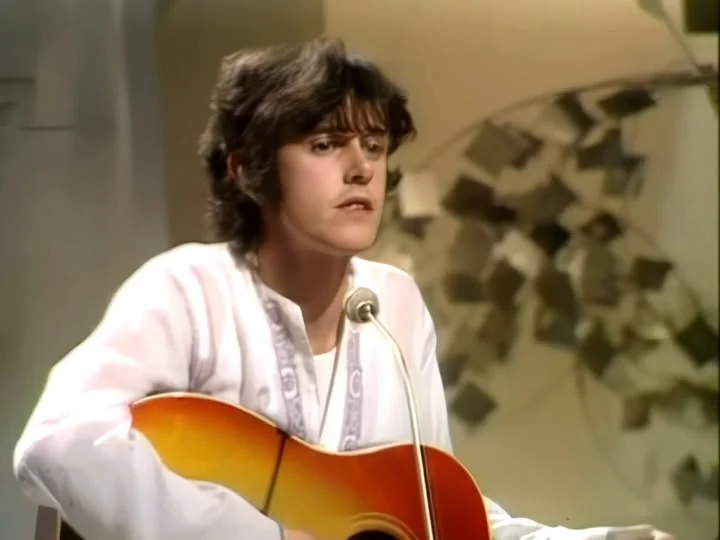
Some songs are not meant to be heard; they are meant to be felt, a vibration that settles deep in the bones long after the needle lifts. Donovan’s “Hurdy Gurdy Man” is such a piece, a sonorous anomaly that refuses to be pinned to the sunny mythologies of 1968. It is a song that arrives like a half-remembered dream, drifting in on a mechanical drone that feels both ancient and unsettlingly new.
The year is 1968, and the Summer of Love has curdled into something darker and more introspective. Donovan, the Scottish minstrel who traded his acoustic folk skin for psychedelic glitter with “Sunshine Superman” and “Mellow Yellow,” was returning from a spiritual pilgrimage to Rishikesh with the Beatles. Something in him had shifted. The playful whimsy gave way to a heavier, more obscure vision. Released as a standalone single in May 1968, “Hurdy Gurdy Man” was a statement that the troubadour had grown a new, thornier skin. Produced by the brilliant Mickie Most, the song was polished yet intentionally scuffed, letting a primal drone ring through the studio sheen.
That drone is the heart of the mystery. The hurdy-gurdy itself—a medieval instrument where a cranked wheel rubs against strings to produce a bagpipe-like hum—is the spiritual guide, even if the sound is achieved largely through an ingenious electric guitar and bass setup. The arrangement opens not with a burst of color but with a throbbing, almost tribal drum pattern. The bass line, reportedly played by a young John Paul Jones of future Led Zeppelin fame, moves with a muscularity that anchors the psychedelic flights. The result is a dark, meditative thrum, a sound that feels too large for the confines of a folk single. Donovan’s vocal is hushed, as if confiding a secret from the bottom of a well. He sings of cosmic travelers—Gideon, the wizard, the wise man—spinning a myth that feels both complete and fragmentary.
The way Donovan’s simple, poetic verses float above the track’s industrial folk-drone is an act of sonic alchemy.
The song’s mythology is as layered as its sound. Rumors persist that Jimmy Page and John Bonham were among the session musicians, creating a pre-Led Zeppelin nexus. While the exact personnel remains debated, the energy is undeniable. It presages the heavier rock that would close the decade. The production uses the studio as an instrument, layering the drone with acoustic foundations and a heavy rhythm section, an uncanny marriage of European folk tradition and emerging psychedelic rock. It is not about volume; it is about low-end definition, the way the bass hums with the acoustic strings, creating a subterranean vibration that demands good home audio to fully appreciate.
Decades later, the song found a chilling second life in the film Zodiac, where it transformed a sunny California day into a scene of unsettling dread. This context revealed the song’s inherent ambiguity. The Hurdy Gurdy Man could be a cosmic harbinger of peace or a grinning fool leading us into dark woods. The music accommodates both. For anyone seeking a deep cut in 1960s popular music, this is it. It is a required listen for understanding the transition from the psychedelic innocence of 1967 to the heavier, more cynical mood of 1969. The track charted well on both sides of the Atlantic, proving audiences were ready for darkness beneath the flower prints.
Beyond sheet music, understanding this song requires listening to the room—the collective breath of musicians finding a new, darker groove. It is the sound of folk’s spiritualism meeting rock’s electric energy. The friction gives the song its unforgettable, unsettling character. Donovan’s often-undersold depth as a songwriter and musical visionary is on full display. The hurdy-gurdy man, with his tireless droning wheel, is still turning, and his message is still worth hearing.
For those drawn to this sound, consider these kindred spirits. Led Zeppelin’s “Dazed and Confused” explores a dark, blues-rock drone with the same rumored rhythm section. The Beatles’ “Tomorrow Never Knows” uses heavy tape loops and drone to create a trancelike state from 1966. The Moody Blues’ “Tuesday Afternoon” blends orchestral textures with a dreamy spiritual tone. Incredible String Band’s “Waltz of the New Moon” offers British psychedelic folk with mystical narrative. Traffic’s “Dear Mr. Fantasy” captures the transition to extended song structures. And Jefferson Airplane’s “White Rabbit” shares the mystical, literary-infused lyrical structure and climactic dynamics.