
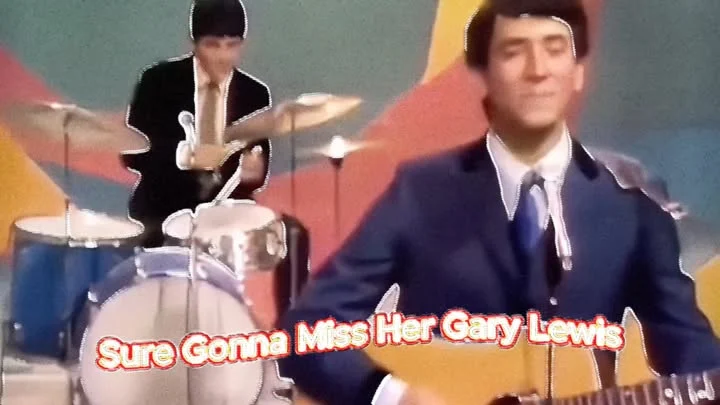
There is a moment in the quiet of the night when the world feels suspended between memory and the present. The streetlights blur through a curtain of rain, and a single note from the radio cuts through the silence. In that instant, a voice emerges, soft and resigned, carrying the weight of a regret that isn’t dramatic or loud but simply true. This is the territory staked out by Gary Lewis & The Playboys in their 1966 ballad “Sure Gonna Miss Her.” It is a song that does not demand attention but earns it, a piece of music that feels less like a performance and more like a confession whispered into the dark.
The track arrived at a strange crossroads in pop history. The radio dial in 1966 was a battlefield of British invation grit and garage‑band swagger, yet Los Angeles offered a different sound—one of meticulous polish and studio perfection. Behind Gary Lewis, the son of comedy legend Jerry Lewis, stood an arsenal of session musicians known as the Wrecking Crew, guided by the producer arranger team of Snuff Garrett and Leon Russell. Their records were not accidents. They were engineered with surgical precision, designed to climb the charts without losing a single ounce of emotional truth. “Sure Gonna Miss Her” became the sixth in a dizzying string of Top 10 hits for the group, released in March 1966 on the Liberty label and later collected on the Hits Again compilation.
The song opens with a gently strummed guitar figure, its minor key immediately painting a landscape of quiet sorrow. The bassline anchors the whole arrangement with a steady, almost plodding pulse, evoking the slow march of time after a breakup. Lewis’s vocal enters, earnest and vulnerable, never forcing the emotion. He is not shouting at the sky. He is staring out a window, remembering. What elevates the track beyond simple pop rock is the subtle orchestration—the brass swells that wrap around the vocal like a warm embrace, the piano that chimes softly at the upper edges, and the drums, played with masterful restraint by session legends like Hal Blaine or Jim Keltner. Each layer is distinct, yet they fuse into a shimmering whole.
The track operates not on shock and volume, but on the accumulated weight of perfectly placed notes and an honest, unvarnished vocal performance.
There is a fascinating duality to the creation of this song. Gary Lewis provided the face and the voice, the personality that connected with millions. But the texture, the deep pocket of the rhythm section, the surprising melodic turns—these came from studio gunslingers who treated the recording booth as their canvas. In an era when self‑contained rock bands were taking over, this sophisticated approach represented the apex of American pop craft. It was a deliberate, high‑stakes formula, and one that produced some of the most enduring music of the decade.
The lyric, penned by Bobby Russell (who later wrote “Little Green Apples” and “The Night the Lights Went Out in Georgia”), is simple and evocative, free of rock and roll melodrama. It speaks to the universal quality of quiet, unspectacular sadness. One can imagine a young couple in 1966 slow dancing to this track, perhaps the first time they truly understood what a broken heart felt like. Today, the song serves as an aural bookmark in the history of teenage emotion—a sonic marker for that first, deeply felt, but ultimately survivable heartbreak.
For anyone exploring the complexities of mid‑sixties American pop, “Sure Gonna Miss Her” is a quiet gem. It demonstrates that clarity and emotional depth need not be mutually exclusive. The production mic placement, the careful mixing, the decision to let the brass swell rather than blast—all of these technical choices serve to enhance, not overwhelm, the simple truth of the lyric. It gives Lewis space to be vulnerable while the session masters provide an unshakeable foundation of brilliance beneath him.
Recommended listening for fans of this sophisticated LA pop sound:
The Association – “Cherish” (1966): Shares the same smooth, highly polished, and layered vocal harmony approach emblematic of the era.
The Turtles – “Happy Together” (1967): Features similarly pristine wall‑of‑sound production by the Wrecking Crew, though with a more upbeat mood.
The Fifth Dimension – “Stoned Soul Picnic” (1968): Another example of Bobby Russell’s thoughtful songwriting with a sophisticated, jazz‑influenced arrangement.
The Grass Roots – “Midnight Confessions” (1968): Uses similar brass swells and a driving, slightly melancholy rhythm section for a powerful emotional release.
Paul Revere & The Raiders – “Kicks” (1966): Produced by Terry Melcher, contemporary of Garrett, showcasing the same crisp, professional LA studio sound.