
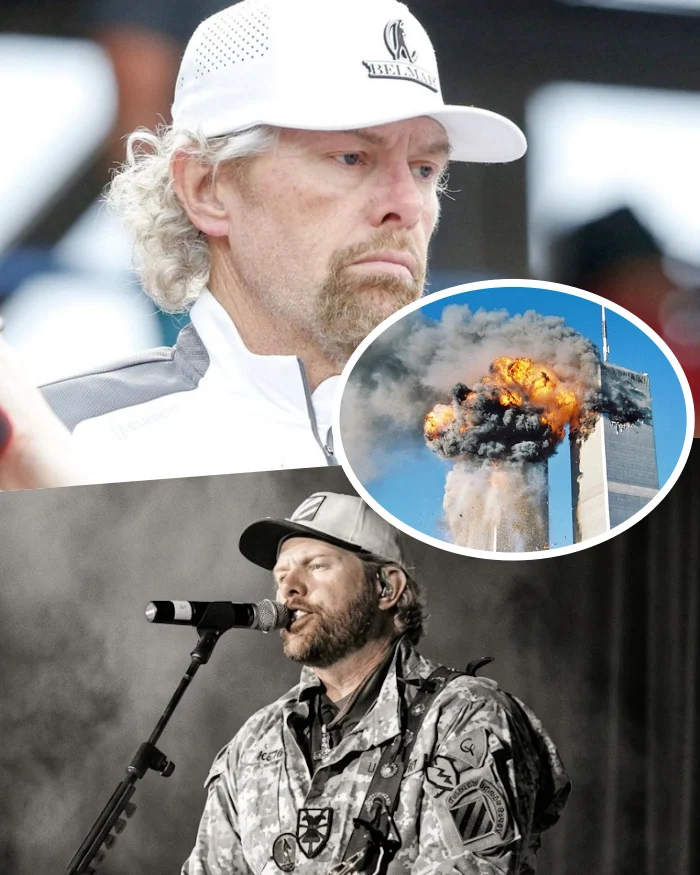
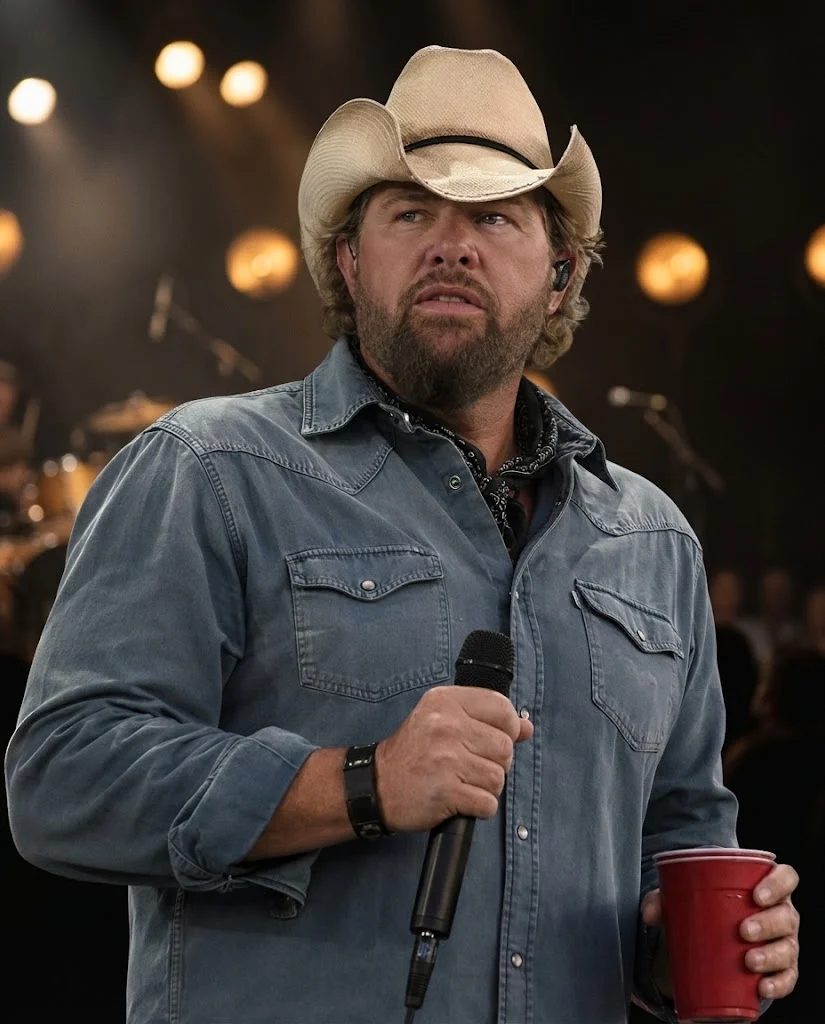
The stage was set for the biggest Independence Day broadcast after 9/11. A star was asked to soften his raw words for millions of viewers. He packed his guitar and walked away. That refusal revealed the true soul behind an American anthem.
In the summer of 2002, Toby Keith was offered the spotlight of a lifetime: a nationally televised July 4th special on ABC, hosted by legendary anchor Peter Jennings. The network wanted him to perform his breakout hit, “Courtesy of the Red, White and Blue (The Angry American).” But as the broadcast neared, producers grew uneasy. They asked him to either tone down the lyrics or pick a different song entirely.
Keith didn’t hesitate. He refused to change a single word. He packed up his guitar and walked away from the prime-time stage. The decision cost him a massive TV slot, but it was never a difficult choice. Because for Keith, the song wasn’t a commercial gimmick—it was a piece of grief, written in the shadow of two devastating losses.
To understand why he said no to a network, you have to know the man who inspired the song. Keith’s father, Hubert K. Covel Jr., was a proud Army veteran who lost his right eye during service. He raised his children in Moore, Oklahoma, with a flagpole in the front yard and a deep respect for the uniform. In March 2001, just months before the attacks, Hubert was killed when a charter bus struck his vehicle.
When the towers fell that September, Keith was still mourning his father. He sat down and wrote “Courtesy of the Red, White and Blue” in about twenty minutes, scribbling the lyrics on the back of a fantasy football sheet. It was an unfiltered expression of what he believed his father would have said if he were still alive.
“The song was not a calculated marketing tool. It was a direct reflection of my working-class roots and my family’s unwavering patriotism.”
Initially, Keith never planned to record the track. He only played it live for military personnel. It was only after Marine Corps Commandant James L. Jones heard the song and told Keith it was his duty to release it for the troops that it finally made it into a studio. Changing the words for a TV broadcast would have felt like a betrayal of his father’s memory.
While the media focused on the ABC standoff, Keith’s most profound tribute unfolded far from cameras. Over his career, he quietly embarked on 11 USO tours, performing for more than 250,000 service members. He didn’t just sing about patriotism from a Nashville studio—he traveled to active war zones in Iraq and Afghanistan, standing on makeshift plywood stages in the desert dust. Showing up in those demanding environments was his way of honoring Hubert’s service in the most direct way possible.
The TV incident did nothing to slow the song’s momentum. Released exactly as written, it climbed to No. 1 on the Billboard Hot Country Songs chart and became a defining track. It resonated not because it was polished, but because it was honest.
Toby Keith built a legacy on refusing to compromise his convictions for applause. He understood that a song born from genuine heartbreak and American pride could not be edited for convenience. The anthem never needed a national television special to find its audience. It only needed the people it was written for.