
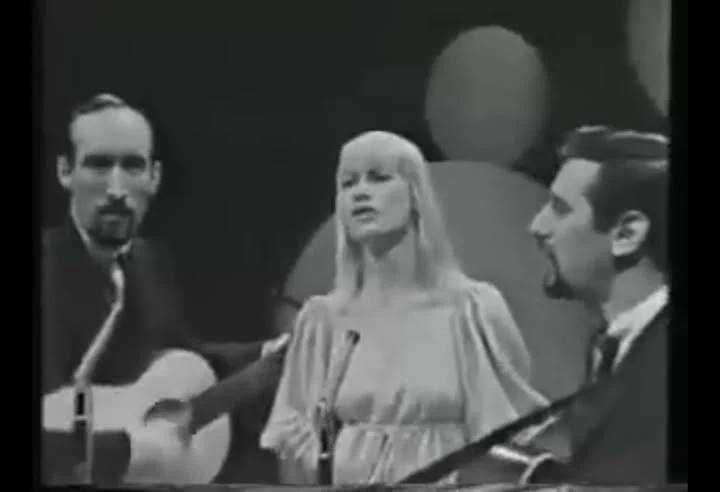
Peter, Paul & Mary stood before a quarter of a million people at the March on Washington in 1963, their voices rising together in a call for justice that would echo through history. That day, their rendition of If I Had a Hammer became more than a song—it became a seismic anthem for a generation demanding change. Written nearly fifteen years earlier by Pete Seeger and Lee Hays, the track had already undergone transformations before the trio wove their signature harmonies into its fabric, creating a version that still stirs the soul today.
If I had a hammer, I’d hammer in the morning, I’d hammer in the evening, all over this land.
The song first appeared on the group’s self-titled debut album in 1962, a record that would shoot to number one on the Billboard charts and achieve double platinum status. Produced by Albert Grossman, the album introduced the world to a sound defined by warm acoustic guitar, seamless vocal blending, and an unwavering commitment to social justice. Alongside tracks like Lemon Tree and 500 Miles, If I Had a Hammer stood out as a rallying cry, its simplicity masking a profound urgency. The instrumentation—gentle strumming, subtle rhythm, and voices that rise and fall in unison—was deliberate. It cleared a path for the message, letting every word land with weight.
The lyrics themselves are deceptively direct. Each verse builds on the last: the hammer for strength, the bell for action, the song for unity. The repetition of “all over this land” transforms the personal into the universal, reminding listeners that the fight for equality is not confined to one moment or one place. When Mary Travers sang with her blend of vulnerability and power, supported by Peter Yarrow and Noel Paul Stookey, the trio captured both the hope and the demand of a movement. As the chorus swells around justice, freedom, and love between brothers and sisters, the song becomes a living document of the 1960s—and a timeless call to responsibility.
The cultural reach of If I Had a Hammer extends far beyond its folk revival roots. After the March on Washington, where Dr. Martin Luther King Jr. delivered his I Have a Dream speech, the song became an enduring symbol of protest. It has since been covered by artists across genres, each version carrying the same heartbeat of simplicity and resolve. Activists in labor movements, environmental campaigns, and peace initiatives have adopted it as their own, proving that its message adapts to every struggle for justice.
For those who feel the pull of this anthem, similar songs from the same era offer companionship in spirit. Bob Dylan’s Blowin’ in the Wind questions the path to freedom with poetic grace. The traditional We Shall Overcome, adapted by Pete Seeger, became the unofficial hymn of the civil rights movement. The Byrds brought Turn! Turn! Turn! to the charts, a meditation on seasons of peace. Peter, Paul & Mary themselves offered Where Have All the Flowers Gone?, a haunting anti-war reflection. And Woody Guthrie’s This Land is Your Land remains an alternative anthem of inclusivity.
What makes If I Had a Hammer endure is not just its history but its architecture. The sparse acoustic arrangement ensures the message remains the star. The harmonies are not mere decoration; they are the embodiment of collective action, of voices joined in purpose. Every time the song plays, it reminds us that the work of justice, freedom, and love is ongoing—and that each of us holds the tools to shape a better world. In the end, this is the power of folk music at its finest: to inspire change, one verse, one voice, one listener at a time.