
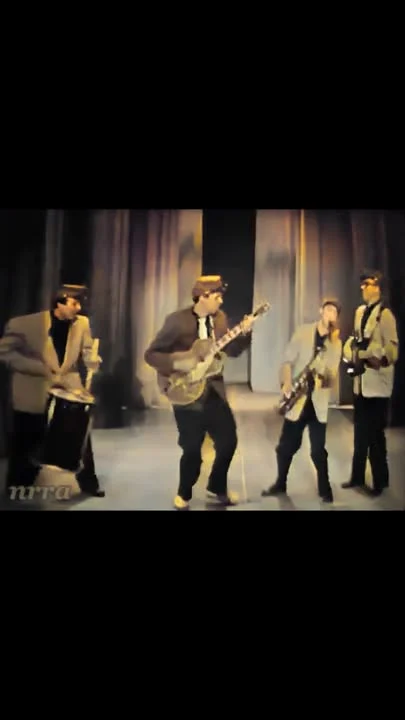
The year is 1958. A teenage guitarist in Phoenix, Arizona, leans into his amplifier, searching for a sound that doesn’t yet exist on any record. What emerges from that quest would become the musical equivalent of a switchblade—sharp, dangerous, and impossibly cool. Duane Eddy wasn’t just playing notes; he was forging an attitude that would define an entire generation’s idea of rebellion.
The track that would seal his legend arrived in May of that year, pressing through radio speakers with a sound so distinct it demanded a new vocabulary. Critics and fans alike would call it “twang,” but that word barely captures the seismic shift Eddy created. His 1957 Gretsch 6120 growled through a heavily customized Magnatone amplifier, producing tones that seemed to come from somewhere vast and hollow—a 2,000-gallon water tank, Eddy himself would later suggest, singing through the reverb circuits with an authority that approached the cinematic.
“The tone of Duane Eddy’s guitar on ‘Rebel-Rouser’ is not merely a technical effect; it is the sonic blueprint for every leather jacket, every drag race, and every whispered dare of the late 1950s.”
Working alongside Lee Hazlewood—the visionary producer and songwriter who understood that rock and roll needed a new kind of bombast—and Lester Sill, Eddy built his masterpiece at Audio Recorders in Phoenix. The studio became a laboratory for a sound that felt both profoundly American and completely alien. Where other guitarists played polite melodies on the treble strings, Eddy anchored his riffs in the bass register, letting the low-end frequencies rumble through the speakers with an aggression that bordered on intimidating.
The session musicians formed a tight ensemble of Phoenix talent. Buddy Wheeler handled the electric bass, Jimmy Simmons plucked an acoustic upright, and Bob Taylor kept the beat on drums. Al Casey added piano textures, while rhythm guitarists Donnie Owens and Corki Casey O’Dell wove complementary patterns behind Eddy’s lead. Together they created a foundation that was deceptively simple—a twelve-bar blues progression that any bar band could play, but none could replicate with Eddy’s menace.
The structural trick that elevated the track from competent to legendary was step modulation. Each time the main theme repeated, the key jumped a half-step higher—from E to F, then to F-sharp, and finally landing on G. This chromatic climb created a relentless forward momentum, the musical equivalent of a drag racer downshifting through gears. It was a device so effective that countless musicians would borrow it in the decades ahead, but in 1958 it felt like discovery rather than technique.
In Los Angeles, after the basic track was completed, the arrangement gained its final theatrical layers. Tenor saxophonist Gil Bernal arrived to lay down lines that swaggered and swerved, trading phrases with Eddy’s guitar like two characters in a late-night confrontation. The saxophone brought a smoky, urban sophistication that balanced the raw desert twang of the guitar. Then came the rebel yells—wordless shouts of defiance provided by the doo-wop group The Sharps, who would later find fame as The Rivingtons. These vocal interjections transformed the track from instrumental exercise into participatory ritual. You couldn’t hear those shouts without wanting to add your own.
The single climbed to number six on the Billboard Hot 100, but chart positions fail to capture its true impact. “Rebel-Rouser” became a cultural shorthand for adolescent defiance, the kind of song that seemed to play itself every time a teenager reached for car keys or lit a cigarette. It appeared later on Eddy’s debut LP, Have ‘Twangy’ Guitar Will Travel, a title that served as both mission statement and self-mythology.
Decades later, the track still carries its original voltage. Directors have used it to score scenes in Forrest Gump and The Sandlot, recognizing that those two minutes and twenty-three seconds contain an entire emotional landscape. It is not background music. It is the sound of a generation deciding that the rules no longer applied, captured in the glow of a desert sunset, with the radio turned up and the highway stretching toward somewhere unknown. Eddy may have called it twang, but what he really found was the sound of freedom itself.